Multilevel EMT Overview
Standard EMT involves a two-level relationship between the organization issuing the original sales order (the PBU) and the final supplier (the SBU). In multilevel EMT, however, the secondary sales order creates yet another PO, which is transmitted to a lower-level supplier.
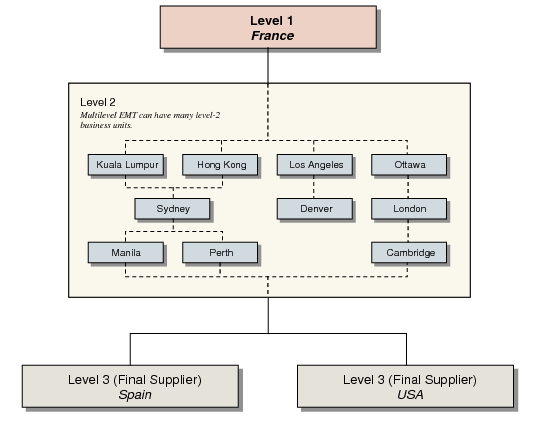
Although multilevel EMT can have as many levels as required by a specific business model, business units within a multilevel EMT supply chain are normally defined at three levels:
• Level 1: The business unit receiving the end customer’s original order. This corresponds to the PBU in standard EMT.
• Level 2: Mid-level organizations between the level 1 business unit that recorded the original customer demand and the final supplier, which actually provides the items to fill the demand. The level 2 hierarchy can include any number of business units. In standard EMT terms, a level 2 unit acts as a PBU in some relationships and as an SBU in others.
• Level 3: The lowest-level business unit in the supply chain, which supplies the original demand. This is the equivalent of the SBU in standard EMT.
The workflow among multiple levels is similar to that used in standard EMT. Business documents such as POs, change documents, and ASNs are passed up and down the supply chain one level at a time. However, some restrictions apply to level-2 business units:
• They must accept changes from business units above or below them on the supply chain. They simply pass them on to the next level using a PO change or PO change acknowledgment, as appropriate.
• They cannot modify the quantity or due date on a primary sales order. They can, however, change the EMT supplier or the EMT type—direct ship, transship, or non-EMT. When they do, the system automatically cancels the purchase order issued by the level-2 business unit and generates a new one.
Multilevel EMT Hierarchy