Defining Number Sequences for Legal Documents
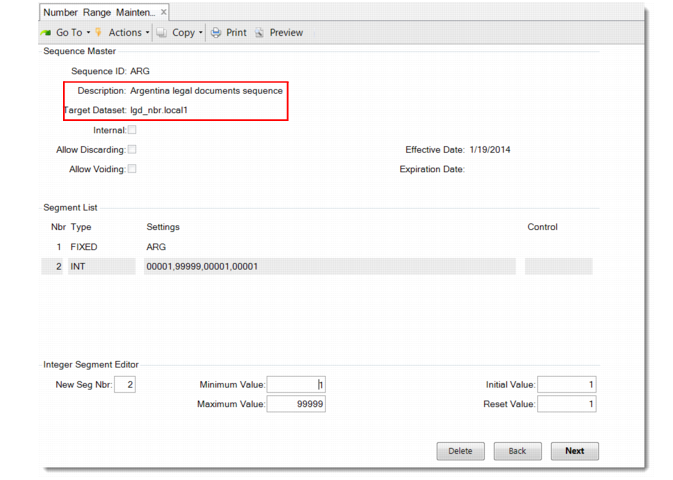
1 Create sequences and define sequence parameters for legal documents using Number Range Maintenance (36.2.21.1). NRM uses a unique sequence ID to retrieve data and generate new numbers for legal documents.
Specify the target dataset for legal documents as lgd_nbr.xxxx, where xxxx can be any character.
For information on setting up NRM sequences, see
QAD System Administration User Guide.
Number Range Maintenance (36.2.21.1)
Target Dataset
Use lgd_nbr.xxxx as the target dataset, where xxxx can be any character.
Internal
Choose Yes.
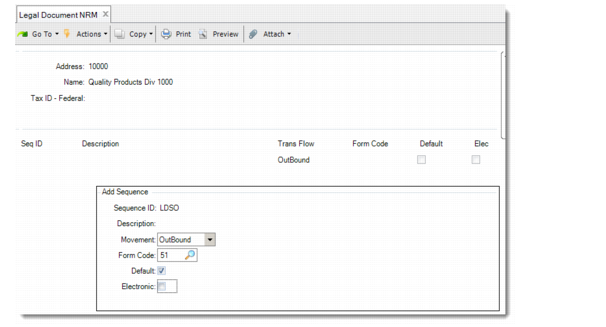
2 Associate the legal documents sequence IDs with ship-from address codes in Legal Document NRM (36.2.21.9).
Use Legal Document Numbering Range Maintenance to maintain site - NRM sequence relationships for legal documents. Legal documents can use multiple NRM sequences at one site or location represented by a physical address. You specify a default NRM sequence to use when generating legal document sequence numbers and can change the sequence as needed.
The Allow Same NRM for Multiple Addresses setting in Legal Document Control (7.10.24) determines whether you can assign the same NRM sequence to multiple addresses with different Federal Tax IDs.
Note: Only sites or locations with physical addresses can be assigned legal document NRM sequences.
Legal Document NRM (36.2.21.9)
Address
Enter the company address that represents the actual physical address of the ship-from site or location. This address is required for legal documents accompanying movements of goods between sites or locations that are physically separated.
Sequence ID
Enter an NRM sequence ID used for generating legal documents at the current address. When you enter a valid sequence ID, its description displays in the Description field.
You can associate multiple NRM sequences with an address.
NRM sequence IDs for legal documents are defined in Number Range Maintenance and use the lgd_nbr.xxxx dataset.
Transaction Flow
Specify the direction of the inventory movement from a business perspective to determine if the transaction requires any legal documents, and if so, what type of legal documents.
• Inbound: Inventory moves into the site/plant and may require receiving legal documents.
• Outbound: Inventory moves out of the site/plant and may require issuing legal documents.
Sometimes, a transaction that requires legal documents in one country does not have such requirements in another. For example, a work order receipt that reports production of finished goods is subject to legal documents in Poland, but this is not the case in Brazil and Argentina. Therefore, in Poland, the work order receipt should be defined as an inbound transaction, but it can be configured otherwise in Brazil and Argentina.
Form Code
Enter a two-digit numeric legal document form code that uniquely identifies a country-specific legal document format. The default code is specified in Legal Document Control (7.10.24).
Currently, the system supports the following form codes: 11, 21, 31, 41, 51, and 61. While these form codes primarily address the legal document formatting requirements of Poland, Chile, Argentina, Turkey, Brazil, and Russia respectively, they can also be used in other countries where applicable.
Default
Enter Yes to set this NRM sequence as the default legal document numbering sequence for the current address; otherwise, enter No.
Electronic
Set to Yes to enable electronic legal documents. This option is used for customized functions.