Model 340 Statement
Business Requirement
Spanish legal requirements include the Model 340 statement, a monthly or quarterly VAT statement that lists all the transactions invoiced during the period selected. It must include all invoices issued and all invoices received.
Two different formats for Model 340 should be provided:
• State format
• Regional format
Model 340 must be declared using the Web site of the government tax authority, and electronic media format is required to upload the records.
QAD Solution
QAD has developed the Model 340 Statement report to meet Spanish requirements.
Prerequisites
• Business relation records must include telephone numbers for the delivered Model 340 Statement to provide a default for when the report is run. Contact person names are optional in setup records, although they are required on the report output.
• Required generalized codes must be set up.
• System and GTM setup must be complete.
• AR and AP invoice transactions must exist.
Generalized Codes Setup
Before you can run the Model 340 Statement report, you must set up the generalized codes that the report requires.
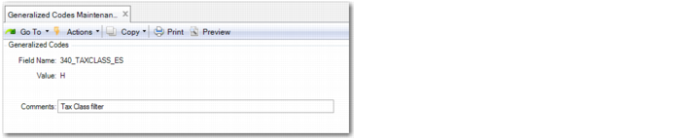
Generalized Codes Maintenance
The generalized codes in the following table are mandatory and must be set up.
Mandatory Generalized Codes
Field Name | Values | Comments | Description |
340_TAXTYPE_ES | ES-VAT ES-ECP ES-ECS ES-ICP | Tax Type Filter | Default values for the Tax Type report filter. |
340_TAXCLASS_ES | H M EXE | Tax Class Filter | Default values for the Tax Class report filter. |
340_TAXUSAGE_ES | S Fa | Tax Usage Filter | Default values for the Tax Usage report filter. |
340_FIXED_TAXUSAGE | A | Fixed Assets | Tax usage for Fixed Assets. |
340_SPECIAL_TAXUSAGE | SP | Special Operations | Tax usage for special operations. |
You can also define the following optional generalized codes if they are needed for the Model 340 Report you are submitting. Specify the associated values and comments for these generalized codes as required.
Optional Generalized Codes
Field Name | Description |
340_REALESTATE_TAXUSAGE | Tax usage for real estate operations. |
340_LEASING_TAXUSAGE | Tax usage for leasing operations. |
340_GOVERNMENTALGRANT_TAXUSAGE | Tax usage for government grants. |
340_INSURANCE_TAXUSAGE | Tax usage for insurance. |
340_TRAVELLING_TAXUSAGE | Tax usage for travel company procurements. |
340_AGRICULTURAL_TAXUSAGE | Tax usage for agricultural and animal breeding compensation. |
340_3RDPARTIES_TAXUSAGE | Tax usage for payments to third parties for professional fees related to intellectual property, industry, and professional associations. |
340_CEUTA_TAXZONE | Tax zone for locations in Ceuta. |
340_MELILLA_TAXZONE | Tax zone for locations in Melilla. |
340_CANARIAS_TAXZONE | Tax zone for locations in Las Islas Canarias (Canary Islands). |
Report Access
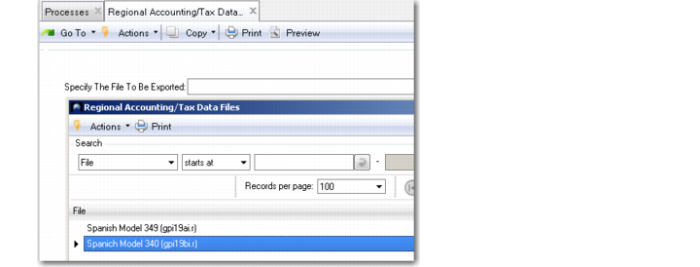
Launch Regional Accounting/Tax Data Export (36.5.3). Then select Spanish Model 340 from the look-up browse and click Next.
Regional Accounting/Tax Data Export
Report Format
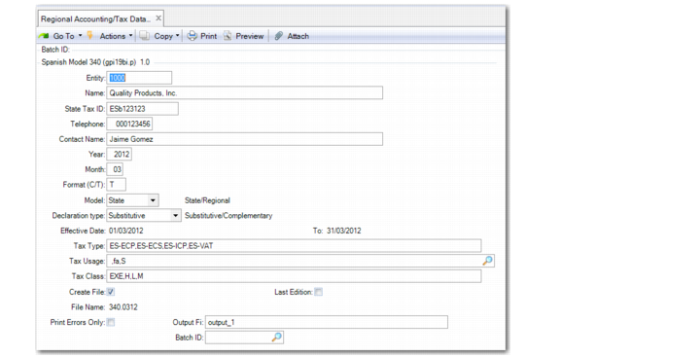
Model 340 Statement Report, Selection Screen
The Model 340 Statement report includes the following selection criteria:
• Entity (mandatory)
The system displays the associated name and tax ID, if applicable, from the entity record.
• Telephone and Contact Name (mandatory)
Government regulations require a contact telephone number and name as part of the delivered statement.
The default is from the primary business relation record for the entity.
Note: These are not required fields in Business Relation Create. However, you must populate these fields before you can generate a statement.
• Month and Year (mandatory)
The system uses this information to select records and to determine the file name
• Format (C/T)
• T (default): The report is in structured ASCII file format that meets specifications required for it be loaded into a government system.
• C: The report is in human-readable format for delivery by e-mail, on a CD, or other similar method.
• Model (S/R)
• S (default): Report meets requirements of the Central Spanish Government.
• R: Report is intended as a Regional or Local Declaration.
• Declaration Type
• Substitutive: Use this report type to correct an existing declaration for the same period.
• Complementary: Use this report type to create a report for data that has never been reported on for the period. For example, in the first monthly declaration, all invoices are reported on. In the second monthly declaration, only additional invoices are reported on.
• Effective Date range
The system populates these fields based on the values of Year and Month.
• Tax Type, Tax Usage, Tax Class
Optionally, enter comma-separated lists of codes for selecting invoices to be included in the declaration report.
• Create File
• Yes: The system generates a file to be delivered to the government based on the setting of File Format.
Note: When Yes, the report is also output to the file shown in Output File. This content is in human-readable format. The file identified in File Name is formatted to be loaded electronically into the government’s system.
• No: The system does not create the file for government delivery. Instead, it writes the report to the Output File. You can review the output for error messages.
• File Name
When Create File is Yes, the system displays a file name based on the government-specified naming convention. This is determined by the value of Statement Method:
• S (Central Government): 340.MMYY
• R (Regional or Local): 340Foral.MMYY
The MMYY value is derived from the Year and Month fields.
• Print Only Errors
Select this option to limit the Output File to error messages. Otherwise, the file includes the complete content of the statement, as well as error messages.
• Output File
Enter the name of the file that the system creates for review and validation.
Model 340 Statement, Output File for State Report