Upgrading QXtend
Select the Host and Modules to Upgrade
Choose the Host and Install Set
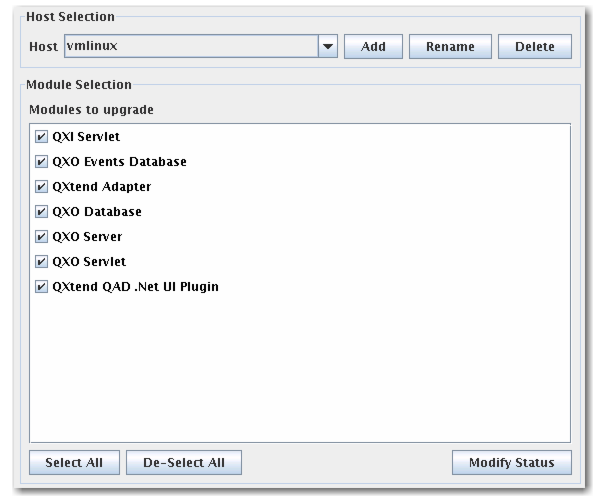
1 In the Host Selection panel, enter the host on which to upgrade the components.
2 Use the Add and Delete buttons to create and delete hosts as required.
3 The components available for upgrade consist of code components (QXtend Adapter, QXO Servlet, QXO Server, and .NET UI Plug-in) and configuration components (QXI Servlet, QXO Event Database, and QXO Database). The configuration components have system information and application data that require transfer to the new QXtend instance. If you do not want to transfer the existing data of a configuration component, use install instead of upgrade.
In the Module Selection panel, select the components to upgrade on the specified host. Upgrading a code component installs a new instance of the component in the same location after backup of the contents to the <target>/backup directory.
4 Click Next to display the Module Copy Selection panel.
Module Copy Selection
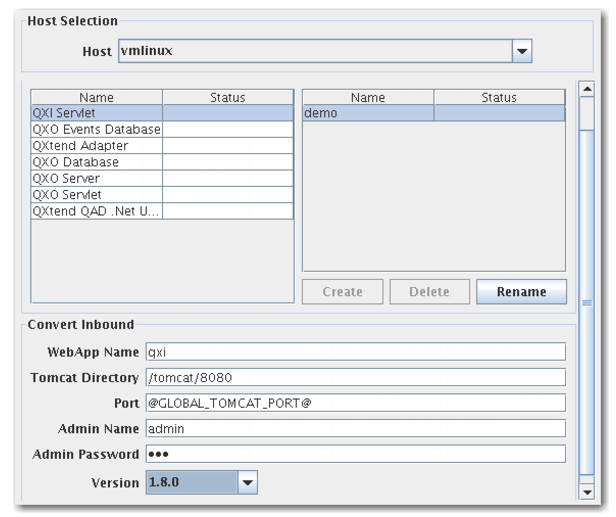
The component list on the left shows the components available for upgrade. The Status column on the right indicates the installation status of each component. The first time the installer is run, the Status column is blank. After an installation, the Status column shows Incomplete, indicating the component was not installed successfully, or Complete, indicating the component was installed successfully.
5 For each selected component for that instance, enter all of the required parameter settings, as described in the following sections.
Note:
• Multiple instances are enabled only for the QXO Events Database and QXtend Adapter. Shut down the target QXODB and target QXEvents databases before upgrading.
• You cannot select a different component until you have entered all of the required configuration information for the currently selected component. Enter information in the fields highlighted in orange.
6 Click Next when you have entered all parameter settings for the required components.
Configure the QXI Servlet
7 Complete the required fields in the Convert Inbound panel.
WebApp Name
Enter the application name known to the Tomcat application server.
Tomcat Directory
Enter the location of the home directory where Tomcat is installed.
Version
Use the drop-down list to specify the version being migrated.
Port
Enter the Tomcat port.
Admin Name
Enter the user name for the Tomcat manager role.
Admin Password
Enter the password of the user with the manager role.
Note: During QXI conversion, a prompt asks you to shut down Tomcat. A shutdown replaces the old servlet with the new one. Shut down Tomcat. Once it has shut down, click Ok. The installer replaces the servlet. When this process finishes, a second prompt asks you to restart Tomcat.
Important: Perform a shutdown/startup before pressing the button.
8 If necessary, select the next component to configure.
Configure the QXO Events Database
9 In the Convert QXEvents panel, complete the required fields.
Physical Name
Enter the physical name of the qxevents database.
Database Directory
Enter the location of the database directory where the source qxevents database is installed.
Version
Select the version being converted in the drop-down list.
Progress Directory
Enter the Progress location that this qxevents instance uses. This directory should be the same Progress version as the QAD Enterprise Application databases.
10 If necessary, select the next component to configure.
Configure the QXtend Adapter
12 If necessary, select the next component to configure.
Note: If the destination directory contains files, they are moved to <destination directory>/<backup>. The timestamp of each backed-up file is used in the file name.
Configure the QXO Database
13 In the Convert QXODB panel, complete the required fields.
Physical Name
Enter the physical name of the QXO database.
Database Directory
Enter the location of the database directory where the source QXO database is installed.
Version
Select the version being converted in the drop-down list.
Progress Directory
Enter the Progress location that this QXODB instance uses.
Configure the QXO Server
15 If necessary, select the next component to configure.
Note: If the destination directory contains files, they are moved to <destination_
directory>/<backup>. The timestamp of each backed-up file is used in the file name.
Configure the QXO Servlet
17 If necessary, select the next component to configure.
Note: If the WebApp directory exists, it is backed up to <tomcat_directory>/<backups>. The timestamp of each backed-up file is used in the file name.
Configure the QXtend QAD .NET UI Plug-in