Convert to a partitioned fact table.
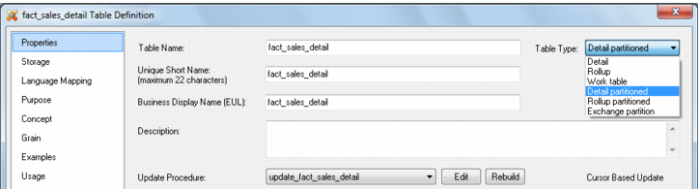
Edit the properties of the fact table to be converted and change the table type to either 'Detail partitioned' or 'Rollup partitioned'. See example below. These two options reflect two different methodologies in the updating of a partitioned fact table. The first (Detail) method moves a partition from the fact table into the exchange table. The data in the exchange table is then updated with any changes or additions. When the update process has completed the exchange table data is moved back into position in the fact table. During the update process the partition in the fact table will be empty. The second (Rollup) method builds all information for a period in the exchange table. The exchange table is then used to replace the relevant period in the fact table. The fact table remains in a queryable state throughout the process.
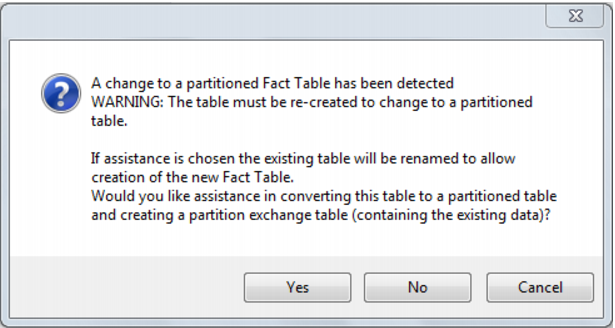
A dialog will pop-up as follows, asking for confirmation that the table is to be converted to a partitioned fact table. If 'yes' is chosen then the existing fact table will be renamed to become the partition exchange table. Any current data will remain in this table.
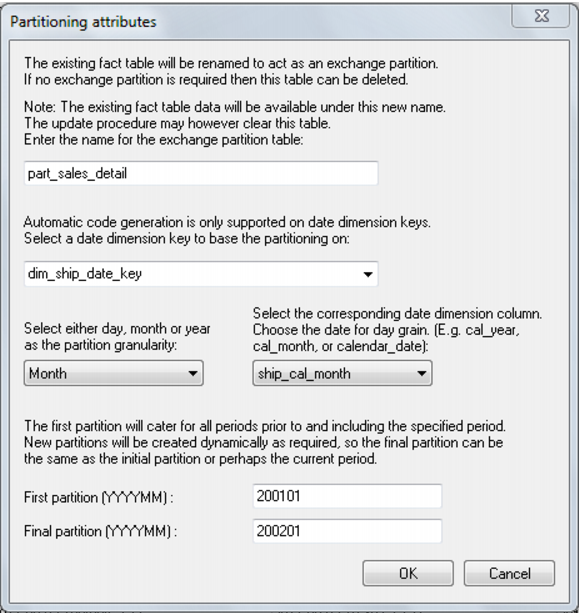
The parameters for the partitioned fact table are then prompted for:
The partition exchange table name is prompted for. This table is identical to the fact table and is used to swap partitions to and from the fact table. Select a name that indicates that the table is not a fact table as such.
The fact table will be partitioned by the date dimension key. You need to specify the date dimension key that will be used as the basis for the partitioning of the fact table. It is assumed that this key has the standard QAD format of YYYYMMDD.
A partition granularity of day, month or year must then be selected along with the corresponding column in the date dimension. For a daily partition a column with a date data type must be chosen. The date dimension key will actually be used for the partitioning but the date column is required. For a monthly partition a column with the format YYYYMM must be chosen. In the standard QAD date dimension this is the column cal_month. For a yearly partition a column with the format YYYY must be chosen. In the standard QAD date dimension this is the column cal_year.
The first and last partition should then be selected. The last partition is not that important as additional partitions will be created as required. Normally just select a partition a few on from the first. The first partition is however important as any data that is dated prior to the first partition will be loaded into this first partition. The partition must be entered in the format shown. For example monthly partitions require the format YYYYMM.
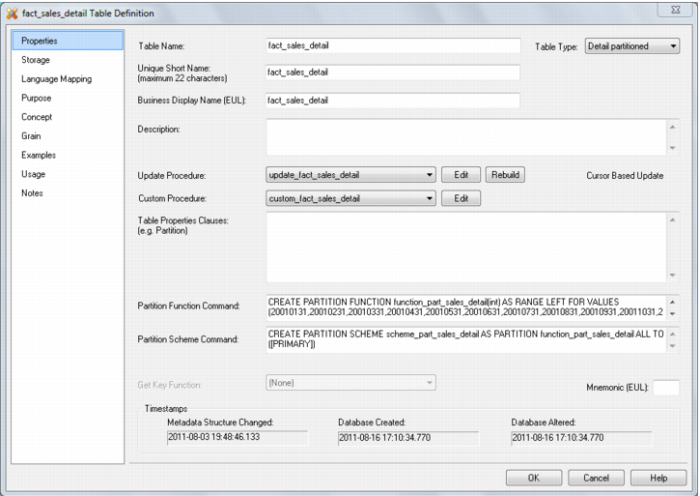
Once the OK button is clicked the conversion process will populate the 'table properties clauses' field of the tables properties. Note that this field is limited in size, so if too many partitions are chosen only the first few will be added to this field. The other partitions will be created dynamically by the update procedure.
Click the OK button on the table properties dialog to begin the process of converting the fact table, creating the new fact table and building the new update procedure. Examine the results screen to see what has been done.
The partition table will now have any current data, to populate the fact table, copy the data from partition table to the fact table, drop and recreate fact index. The date dimension key used to base the partitioning on is not allowed to have nulls. QAD Data Warehouse Designer has modified the table property, however the partition table needs to be validated and recreated to be valid. Now the fact table can be processed.