Overview
If a manufacturing process in QAD Enterprise Applications yields one product, the process is supported by regular bills of material (BOMS), formulas, processes, and routings. Co-products/by-products functionality manages processes that produce more than one product.
In processing co-products/by-products, you can keep information on both the intended products (called co-products) and the unintended products (called by-products). This introduction defines these and other key terms used in QAD Enterprise Applications co-products/by-products functionality.
Definitions
Co-Products
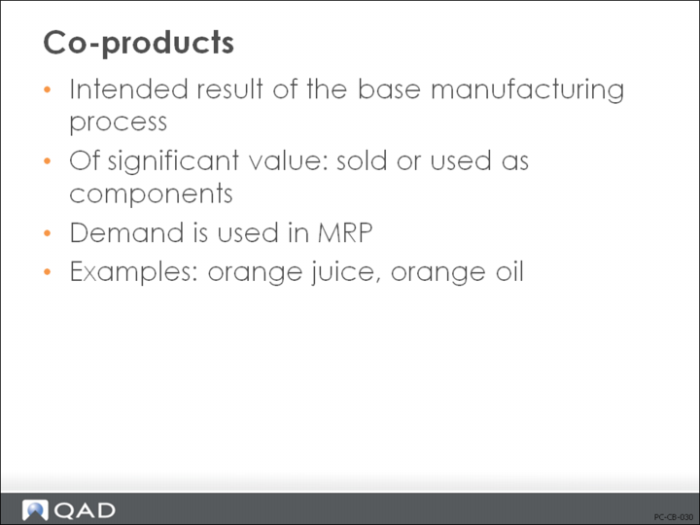
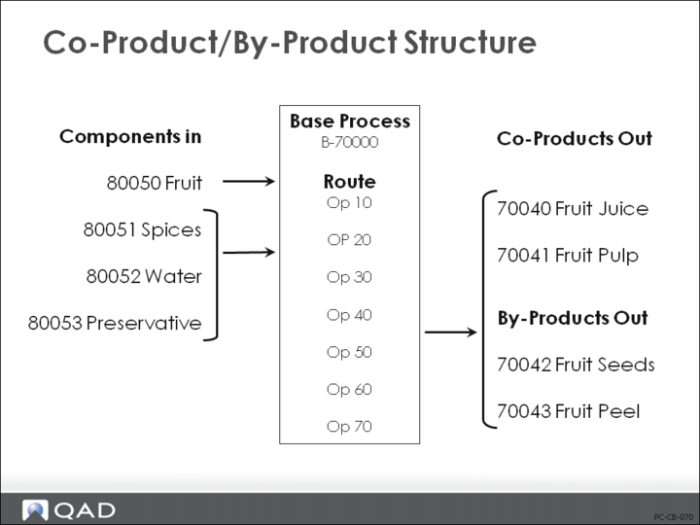
Co-products are intended results of a co-product/by-product process. They are of significant value and are sold or used as regular or routable components of other processes (product structures). Because co-products are the intended result, their demand drives planning of the co-products/by-products manufacturing process.
By-Products
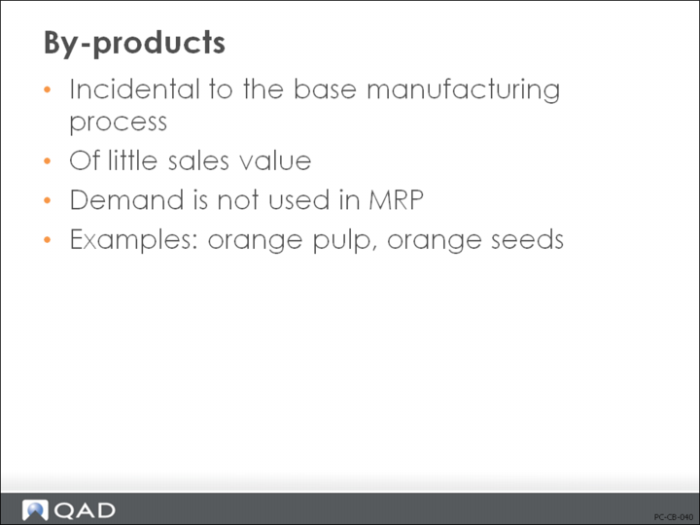
A by-product in QAD Enterprise Applications might differ from the definition of a by-product used in other places. A by-product in QAD Enterprise Applications is incidental and usually has little or no value. By-product demand is not considered in planning. The cost of a by-product is fixed and is subtracted from the total cost of the manufacturing process. Often, by-products of manufacturing processes are products that can be sold as scrap.
Base Process
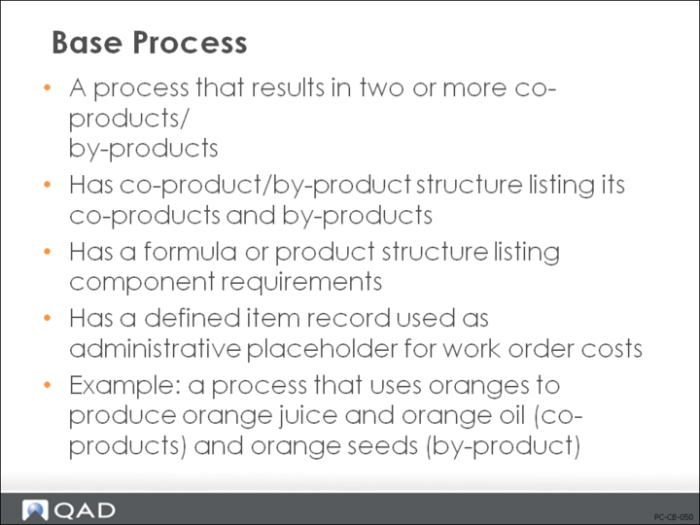
A base process is a common process that results in two or more co-products/by-products; it is “what you do” to obtain the usable co-products. Although you cannot sell it or stock it, you have a work order for it, issue component material to it, and record labor time against it.
• In QAD Enterprise Applications, the base process is an administrative place-holder; for example, work order costs are accumulated at the base process level
• A base process is not stocked, and it is not used in transactions such as unplanned receipts, purchase orders, sales orders, or any other transaction associated with stock
Co-Products/By-Products Example
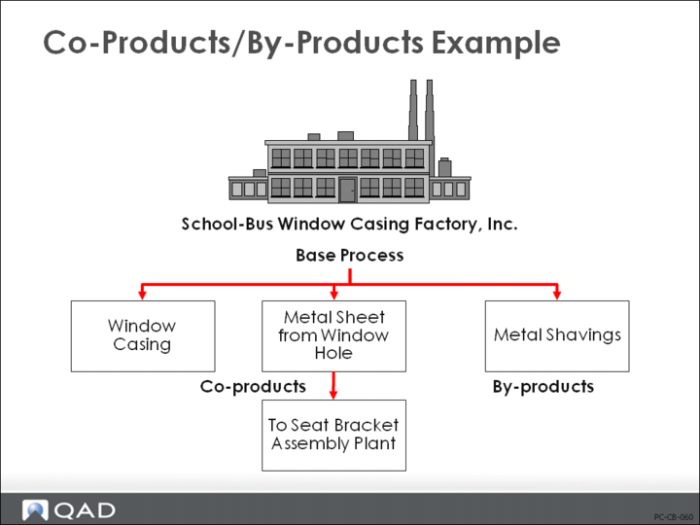
In this example, two co-products are part of the manufacture of school-bus window frames
• The window casing, stamped out of sheet metal
• The piece of sheet metal that results from cutting the window hole in the casing. We call this second piece of sheet metal the window hole.
The window hole is a valuable component that is made into a bracket for a school-bus seat. The window casing is sold to the school-bus company and the window hole goes to the plant that produces school-bus seats.
Some might call the window hole a by-product. In QAD Enterprise Applications, it is a co‑product. It has value as a component for another assembly.
After the window casing is stamped, holes are drilled and edges are ground. The metal shavings are waste. If they can be sold as scrap and therefore have some value, the planner should decide whether to process them as a co-product or by-product.
If our company manufactures entire school buses, the window casing can be a routable component of the school-bus assembly. When a work order is planned for a bus, a joint order is generated for a number of window casings and seat brackets.
Co-product/By-product Structure
• The difference between a regular item and co-products/by-products is the co-product/by-product structure, which is a special type of product structure record (type “J”). The BOM defines the inputs to the process; the co-product/by-product structure defines the output of the process (co-products, by-products, and their quantities).
• MRP and work order entry/maintenance use the co-product/by-product structure to create a joint order set from an order (see
Joint Order Sets).