Business Considerations
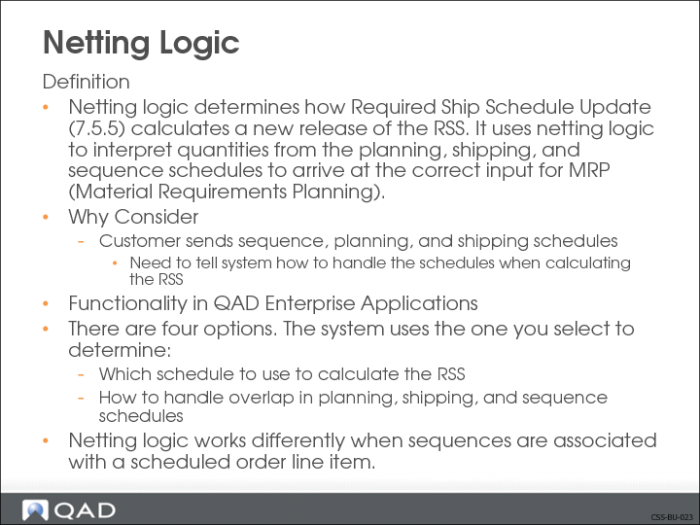
There are several business considerations to look at before setting up QCS in QAD Enterprise Applications. This section does not discuss all potential considerations, but presents some to generate thought and discussion.
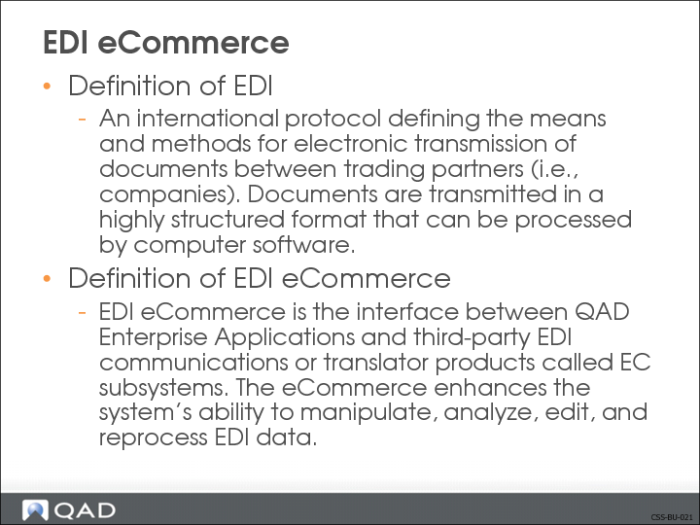
EDI eCommerce
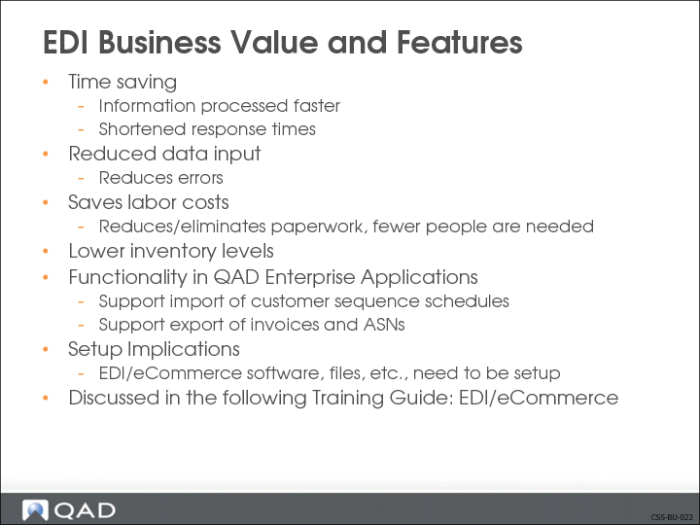
EDI Business Value and Features
Netting Logic
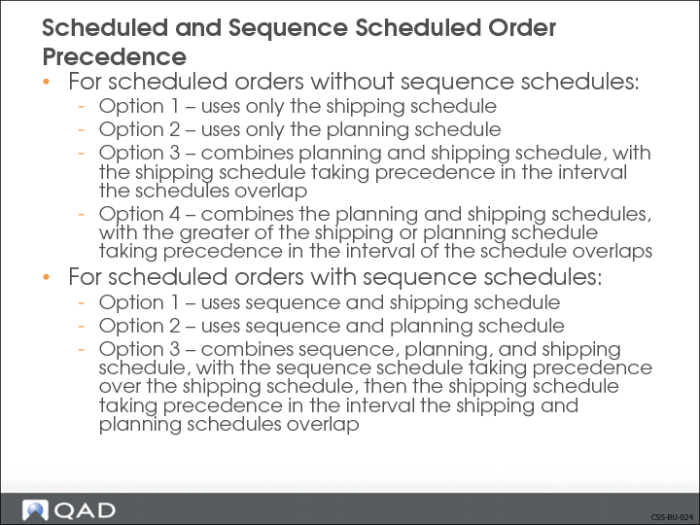
Scheduled and Sequence Scheduled Order Precedence
For scheduled orders without sequence schedules:
• Option 1 – uses only the shipping schedule
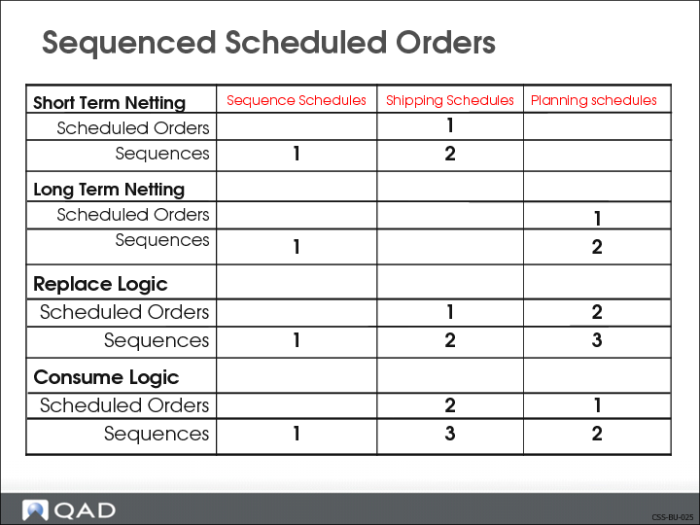
• Short-term planning
• Option 2 – uses only the planning schedule
• Long-term planning
• Option 3 – combines planning and shipping schedule, with the shipping schedule taking precedence in the interval the schedules overlap
• Replace logic
• Option 4 – combines the planning and shipping schedules, with the greater of the shipping or planning schedule taking precedence in the interval of the schedule overlaps
• Consume logic
Note: Discussed in Training Guide: Customer Schedules.
Sequence Scheduled Orders
For scheduled orders with sequence schedules:
• Option 1 – uses sequence and shipping schedule
• Short-term planning
• Option 2 – uses sequence and planning schedule
• Long-term planning
• Option 3 – combines sequence, planning, and shipping schedule, with the sequence schedule taking precedence over the shipping schedule, then the shipping schedule taking precedence in the interval the shipping and planning schedules overlap
• Replace logic
• Option 4 – combines sequence, planning, and shipping schedules, with the greater of the shipping or planning schedule taking precedence in the interval of the schedule overlaps
• Consume logic
Setup Implications
• Customer Scheduled Order Maintenance (7.3.13) needs to reflect the netting logic used for this customer’s sequence scheduled order
• Each sequence scheduled order can have a different netting logic
Sequenced Scheduled Orders
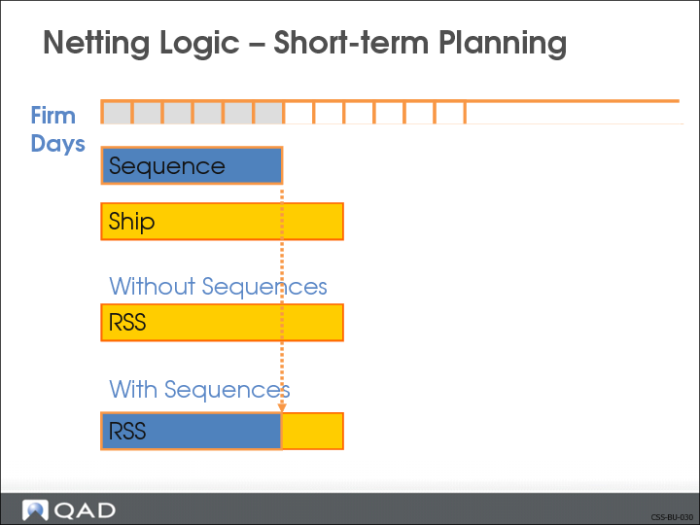
Short Term Planning
System uses the sequence and the shipping schedule to calculate the RSS.
• To determine the number of sequence schedule days, the system uses the number of Firm Days specified in the sequence scheduled order
• Specified in Customer Scheduled Order Maintenance, Sequence Delivery Data frame
• Shipping schedule is appended to the end of the sequence schedule days
• In other words, the beginning of the shipping schedule is replaced by the number of days specified by the Firm Days in the sequenced scheduled order
Using the above graphic as an example, the Firm Days are six.
• When calculating the RSS with sequences, the calculation starts with the sequence schedule for the first six days
• After six days, the calculation goes to the shipping schedule
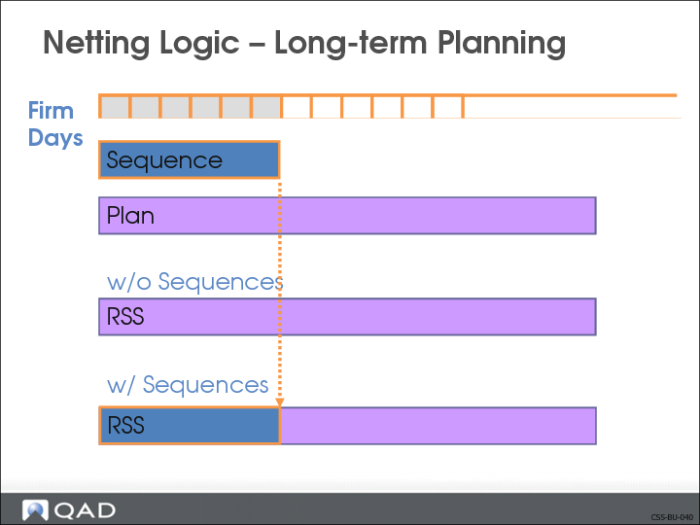
Long-term Planning
The system uses the sequence and planning schedule to calculate the RSS.
• To determine the number of sequence schedule days, the system uses the number of Firm Days specified in the sequence scheduled order
• Specified in Customer Scheduled Order Maintenance, Sequence Delivery Data frame
• Planning schedule is appended to the end of the sequence schedule days
• In other words, the beginning of the planning schedule is replaced by the number of days specified by the Firm Days in the sequenced scheduled order
Using the above graphic as an example, the Firm Days are six.
• When calculating the RSS with sequences, the calculation starts with the sequence schedule for the first six days
• After six days, the calculation uses the planning schedule
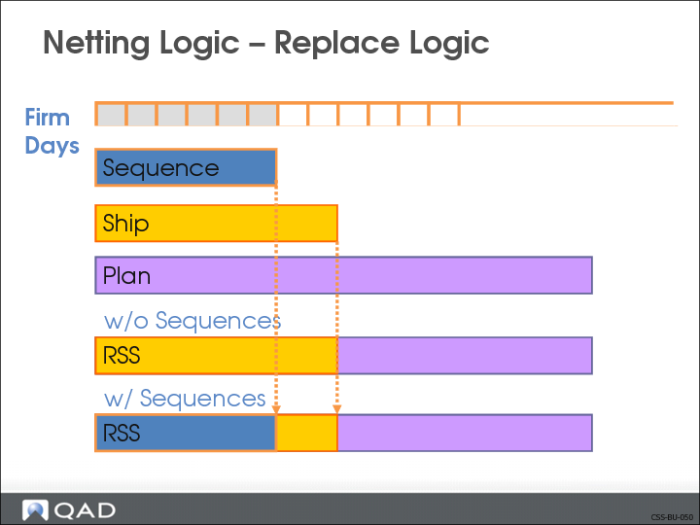
Replace Logic
System combines the sequence, planning, and shipping schedules. Calculation starts with the specified sequence schedule days, followed by the shipping schedule, then the planning schedule.
• Sequence schedule days takes precedence over the shipping and planning schedule
• Shipping schedule takes precedence over the planning schedule
Using the above graphic as an example, the Firm Days are six.
• When calculating the RSS with sequences, the calculation starts with the sequence schedule for the first six days
• After six days, the calculation goes to the shipping schedule
• If the planning schedule extends beyond the shipping schedule, that is used after the shipping schedule
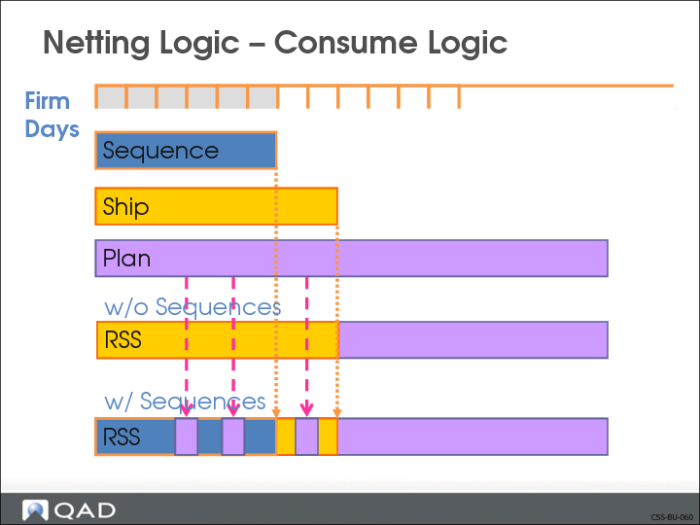
Consume Logic
The system uses the sequence, shipping, and planning schedules to calculate the RSS.
• The sequence schedule is processed first
• The shipping schedule is processed after the sequence schedule
• The planning schedule is processed last
The schedule consumes the shipping schedule. The shipping schedule consumes the planning schedule. Any discrepancy is reconciled in the last daily bucket.
Review Questions
1 In what instances would you choose Replace Logic?
2 What events occur if a customer sends you a revised sequence schedule one day prior to shipment? One hour?
3 How does MRP impact schedules?