Customer Payment—Allocate
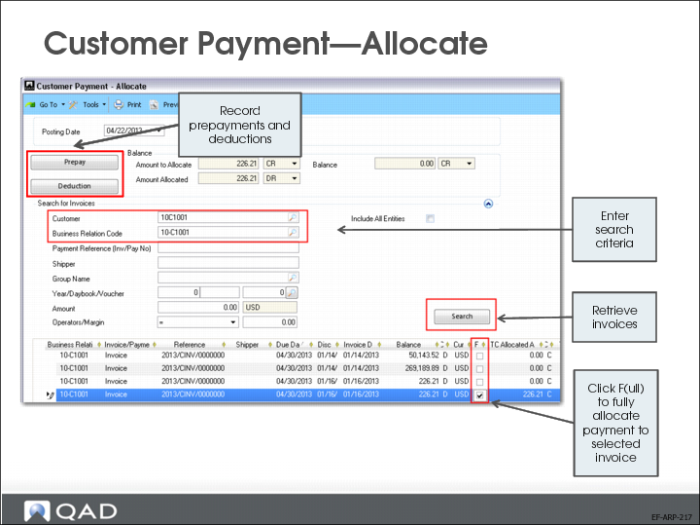
This screen displays when you click Allocate to retrieve open items for this customer to which you can allocate the customer payment.
Searching for Invoices
Use the search criteria fields to select open items for allocation to the customer payment. You can simply search for all open items for this customer, or specific invoices or invoice amounts.
You can also allocate to open items for any customer in the system. The system retrieves the customer name and business relation details into the Allocation screen from the payment screen as defaults. Delete these details and click Apply to search for all open items for all customers.
Creating a Deduction
You can record a deduction if a customer pays less than the amount owed. Deductions and how to record them are described in detail in
Deductions.
Creating a Prepayment
At this stage of the payment process, you can create a new prepayment instead of allocating the payment amount by clicking Prepay. Do this when you have received a payment and do not know which invoice it is related to or receive payments before invoices are sent.
Check Payment (Short Flow)
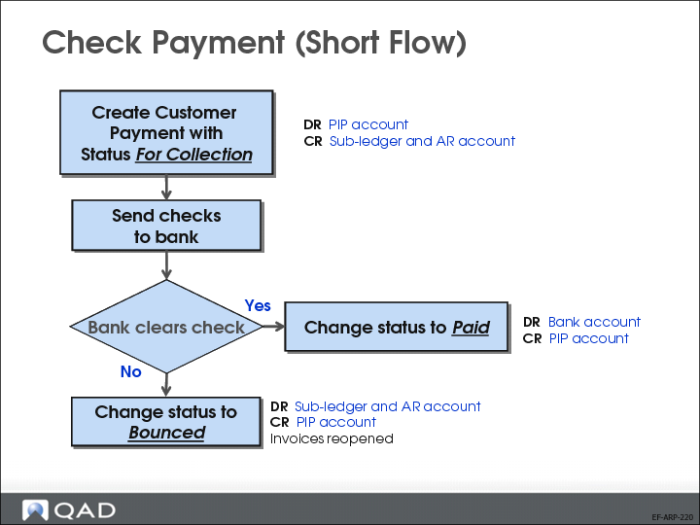
When a customer check for a payment is recorded in the system, the payment status is set to Paid. The check is directly posted against the bank GL account and does not reference the PIP account.
Check Payment (Multiple PIP)
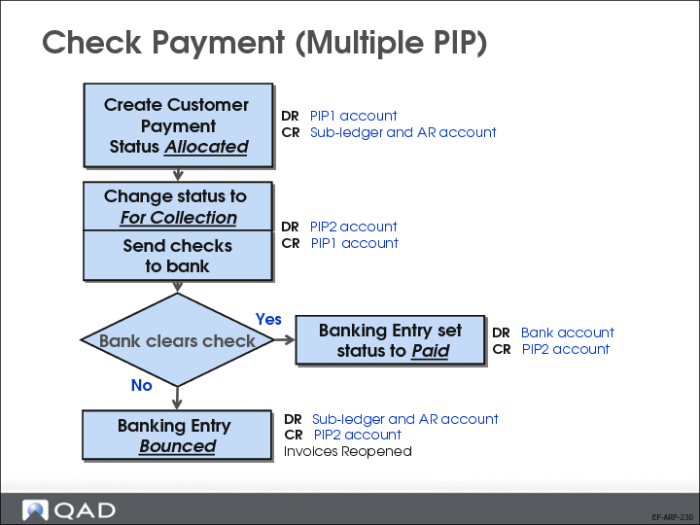
A PIP account is used to allow more efficient follow up and bank reconciliation.
Supplier-Initiated Drafts
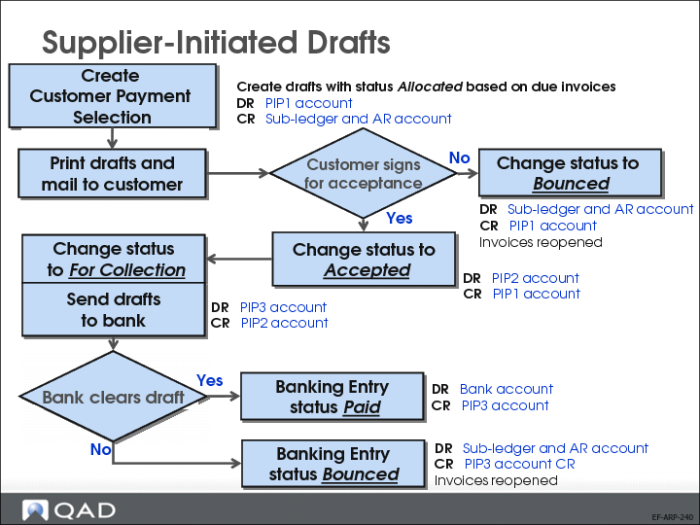
The draft or bill of exchange is a negotiable security signed and dated by its issuer (in this case, you—the supplier). It contains an unconditional order or instruction for the customer, who draws upon it to pay a fixed amount on the agreed due date. The customer accepts the draft by signing it. Once signed, the draft is considered a collection instrument. Its form, content, and legal consequences are governed by law.
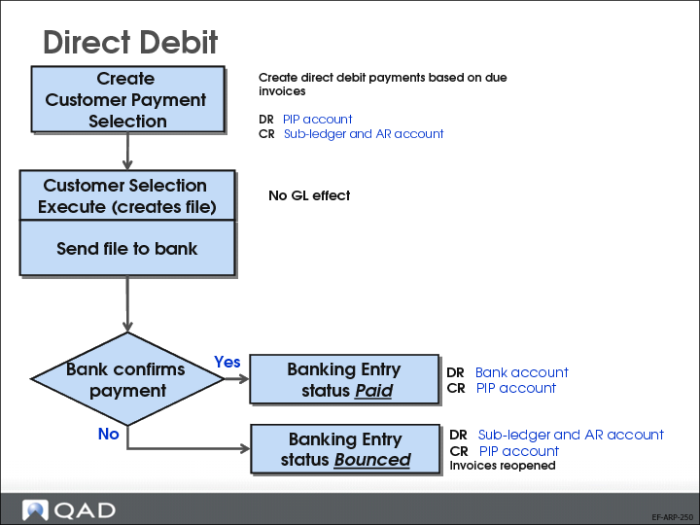
Direct Debit
Direct debit is an agreement between you, the customer, and the customer’s bank that regular amounts are to be debited from the customer’s account to settle open items. Direct debits can be in paper or electronic form. Direct debits are automatic payments, and can use the electronic payment formats.
Other Payment Instruments
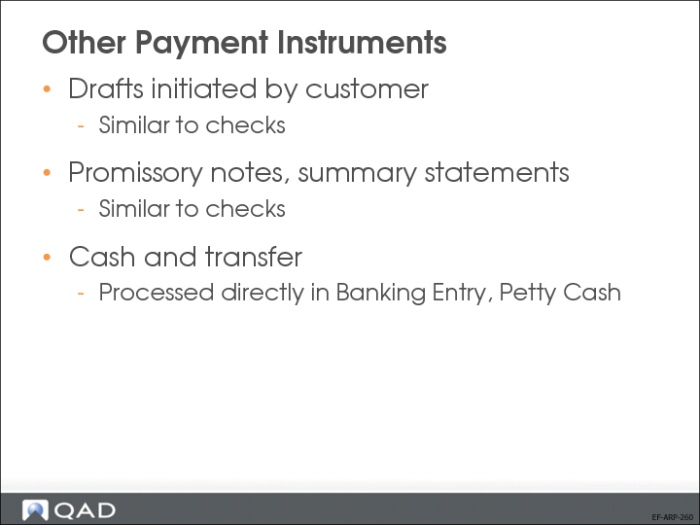
Other payment instruments, such as customer-initiated checks, promissory notes, and summary statements, follow the same flow as customer checks.
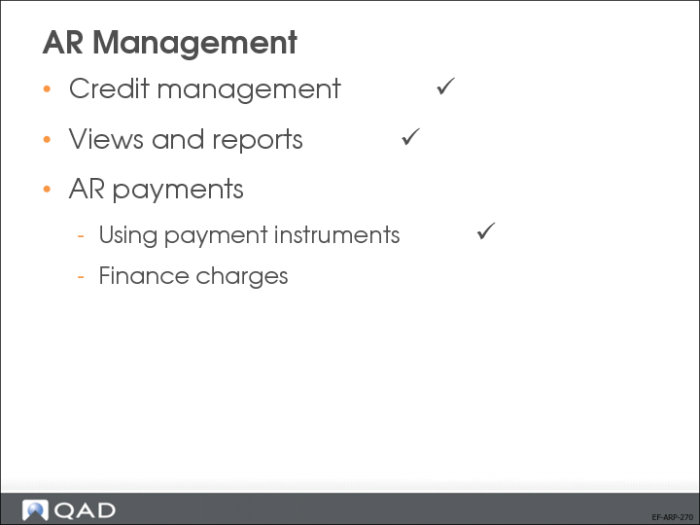
Customer invoices that are not paid on the due date can be subject to finance charges. You will now learn about the finance charges functionality.