Business Model
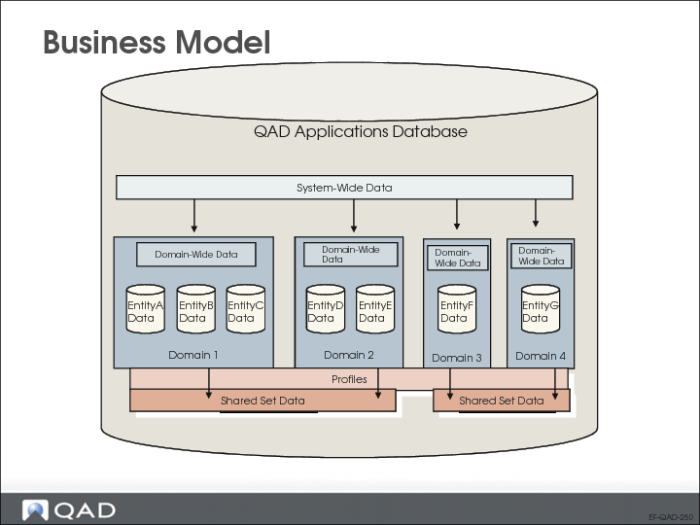
When planning your financial implementation, you must set up the infrastructure of your business organization. Domains and entities represent business operations and specific business units for which you want to produce profit and loss statements, and financial reports.
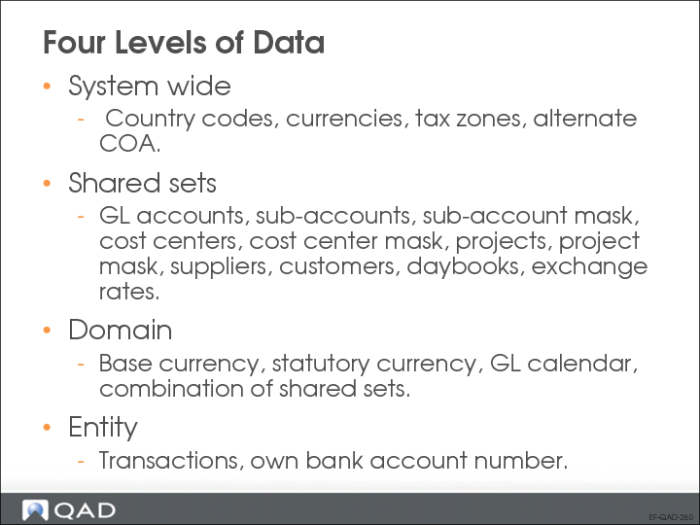
There are four levels of data in the QAD Enterprise Edition business model.
Four Levels of Data
• Some financial data is shared throughout the system, such as currency and country codes, and tax zones. This data is never different from one business unit (entity or domain) to the other, so it makes sense to share it across all business organizations.
• Shared sets group data that can be shared across domains. A single domain can have an independent chart of accounts or several domains can share the same chart of accounts, streamlining setup and maintenance.
• A domain represents the base unit of the system and comprises one or more entities. Each domain has its own base currency, and, optionally, statutory currency, which is then shared by the entities within the domain.
• Entity-level data is limited, for example, the organization’s own bank account number. Transactions are entered at entity level.
Shared Sets
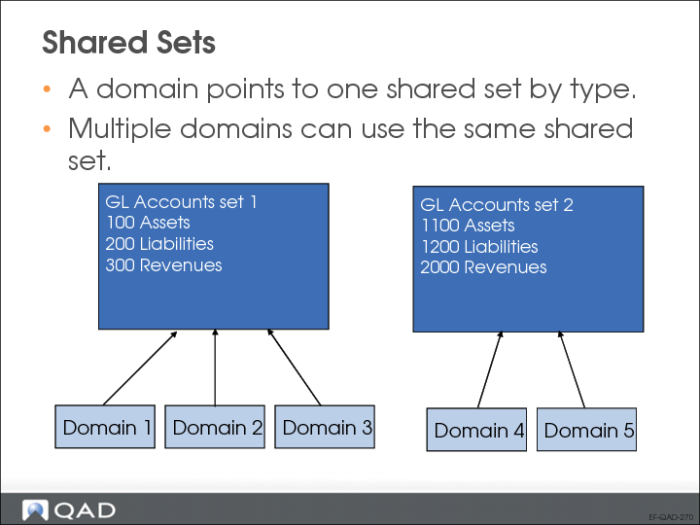
Shared sets provide great flexibility in how you can set up a system.
A default set of shared set codes is supplied with the system. However, you can create as many shared sets as required. The following types of data can be shared: customers, suppliers, accounts, sub-accounts, cost centers, projects, exchange rates, and daybooks.
For example, three US domains can use the same chart of accounts, while two other domains in Japan can use another accounts shared set.
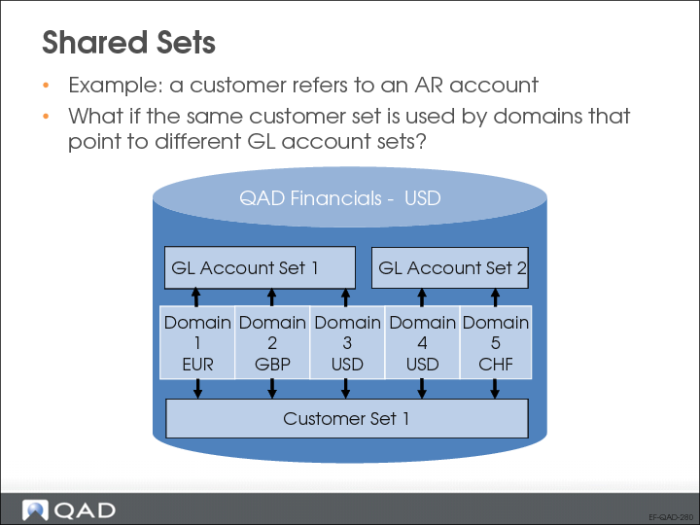
You might need to connect data in one shared set to another. For example, if several domains share a customer set, but refer to two different chart of accounts, you would need to link different customer control accounts to a single customer.
Example
Business Relation
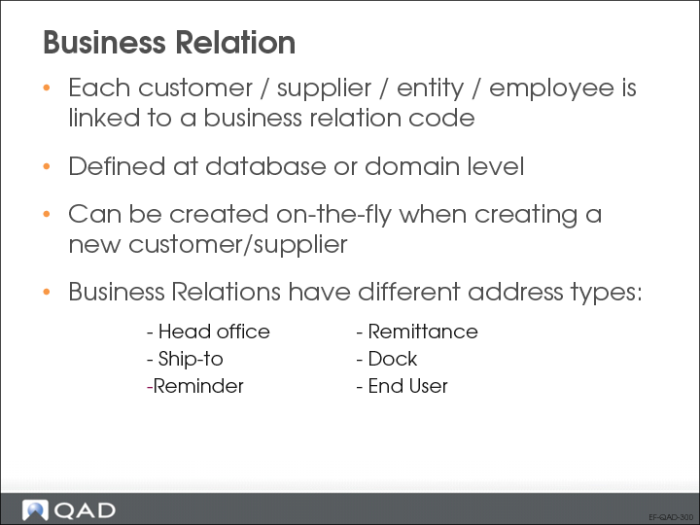
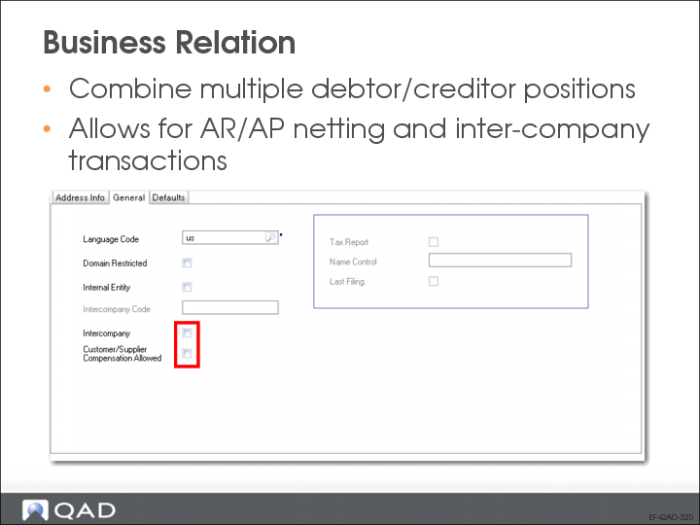
Business relations represent any organization or person that a company does business with, for example, customers, suppliers, employees, or an internal entity. A business relation address is a prerequisite for creating any of these records.
You can also create a business relation from within the customer or supplier creation menus.
Business relations can have different address types, as shown above.
Business Relation