Alternate Chart of Accounts
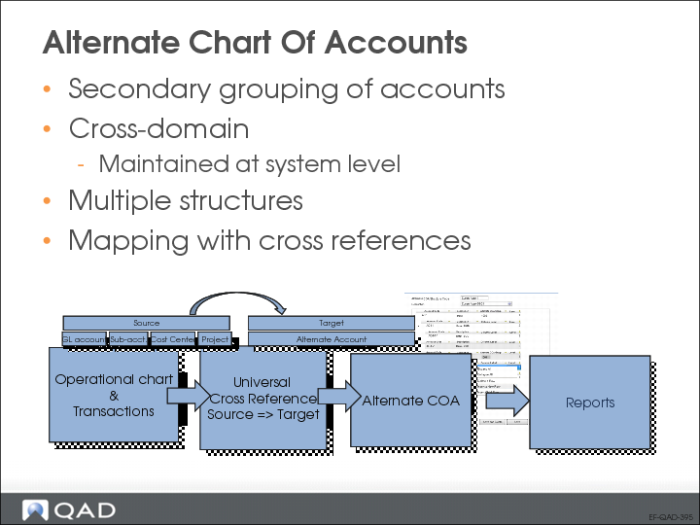
The Alternate Chart of Accounts functionality was introduced in QAD 2009 Enterprise Edition to provide the ability to report accounting activity using a standardized chart of accounts provided by local legal authorities (required among others in China, Russia, France).
Alternate COAs are maintained at system level to be used across domains, and you can set up as many as required.
No posting occurs to the alternate COAs, which are only used for reporting.
You set up alternate COAs by defining cross-references from source GL combinations to target alternate accounts.
Learn more about alternate COAs in the Advanced Financials class.
Currencies
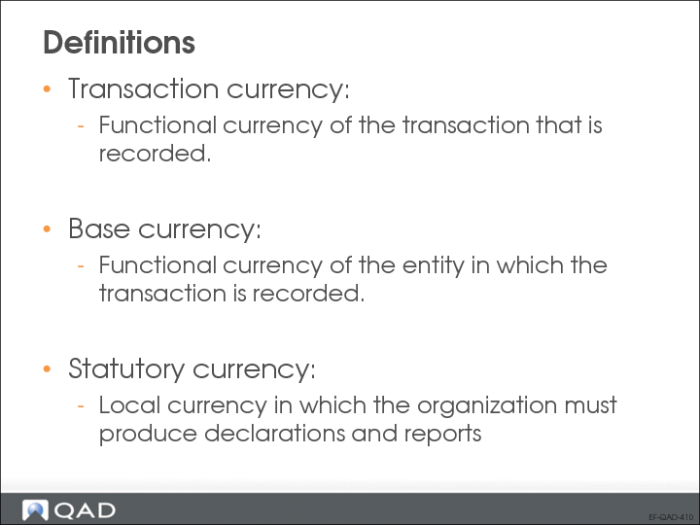
In addition to the primary base currency at domain level, you can define a second management currency at database level, for reporting purposes. This currency is known as the statutory currency, and is normally the local currency of the country in which the organization must produce its declarations and financial reports.
The need for a statutory currency is most likely to arise in a country that is geographically close to a strong currency zone (for example, Mexico and Poland), where the country itself has another local currency. Companies operating in countries close to strong currency zones, such as the Euro and US Dollars, might use the stronger currency as their base currency (functional currency). However, local auditors and tax controllers can mandate that companies submit their declarations and financial reports in the local currency of the country. In these cases, the local country currency becomes the organizations’ statutory currency.
Definitions: Transaction, Base and Statutory Currency
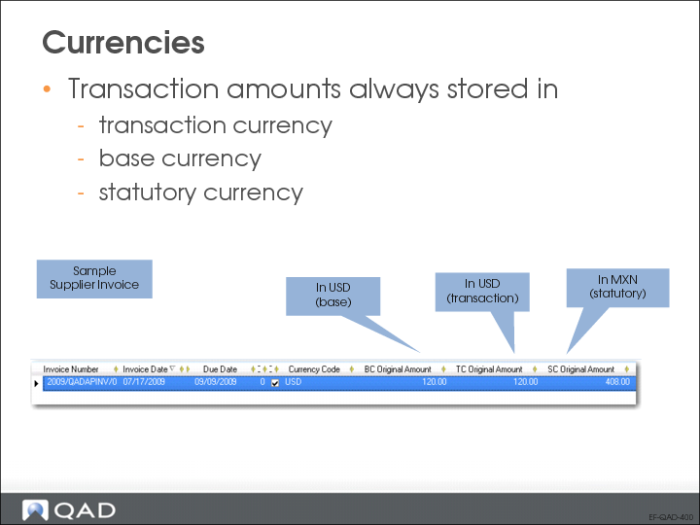
Foreign currency transactions can be stored in a maximum of three currencies: the transaction currency, the base currency, and the statutory currency. This three-currency system lets you display a transaction or create a report in any of the defined currencies. This feature is especially important in environments with high inflation and strong currency fluctuation.
Usage Example for Dual-Base Currency
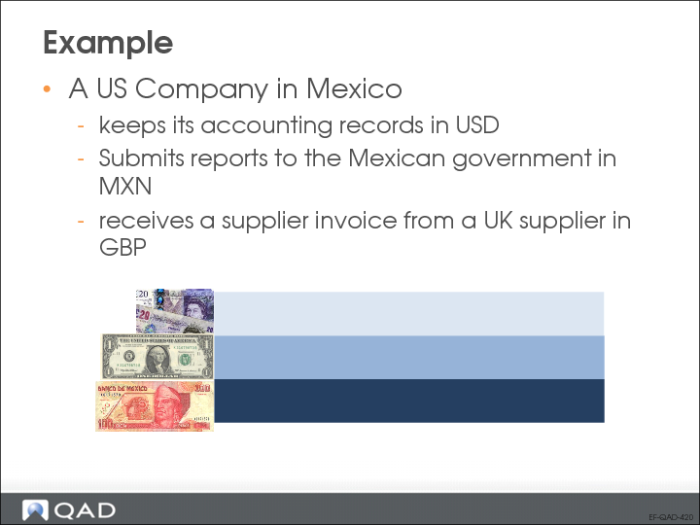
A multinational corporation has a subsidiary in Mexico. In the Mexican subsidiary, most business transactions are conducted in USD, which is the base currency. However, all reports that the subsidiary must produce for the Mexican government are in Mexican pesos, which is the statutory currency.
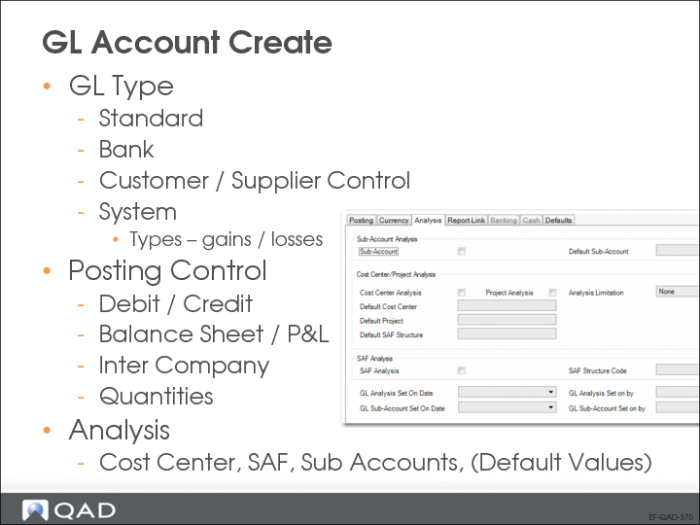
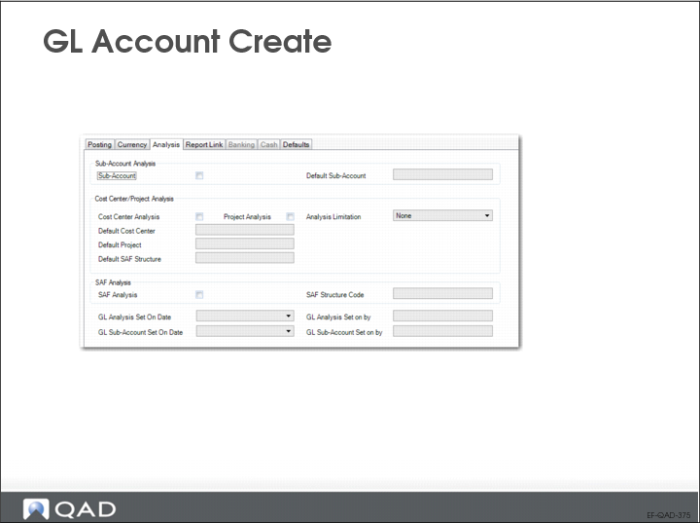
GL Account Create
Some of the features of General Ledger accounts in QAD Enterprise Financials include:
• Several GL types with added functionality for each.
• Posting control, where some of the attributes are mandatory.
• Extensive analysis capabilities with sub-accounts, cost centers, projects, and Supplementary Analysis Fields (SAFs).
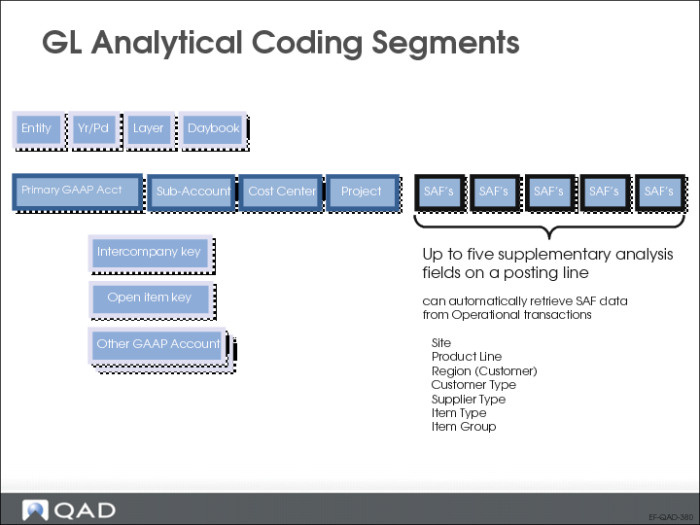
GL Analytical Coding Segments
QAD Financials uses standard, industry-recognized components to implement your chart of accounts. The strength of the application is its flexibility; you can configure the business model to generate many different types of accounting information.
GL accounts, sub-accounts, cost centers, and projects combinations can be validated using a GL mask. The GL mask validates account element combinations when transactions are posted, preventing any posting errors.