Warehouse Management Systems
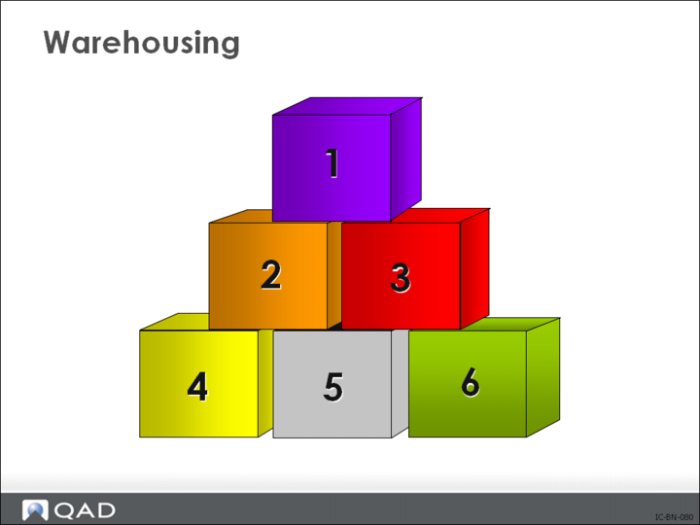
Warehouse Management Systems Allow You To
Process import transactions from the warehouse system. The warehouse system creates import transactions that send all inventory receipts, shipments and issues, adjustments, and dispositions processed in the warehouse to QAD Enterprise EA.
Why Consider Warehousing?
The warehousing interface treats your warehouse as a satellite storage area within a QAD site. You can transfer data between an external warehouse and QAD EA. You can also create various export transactions that extract information on items, customers, suppliers, and orders of all kinds for exportation to the externally controlled warehouse.
Setup Implications
The warehouse is considered an extension of the QAD site with the QAD system:
• Managing its supply and demand orders
• Recording its summary inventory balances
• Sending it item, trading partner, and order information
In turn, the warehouse system sends most of its inventory transactions back to the QAD system.
Customized programs may be needed to accomplish an interface with some third-party warehouse packages.
Regulatory Attributes
Note: This module is named Compliance module in QAD SE systems; it is named Regulatory Attributes in QAD EE.
Regulatory Attribute Module Allows You To:
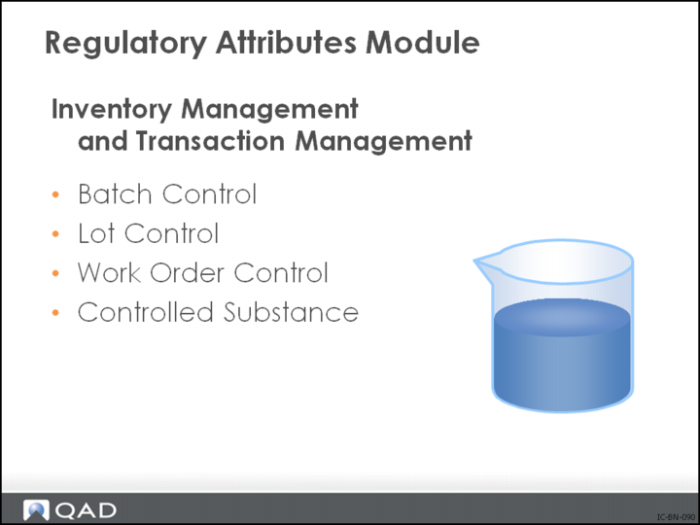
Provide batch control, lot control, work order control, and controlled substance fields. Lot Group codes can be automatically assigned.
Why Consider Regulatory Attributes?
Batch Control
Assign batch numbers to work orders for traceability and reporting. Enter batch numbers as you create work orders or add them to existing work orders.
Lot Control
• Provide control enforcement of unique lot numbers
• Define lot groups for assigning lot numbers
• Update inventory attributes for multiple lots
• Restrict receipts to a single lot
• Generate reports with lot numbers as an index
• Enter supplier lot numbers and manage expired inventory
• Work with number range management
Multi-Lot Inventory
Change assay percentage, grade, status, and expiration date of inventory items based on lot and serial numbers.
Work Order Control
Restrict component items issued to work orders unless they are on the bill of material (BOM) or they are valid substitute items. There is a similar control for receipts of joint product items.
Inventory Attributes
Enter inventory attributes information on work orders to increase the control and tracking of material as it progresses through manufacturing into inventory.
• Use batch and other work order processes to meet business requirements
• Assign default inventory attributes and change existing attributes by:
• Assay percentage
• Grade
• Expiration date
• Inventory status
Controlled Substances
• Maintain a list of regulatory agencies
• Link a regulatory or control number to an address code or a site
• Associate a regulatory or control number to an inventory item
• Record GL and individual license information for exports
Setup Implications
Each feature can be used in conjunction with or independent of the other features.
Backward Exploded Receipts
Backward exploded receipts are often used in kitting or simple assembly operations. There is no need to set up a work order.
Recording the receipt of the finished item indicates that you used a certain group of materials
Review
Summary