Locations
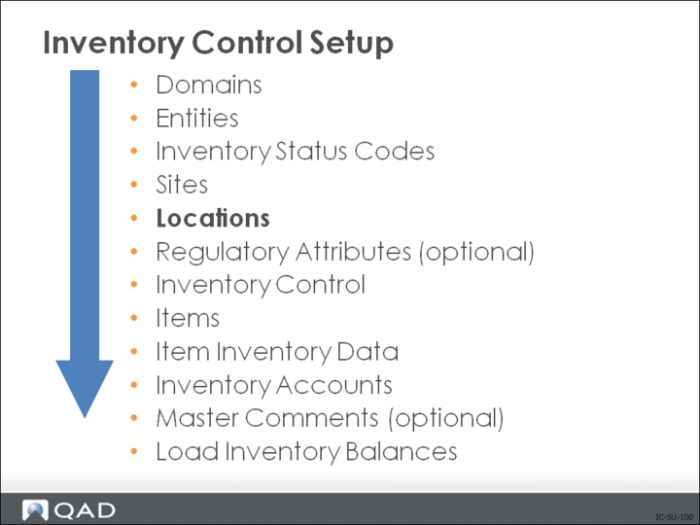
Locations identify areas of a site where inventory is stored. A location defines an area, such as a shelf, bin, or tank within a site. Each location's parameters identify what can be stored there and how that inventory can be used. The same location codes can be used for different sites.
Every inventory transaction must have a site and location. Both default from Item Master Maintenance (1.4.1).
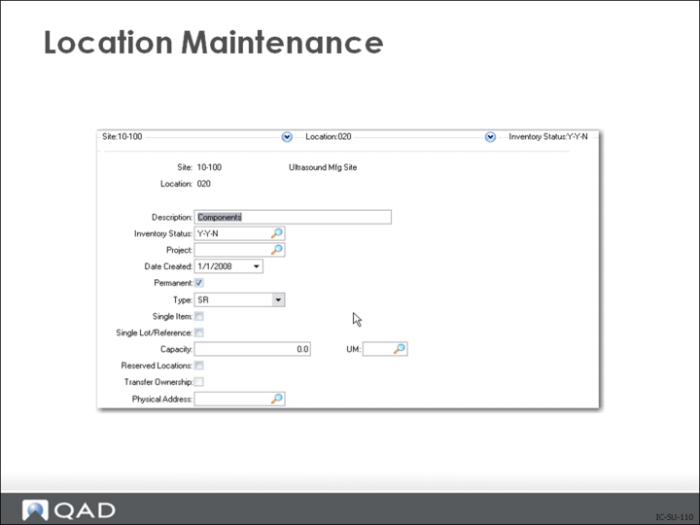
Location Maintenance
Inventory Status
The usual status of inventory held in this location. This status defaults into transactions for this location and may be identified. See
Inventory Status Code Maintenance.
Project
Optionally, specify a GL project code to associate with this location. When Verify GL Accounts is Yes in Domain/Account Control, this field is validated against GL project codes.
If you do not use the Project Realization Management (PRM) module, this field is for reference only.
When you do use PRM, this field identifies a PRM project location. For a project location, the GL project code in this field must have a corresponding PRM project with the same identifier.
Permanent
If this field is Yes, the location is permanent. It is retained even if the on-hand balance is zero. When a location is defined as permanent, all location details are maintained on the system until they are deleted using the Zero Balance Delete/Archive.
If this field is No the location is temporary. If you define a location as temporary, the system automatically deletes inventory detail records when the location’s balance falls to zero
The use of temporary locations helps to keep inventory reports at a reasonable length, particularly when there are lot and serial controlled items with zero balances.
Permanent inventory locations may be desirable when items have fixed or designated stocking location. Even if the inventory balance falls to zero, you want to see that on reports and inquiries.
Type
Locations are categorized by type and each item is assigned to a specific type of location.
When the item is received or transferred, the system verifies that the type of the location that the item is being received into matches the location type associated with the item. If it does not, an error displays and the transaction may not be processed.
The code identifying the type of location is useful for items with special storage requirements, such as temperature or humidity. The location type can flag this and comments describe the exact requirements.
Single Item
Indicates whether more than one item or product may be stored in this location.
Set this field to Yes to prevent receipt of more than one item number into a location.
This field is checked for positive receipt, negative issue, and cycle count adjustment transactions. It is not checked when counting tags or updating inventory balances using Physical Inventory.
Single Lot/Ref
Indicates whether more than one lot/ref number of the same item may be stored in this location.
Set this field to Yes to prevent receipt of more than one lot/serial number into a location.
This field is checked for positive receipt, negative issue, and cycle count adjustment transactions. It is not checked when counting tags or updating inventory balances using Physical Inventory.
Reserved Locations
Used with customer consigned inventories. If checked “yes,” another frame appears to enter one or more customer ship-to addresses.
Transfer Ownership
Used with supplier consigned inventories. If supplier consignment inventories are active in Supplier Consignment Control this field determines when transfer of ownership occurs.
Capacity
The capacity of an inventory storage location is expressed in terms of the capacity unit of measure.
This field is for reference only, and may appear on some selected reports and inquiries.
Unit of Measure (UM)
The unit of measure in which the location capacity is expressed.
This field is for reference only and may appear on some selected reports and inquiries.
Physical Address
The address code of this location. Used to generate shippers for transfers between locations that are physically separated.