Overhead and Burden Cost Update
T
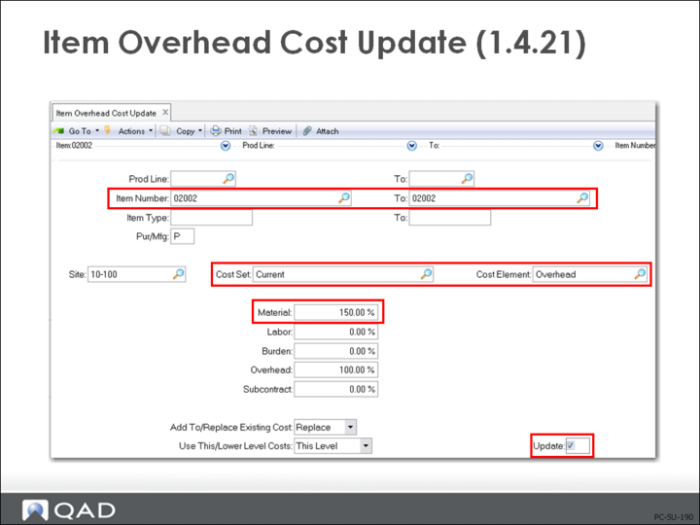
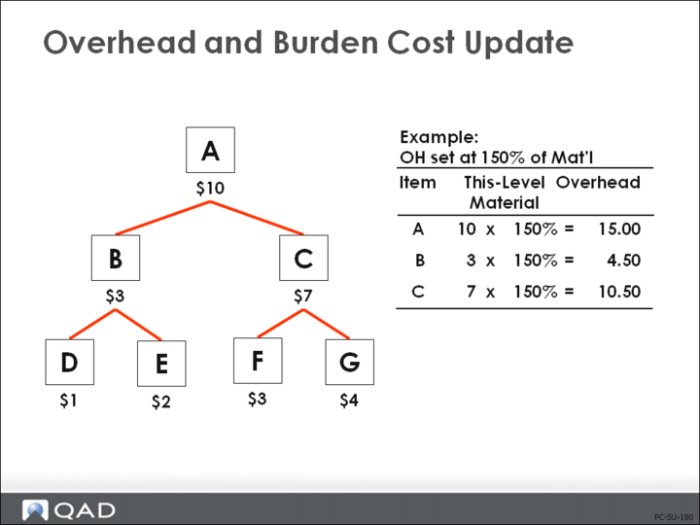
This graphic shows the effect of using Item Overhead Cost Update (shown on the next graphic) to update overhead costs to 150% of the This Level Material cost.
You can calculate overhead and burden as a percentage of lower-level costs by using Item Burden Cost Update (1.4.20), Item Overhead Cost Update (1.4.21), or Item-Element Cost Calculation (30.17.10). This is useful for companies that calculate overhead and burden based on material cost rather than labor cost.
Calculate Overhead and Burden in Three Steps
1 Roll up product structure costs to ensure that you calculate overhead (OH) from accurate lower-level costs. Use Product Structure Cost Roll-Up (14.13.13).
2 Calculate this-level item overhead costs for the lower-level items by using Item Overhead Cost Update (1.4.21). Or calculate this-level item burden by using Item Burden Cost Update (1.4.20).
3 Roll up the product structure costs again to add the calculated overhead to the lower-level costs.
Example: In the previous example, the product structure for item A consists of lower-level items B and C. The lower-level material costs originate in the components for B and C - items D, E, F, and G. This-level overhead is 150% of lower-level material cost. The lower-level material costs are:
Item D = $1
Item E = $2
Item F = $3
Item G = $4
• The first product structure cost roll-up for item A calculates lower-level material costs of $3 for item B, $7 for item C, and$10 for item A.
• In Item Overhead Cost Update (1.4.21), set the material percentage to 150% and the other percentages to zero. Set Use This/Lower Level Costs to Lower.
• This calculation generates overhead costs of $4.50 (150% of $3) for item B, $10.50 (150% of $7) for item C, and $15 (150% of $10) for item A. Items D, E, F, & G have OH costs of 0.
• The second product structure cost roll-up adds the calculated this-level overhead costs for items D and E to B, then the costs of F and G to C, then the costs of B and C to A
Processing Considerations
Before running the calculation, consider the following:
• At which level will you calculate overhead? The lowest level parent item? The highest level parent item? The planning level? This decision varies from company to company.
• Which overhead percentage will you use for each level?
In the item burden and overhead cost update functions, the default percentage is 100%. When calculating lower-level costs, typically change this to 0%.