Transaction Programs
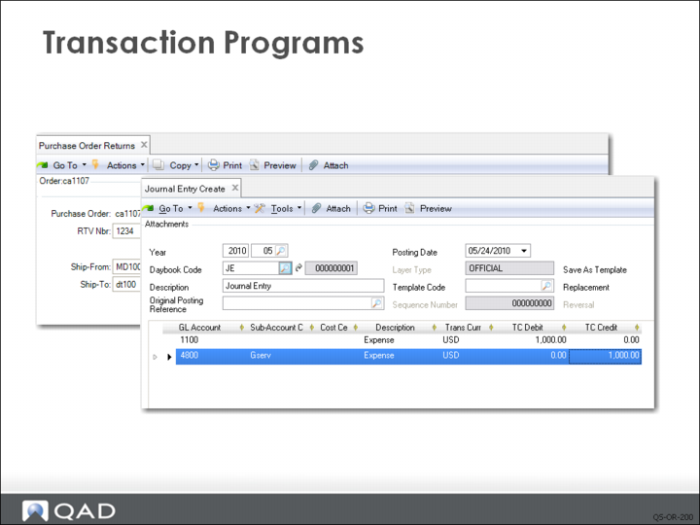
Transactions express the core business activities of a company. They control and record activities related to business documents such as sales orders and invoices. Example of transaction are shipping a sales order or receipt of a shipment for a purchase order. Enterprise Financials transactions programs include Customer and Supplier Invoice Create and Journal Entry.
Most data in the database is transaction data. Every day, sales orders come in, purchase orders go out, and work orders make demands on and create material for inventory. These events result in transactions, which are stored in transaction tables. In contrast to control programs, transaction tables are constantly updated by users of the system.
Transaction programs often update multiple database records and generate general ledger account transactions. Shipping a sales order and posting the invoice, for example, updates the on-hand inventory balance for the items shipped, charges the value to cost of goods sold, updates the sales ledger for the value of the sale, updates the customer’s accounts receivable record, books charges to appropriate freight accounts, tax accounts, sales commission accounts, updates the inventory allocations, and updates the inventory quantities available to promise
Utilities are a special type of transaction that is often designed to be used only once or under special circumstances. For example, many utilities perform one time data conversions following system upgrades. Other utility programs enable you to manage and perform calculations in internal databases. In Purchasing, Closed PO Delete/Archive is a database management utility, and in MRP, Net Change Materials Plan causes the system to run net change MRP calculations