Work Order Type
The work order type indicates how the work order will move through production and how it affects other modules, especially the financial modules.
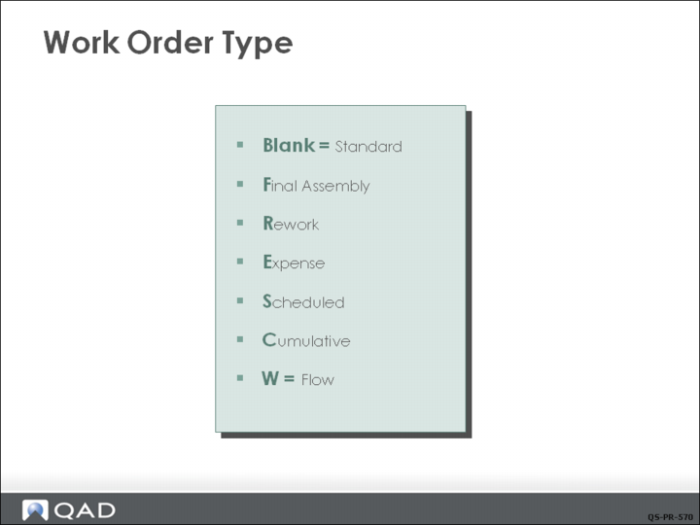
Most work orders are entered with a blank type. These represent normal manufacturing orders with a standard product structure and routing. The other types indicate special kinds of work orders. All work order types are similar in terms of planning, inventory, and accounting. They differ in their default bills, routings, and status codes.
Joint order sets are a special case associated with Co/By Product orders. Joint order sets can be created for regular work orders that are type code blank. See the related training materials on Joint Products for detailed information. Rework and Expense work orders can share the same work order number as a joint order set, but are not considered part of the joint order set. For example, a work order for co-product or by-product can be reworked using the original work order number. The type code must be blank for a base process work order.
Note: Each work order is uniquely identified by the combination of the work order number and the work order ID number. For scheduled orders, the work order number is typically the number of the item being scheduled, and the work order ID becomes the unique identifier.
Expense and Rework orders are always created by users.
The system generates work orders of type S, C, F, or W.
S (Scheduled)
Generated by the system when a Repetitive schedule is entered. The work order number is the item number scheduled for production. Scheduled orders can be tracked using Repetitive feedback functions or released to create work orders. To release it, change the status field from exploded to allocated or to released. The system will automatically change the Type to blank and will treat it like a normal work order. The system will also update the repetitive schedule to exclude the order.
C (Cumulative)
Generated by the system to track repetitive production costs. These cannot be processed by work order functions. Cumulative orders are associated with both regular and sequenced repetitive line schedules.
F (Final Assembly)
Generated when a sales order for a configured product is released to manufacturing. The work order number will be the sales order number with a decimal and number to correspond to the sales order line number. It uses the standard routing for the item, but the product structure contains only the items chosen on the sales order configuration. These orders are released and processed as regular work orders. You must specify Type F in Multiple WO Release/Print to release the work order, however.
W (Flow)
Generated when you use Flow Schedule Maintenance to create a flow scheduled order that does not reference an existing work order. These cannot be processed by work order functions.