Close Work Order
Work orders are typically closed when all the items are received. For most purposes, this ends the life cycle. If a partial receipt is made, the work order can be left open to receive the balance of the items at a later time.
To close a work order:
• Change the order status to Closed. You can do this by setting Close to Yes when completed units are received using Work Order Receipt, or by using Work Order Maintenance.
• Run Work Order Accounting Close to post variances, clear WIP, and close outstanding operations. Execute this program regularly, at least at the end of each fiscal month, for completed orders.
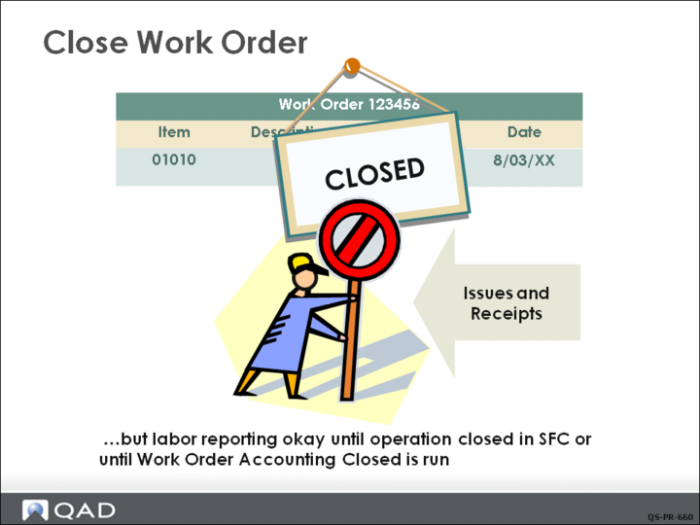
The system prevents component issues and work order receipts for a closed work order. However, additional labor can be reported until either the operations are closed in Shop Floor Control, or Work Order Accounting Close is executed.
To process inventory for a closed work order, you must change its status back to Released.
Executing Work Order Accounting Close:
• Completes open work order operations.
• Calculates and posts work order variances for material, labor, burden, and subcontract costs.
• Calculates and posts usage variances when the labor quantity used differs from the standard. For example, if an operation scheduled for 5 hours took 6, a 1 hour labor usage variance is posted.
• Calculates and posts rate variances for material and subcontract when cost used differs from standard cost. If pay rates are defined in Actual Pay Rate Maintenance, rate variances are also calculated for labor.
For example, when the standard subcontract cost is $10 and the PO cost is $12, the subcontract rate variance is $2.
• Reconciles the WIP account for closed work orders by calculating and posting method change variances for any residual variances. WIP balances cannot be changed after the work order variances are posted.
• Updates current labor and subcontract costs.
• Posts floor stock amounts.
Important: Work Order Accounting Close is normally an accounting or finance function done in conjunction with the period end close. It should be carefully coordinated with other period end accounting processes and controlled by internal procedures.