End-Item Planning: Introduction
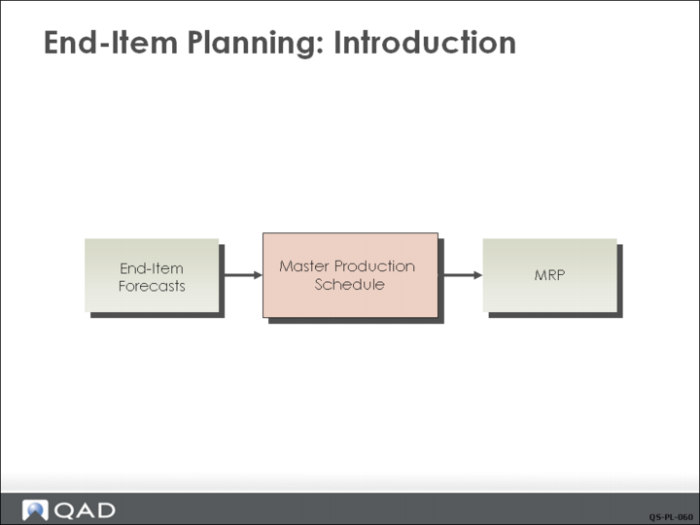
In QAD EE, end-item planning is done in the Forecast/Master Plan module. It begins with the master scheduler, who estimates the demand for a product and determine how many to produce. The planning horizon should be at least as long as the longest cumulative lead time in the system. Many companies like to plan and forecast 12 to 18 months into the future to ensure adequate resource planning and coverage for seasonal products.
Inputs
The primary inputs to the master scheduling process are actual and forecast demands. Forecast demands are derived from the product line plans but are much more detailed. Unlike product line plans, which express forecasts in terms of thousands of dollars of production for a complete line of items by month, forecasts are expressed in terms of quantities for a specific item and site by week. Products subject to seasonal demand can have forecasts that fluctuate widely from week to week. Seasonal build schedules are used to smooth these requirements, increasing production in advance of anticipated spikes in demand.
Output
The output of the master scheduling process is a detailed plan of the number of end items and the schedule for their production. The check on this plan is the availability of critical resources. If you want to make 50 items next week but your fabricator only makes 25 in a week, you cannot fulfill the plan. Detailed resource planning is done at this stage, looking at the actual schedule and its demands on resources as specified in item resource bills. In many cases, only bottleneck resources are reviewed.