End-Item Planning: Forecasting
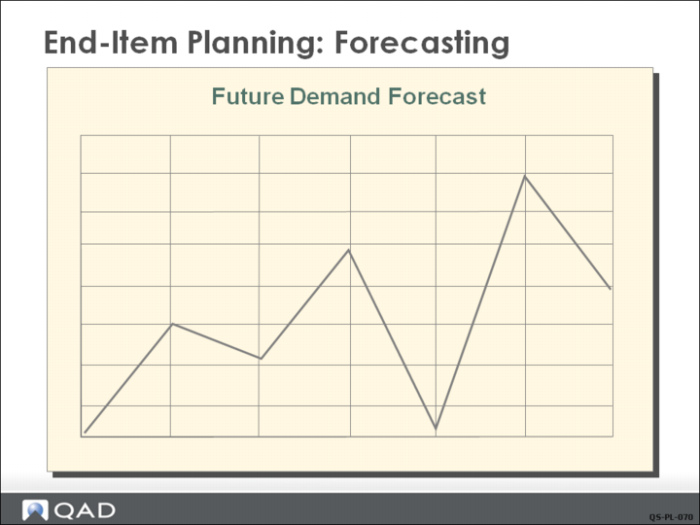
The forecast is an estimate of future demand for an item at a particular site, stated in terms of quantity per week. It is the starting point for developing an executable plan. In QAD EE, this is a shipment forecast, or the quantity of an item to be shipped (not ordered) that week. Forecasts are normally entered for items subject to independent demand, from sales orders or spares. Dependent demand—for components and raw materials—is calculated from this.
The system keeps a running total of the actual quantity to be shipped each week, determined by the due date on the sales order line item or customer schedule.
In summary, forecasts:
• Estimate future demand for an item
• Are typically a sales function
• Can be an integral part of master scheduling
• Represent one point of input to the master schedule
Source of independent demand can be created for any item, but is usually created for:
• End items
• Critical subassemblies
• Service parts
Terminology
Abnormal Sales Demand
Some sales order demand cannot be anticipated by the forecast and is considered abnormal sales demand. This demand could be generated by major new accounts or windfall orders, such as orders for roofing materials after a hurricane. Since abnormal sales demand was not anticipated by the forecast, it should not consume the forecast. This effectively adds abnormal sales order demand directly on top of the net forecast. A sales order demand is classified as abnormal by using the Consume Forecast option in Sales Order Maintenance.
Net Forecast
Net (remaining) Forecast is the amount of the forecast not sold in any given week. MRP always plans to make enough product to match actual orders (regular sales and abnormal), but it also plans production to satisfy any remaining forecast, since orders for this amount may still be expected.
Production Forecast
Production Forecast is calculated by the system based on the forecast of sales of another product. For example, sales of disk drives are based on the forecast of computer sales. These are also planned by MRP.