End-Item Planning: Forecast Consumption
Incoming sales orders and scheduled customer deliveries are netted against the forecast. The net (remaining) forecast is calculated as the original forecast less quantity sold (except abnormal sales). Planning sees total demand as actual sales (normal and abnormal), net forecast, and production forecast.
Forecast Consumption
The process of netting sales order quantities from the forecast is called forecast consumption.
As a rule, forecasts are more accurate in the long term rather than the short term. Since forecasts are entered for one-week periods, actual shipments seldom correspond to the forecast for a single one-week period. Shipments may be predicted with more accuracy over a month or a quarter.
Consume Forward/Backward
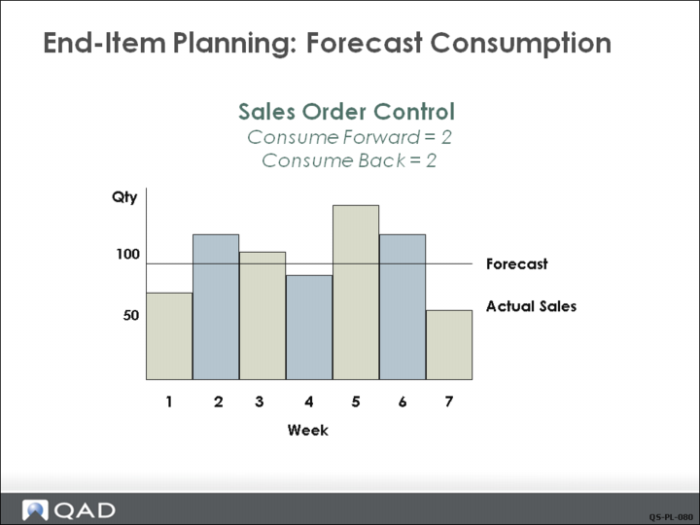
One method of managing this type of fluctuation is to expand the forecast window by using forward and backward consumption. As you would expect, when sales orders are booked, they consume the forecast in the week they are due. But if there is no unconsumed forecast in that week, the system looks at a specified number of weeks before and /or after it to check for unconsumed forecast. This method recognizes that unsold forecast may exist in other weeks that should be consumed.
The rules for forecast consumption are set up in Sales Order Control.
Forecasts are often done by month (as in Forecast Simulation), then arithmetically spread to weeks.
• Using a forecast consumption value of forward one week and backward two weeks, plus the current week a sales order is booked in, gives a four week period for the actual sales to equal the original month forecast.
• Forward two weeks and backward one week, or backward three weeks and forward none, gives the same effect.
Most companies would choose to consume unconsumed forecast from prior periods before taking consumption from future periods.