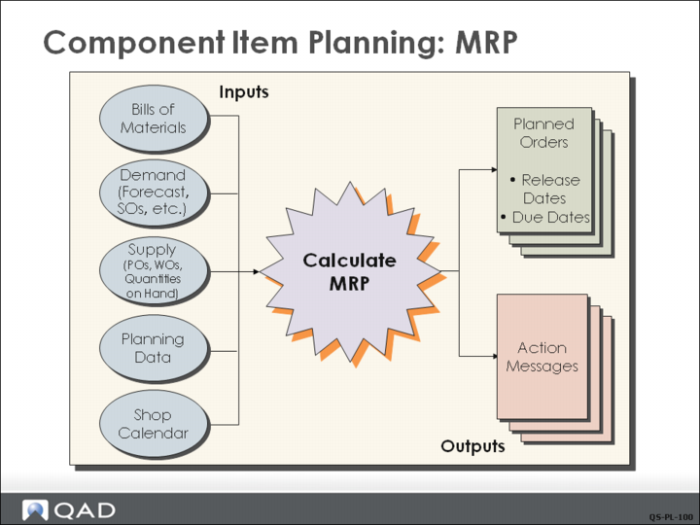
Component Item Planning: MRP
The master schedule is a detailed schedule of production, but production can be achieved only if the component materials are available.
MRP and DRP explode the master schedule to calculate the demand for components based on the bill of materials (BOM). These components can be purchased, manufactured, or acquired internally from another site.
MRP Inputs
• Sources of demand (forecast, production forecast, sales orders, gross requirements, seasonal build, safety stock)
• Sources of supply (nettable quantity on hand, purchase orders, work orders, repetitive schedules, quality orders)
• Item planning data, lead times, order policy, whether the item is manufactured or purchased
• Product structures/formulas
• Shop calendar
MRP Outputs
The primary outputs of MRP are planned orders and action messages. Within the time fence, you just get action messages. Planned orders are generated outside of the item’s time fence. Usually the planner reviews and approves MRP planned orders as either work orders or requisitions.
In summary, MRP is a time-phased priority planning system that calculates material requirements using product structures, inventory status, the master schedule, and open order dates.
Supply is scheduled and rescheduled to meet changing demand and maintain valid due dates
MRP Options
The material requirements plan can be created using either net change, regenerative or selective methods.
Net Change
Net change MRP replans items for all selected sites that have changed since the last MRP run. The primary advantage of net change MRP is that it often takes less time to process then regenerative. A net change MRP run processed after correctly acting on action messages should yield the same result as a regenerative MRP.
Regenerative MRP
Regenerative MRP creates a completely new material plan for all selected sites starting at the top level, exploding new requirements, and continuing to lower-level components. (Remember each site is a separate MRP plan. Only DRP passes requirements between sites.) One advantage of regenerative MRP is that it guarantees that all plans are in complete synchronization and that all due dates are valid.
Selective MRP
Selective MRP is a special case situation and processes a limited set of user defined items, and could be used for what-if analysis.
Capacity Requirements Planning (CRP)
MRP component planning is checked against the capacity requirements plan (CRP). CRP determines how much labor and how many machine resources are required for production, and it calculates workload for a department, work center, or machine. It is used for short to medium-range capacity management to determine and provide the resources required to meet MRP’s detailed item schedules.
Time Fence
Time fence is a policy or guideline established to note where various restrictions for changes in operating procedures take place. For example, changes to the master schedule can be accomplished easily beyond the cumulative lead time, while changes inside the cumulative lead time become increasingly more difficult (to a point where changes should be resisted). Time fences can be used to define these points.
A time fence is expressed in days and is defined in Item Planning Data Maintenance (1.4.7) or Item Site Planning Data Maintenance (1.4.17). It tells the system not to change any planned orders within that number of days, but instead to provide action messages telling the planner what the system suggests be done.