Work Order Receipts
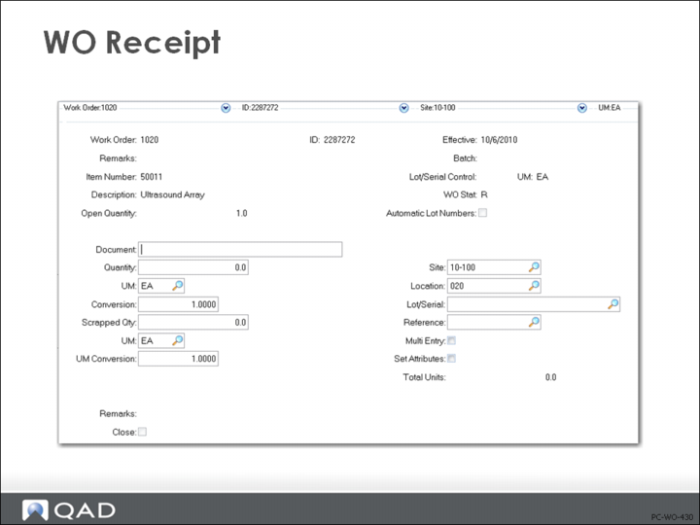
WO Receipt
Once items have passed through all of the manufacturing operations, the finished units are received into stock either by using Work Order Receipt (16.11) or Work Order Receipt Backflush (16.12).
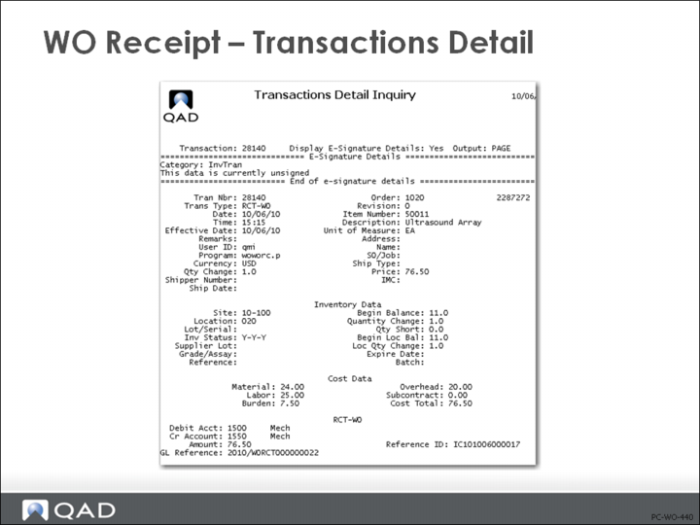
WO Receipt: Transactions Detail
Work order receipt generates two GL transactions.
• First, it increases Inventory (debit) and decreases WIP (credit) for the total standard GL cost (including overhead) of the finished item at that site.
• We removed the total standard cost of the item from WIP, including this-level overhead. But this-level overhead was not posted to WIP, so if we stopped here, our subsequent variance calculations would be incorrect. So, in a second GL transaction, this-level Overhead amount is put back into WIP (debit) and absorbed by posting it to the Overhead Applied account (credit). This ensures that usage and method variances are not created for overhead amounts.
As with other transactions, for ease of audit, the GL transaction is identified as a type IC with the description set to RCT-WO followed by the work order number. The corresponding inventory transaction is identified as type RCT-WO as well.
Note: Finished items can be received into a site other than the work order site. When this happens, the system still processes the receipt into the work order site. Then it processes an inventory transfer.
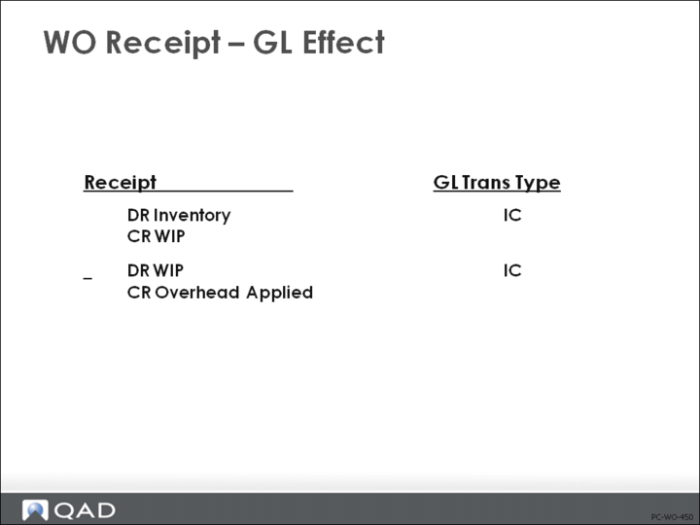
Work Order Receipt: GL Effect
The default general ledger entry:
• Debits Inventory
• Credits WIP
• Debits WIP
• Credits Overhead Applied
Work Order Receipt: Reject Costing
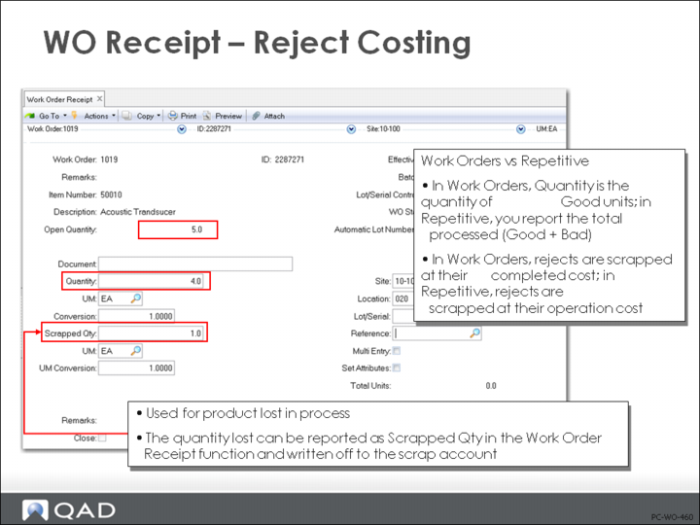
The following pages provide a brief review of “reject” costing and “loss” costing (yield percent) as they pertain to Work Order Receipt (16.11). These concepts were discussed in detail in Training Guide: Product Costing.
In reject costing, you can report scrap in Work Order Receipt (16.21), shown in the figure above.
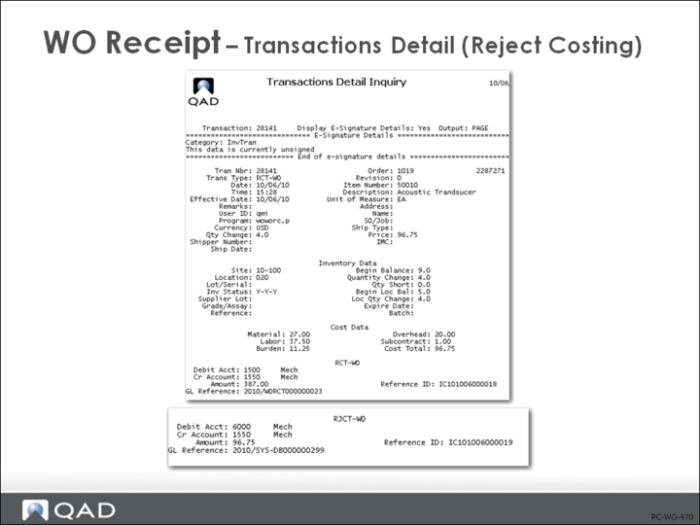
Transactions Detail: Reject Costing
• Upon completion of production, Inventory is debited the actual quantity of good units (standard quantity - scrapped quantity) × GL cost (see RCT-WO in figure above)
(Qty Complete - Scrapped Qty) * GL Cost
(5-1) * 96.75 = 387.00
• Scrapping is booked by crediting for the number of scrapped units ∗ (GL cost - overhead), and debiting the Scrap account for the same amount (see RJCT-WO in figure above)
Number of Scrapped Units ∗ (GL Cost - Overhead)
1 * (96.75- 0) = 96.75
Work Order Receipt: Loss Costing
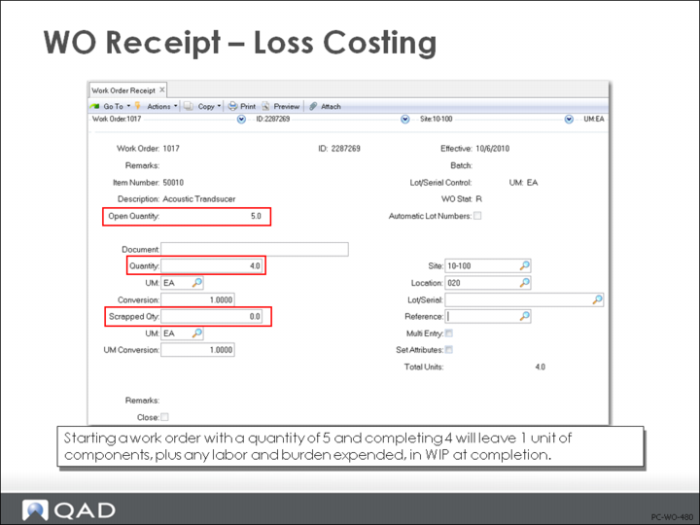
In loss costing (yield%), a standard yield factor has been added to the item such that the standard yield cost is built into the cost of each unit. In this case when you complete more units or fewer units than standard quantity, you do not report scrap at work order receipt. See Training Guide: Product Costing for a detailed discussion of Loss Costing (yield%).
The Work Order Accounting Close (16.10) calculates the usage variances.