Work Order Cost Report
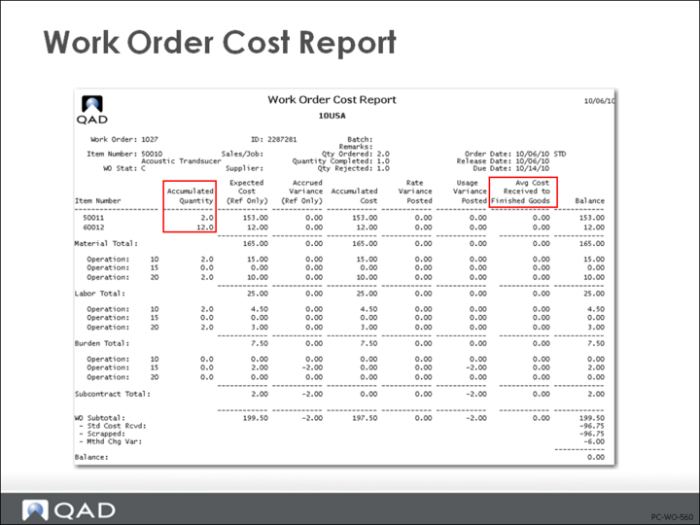
The Work Order Cost Report (16.3.4) is designed for accountants and managers who need to analyze the costs and variances associated with work orders. This report is normally used for reporting closed work orders. It identifies work order costs, grouping them into five categories: material, labor, burden, subcontract, and method change.
• Material costs are supported by data from inventory transactions for work order components
• Labor, burden, and subcontract costs are supported by transactions for work order operations
Note: If this report is run for work orders before they have been processed by Work Order Accounting Close (16.21), the variances calculated for those work orders might be incomplete.
Detailed Discussion of the Work Order Cost Report
On the following pages, the calculations behind the numbers are provided by column (expected cost, accrued variance, accumulated cost, rate variance posted, usage variance posted) and by category (material, labor, burden, subcontract, method variance).
First, though, three headings—accumulated quantity, average cost received, and balance—are covered more generally rather than by category.
Note: Work Order Cost Report (16.3.4) does not detail overhead costs.
Accumulated Quantity, Average Cost, Balance
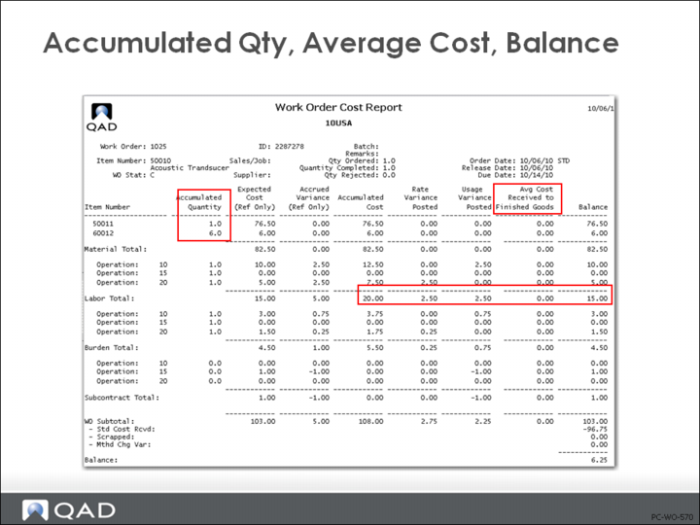
For Material, Accumulated Quantity is the actual quantity of components issued to this work order or parent items processed by operation. For Labor and Burden, Accumulated Quantity represents the quantity reported complete in Shop Floor Control.
Average Cost Received to Finished Goods
Average Cost Received to Finished Goods is only used when the costing method for the GL cost set is average. This covered in detail in the Average Costing class.
Balance
Balance is the accumulated cost minus the rate and usage variances.