Expected Cost: Subcontract
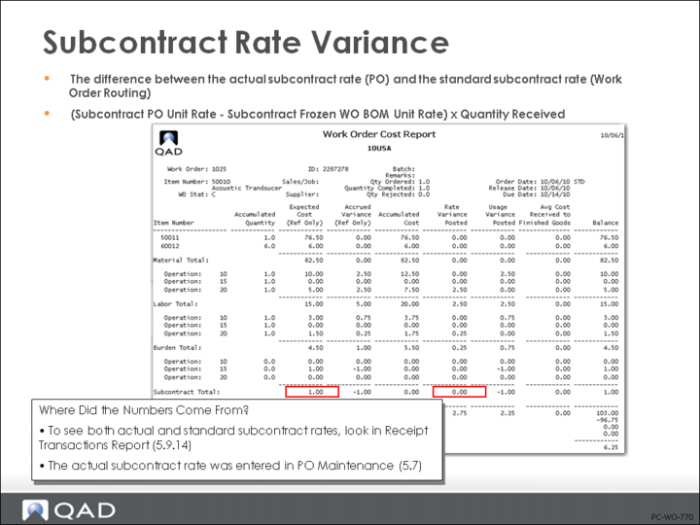
In this example the expected cost is 1.00 but there is no purchase order linked to the work order to receive the units back into WIP; hence, the -1.00 subcontract variance.
Subcontract is similar to material in the way that it is handled.
• The Accumulated Quantity is the quantity received on the purchase order
• The Expected Cost for subcontract is the quantity completed plus rejects multiplied by the subcontract cost from the routing operation (see figure above)
• The Accrued Variance is the variance the system has already recognized. It should be equal to the total of the rate variance posted and the usage variance posted columns.
• Accumulated cost is the actual purchase order cost multiplied by the quantity received
Rate Variance Posted: Subcontract
In this example; had there been a purchase order, with a none standard cost it would have generated a purchase price variance.
The Subcontract Rate Variance is the actual purchase order cost minus the subcontract cost from the routing multiplied by the quantity received. It is calculated at the point of receipt (see figure above).
(Subcontract PO Unit Cost - Subcontract Frozen WO BOM Unit Cost) * Qty Received
Usage Variance Posted: Subcontract
The Usage Variance for subcontract is the difference between the quantity received on the purchase order and the quantity completed plus rejected multiplied by the subcontract cost from the router. It is calculated at accounting close.
This can occur if the vendor has quality problems and some units are damaged or destroyed in their process
[Qty Received - (Op Qty Completed + Op Qty Rejected)] * Subcontract Frozen WO BOM Unit Cost
Standard Cost Received
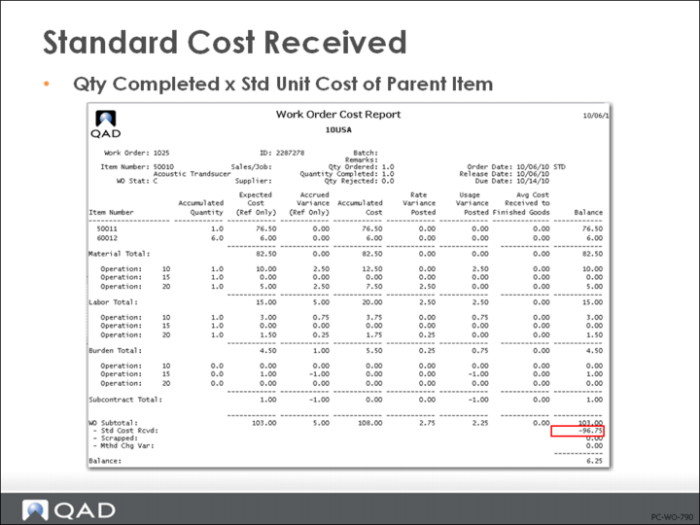
The Standard Cost Received is the quantity completed multiplied by the standard cost of the parent in effect at the point of receipt.
Scrapped amount is the quantity rejected multiplied by the GL Standard cost of parent item at the point of receipt.
Method Change Variance
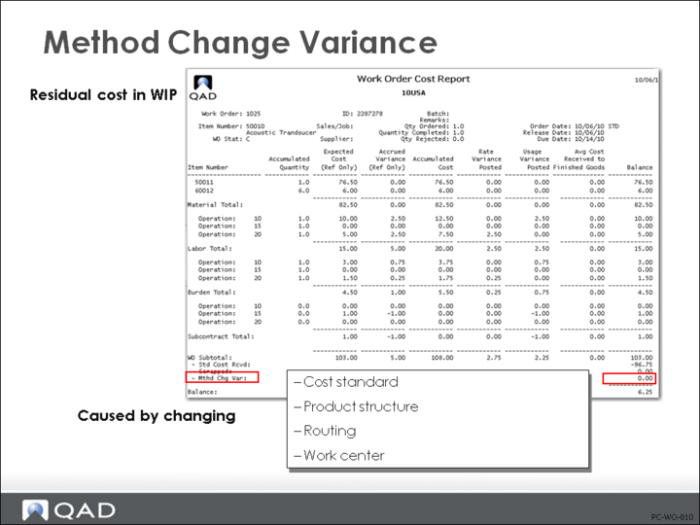
Method Change Variance is the residual cost in work in process. A residual work in process is caused by changing the cost standard, product structure, routing, or work center.
• If roll-ups are not performed after a change, the resultant differential in costs will produce a method change variance
• If the work order is in process at the time of the roll-up, a revaluation of work in process might be required
• Work orders that are not released or closed do not need to be revalued
• Using an alternate bill of material or routing will result in a Method Change Variance, unless the cost of the alternate is equal to the primary bill of material and routing that was the basis for the standard cost
• Direct updates to values in the WO BOM/Routing, which control variance calculation, like frozen quantity per, will result in a Method Change Variance
• If setup time is used and the Qty Received-plus-Qty Rejected amount on the work order varies from the Order Qty in Item Planning Data, a Method Change Variance will result
• If the Qty Complete in the Shop Floor Control reporting is different than the Qty Received-plus-Qty Rejected amount in the work order, a Method Change Variance will result