Introduction to Supply Chain Management
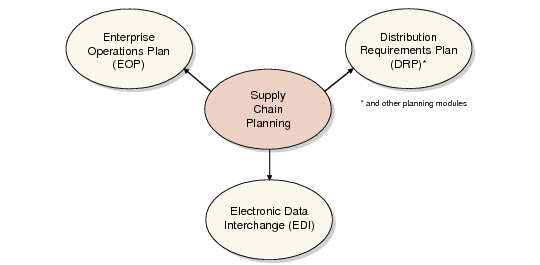
The Supply Chain Management module includes several tools that help you manage and schedule key parts of your enterprise.
Supply Chain Management
Enterprise Operations PlanUse Enterprise Operations Plan (EOP) to balance supply and demand and reduce inventory levels across the enterprise by consolidating data from multiple sites within domains in a single database and across multiple connected databases. The system determines whether database switching is needed based on the domain associated with the site in Site Maintenance (1.1.13).
EOP helps planners establish global inventory and production levels to satisfy sales forecasts while meeting objectives for profitability, productivity, inventory and lead time reductions, and customer service.
Distribution Requirements PlanningUse Distributions Requirements Plan (DRP) to manage supply and demand between sites within a domain, between domains in a single database, or between sites in domains in different databases. DRP calculates item requirements at a site and generates DRP orders at the designated supply sites. DRP orders provide intersite demand to MRP at the supply site. DRP shipments manage the transfer of material between sites, with appropriate inventory accounting and visibility of orders in transit.
To plan by product line rather than individual item, use Product Line Plan. You can plan shipments, production, inventory, backlogs, and gross margins—all measured by overall sales and cost to ensure that the plan meets all the financial needs of the business.
Use Resource Plan to check resource loads for both the product line plan and the master schedule. Resource checking is a necessary step for validating the plans and master schedules before submitting them to MRP for detailed planning.
Electronic Data Interchange (EDI)
EDI is an important tool in supply chain management. You can use it to import and export standard business transactions between your company and its customers and suppliers using your e-mail system or network connections.
EDI eCommerce is a globally deployable EDI solution that provides EDI with reduced installation and support requirements. EDI eCommerce processes international EDI document standards with most major third-party EDI communications or translation software—referred to collectively as EC subsystems—currently on the market.
Many different modules in QAD Enterprise Applications use interoperability features provided through EDI eCommerce. For this reason, EDI is described in its own guide. See User Guide: QAD EDI eCommerce for details.