Enterprise Operations Plan
This chapter introduces general concepts associated with operations planning. Then, it describes how the Enterprise Operations Plan module works and how you use it.
Introduction to Operations PlanningDescribes some of the basic principles and uses of Operations Plan.
Operations Planning ExampleGives an example of how Operations Plan is used to streamline operations.
Module OverviewDescribes some of the features of Operations Plan.
Introduction to Operations Planning
Large manufacturing companies normally have multiple sites. Each site handles at least one of the following activities.
• Sales
• Inventory storage and distribution
• Production
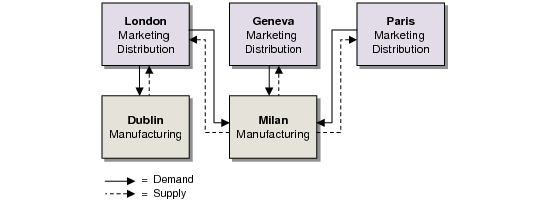
Example: A company has five sites, as shown in
Example of Organization Structure. The headquarters is in London. Four additional sites are in Geneva, Paris, Dublin, and Milan.
Example of Organization Structure
Within a site, it is relatively easy to balance sales forecasts, inventory, and capacity. However, it is much harder to do this between sites. For example, Geneva often has inventory shortages, but Paris has surpluses. Also, Milan incurs high overtime costs even though Dublin has ample production capacity.
To control inventory levels and balance resources among sites, many manufacturers use supply chain management techniques such as:
• Setting up focused factories dedicated to specific manufacturing activities
• Consolidating purchasing across sites
• Defining target inventory coverage levels globally instead of by site
These techniques help. But without a central production planning tool, balancing supply and demand between sites in the supply chain is still a difficult task.
Operations planning is a strategic and tactical production planning tool designed to do exactly this. It is especially useful in high-volume, make-to-stock companies.
As a strategic tool, you can use operations planning to:
• Project long-term labor, equipment, and cash needs.
• Develop long-term material procurement plans for negotiations with major suppliers.
As a tactical tool, you can use operations planning to:
• Optimize target inventory and production levels throughout the enterprise.
• Identify variances between planned and actual performance.
• Develop schedules for sites and production lines.
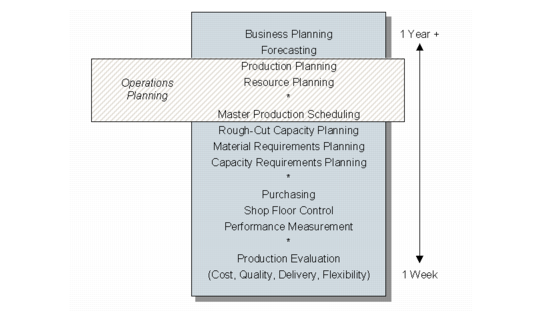
Enterprise resource planning (ERP) is an information system for planning the company-wide resources needed to take, make, ship, and account for customer orders. In companies that use ERP, operations planning is the key link between long-term business planning and medium- to short-term planning and execution activities (
Operations Planning and ERP).
Operations Planning and ERP
Operations planning calculates target inventory levels that support company objectives for profitability, inventory and lead time reductions, customer service, and so on. It also calculates the corresponding production demands. These demands eventually pass into production, purchasing, and material requirements planning (MRP).
The Enterprise Operations Plan module closely parallels the classic APICS model for sales and operations planning. However, it is superior in that it generates firm planned work orders that can replace master schedule orders. To prevent duplications, do not use the Forecast/Master Plan module for item-sites already included in operations planning.
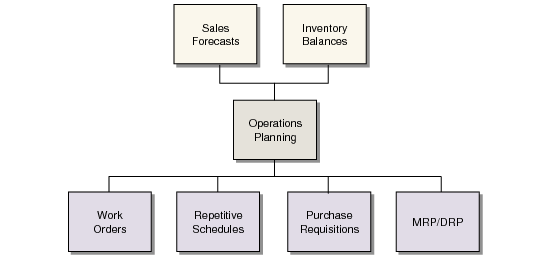
Operations Plan Data Flow summarizes how operations planning transforms data. Operations planning calculates target inventory levels based on upcoming sales forecasts. It also calculates production demands required for target inventory levels. For medium- to short-term planning, it nets these production demands against on-hand inventory balances.
Operations Plan Data Flow
Operations planning transforms production demands into firm planned work orders, repetitive schedules, or purchase requisitions. It also passes these demands into MRP/DRP, which calculates the component requirements.
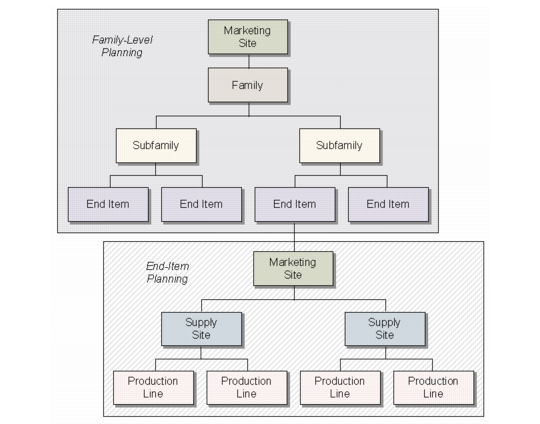
Operations planning includes two major planning levels:
• Family-level planning. High-volume, make-to-stock companies frequently have a wide variety of similar items that differ only by size, color, packaging, or other minor characteristic. To simplify long-term business planning, these companies forecast and plan production by product family.
• End-item planning. In the medium to short term, companies forecast and plan production for end items.
Planning Levels summarizes the relationships between the two levels.
Planning Levels