Defining Family Hierarchies
For operations planning, the family hierarchy defines several things:
• Nature of demand relationships for a product family
• End items and subfamilies in the family, and the percentage of total family sales forecast contributed by each
• Marketing sites that generate sales forecasts
Family hierarchies resemble product structures. The hierarchy consists of a parent family item and one or more subfamilies. Subfamilies can be either lower-level hierarchies or end items. Subfamilies in the lowest level must be end items. Within a hierarchy, each subfamily contributes a percentage of the total sales forecast for the family item.
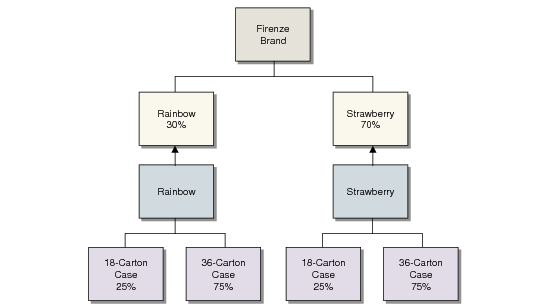
Example: The Firenze brand is a top-level family with its marketing site in London. The Firenze family has two subfamilies, Rainbow flavor (30% of demand) and Strawberry flavor (70% of demand). Each subfamily is also a lower-level hierarchy with two end items, an 18-carton case and a 36-carton case.
Family Hierarchies
You can set up flexible hierarchies that mirror your company’s planning groups. For example, you can set up hierarchies by buyer/planner group, brand, flavor, color, distribution channel, sales region, production line, and so on. The same subfamily or end item can belong to multiple families. Marketing may plan items by geographic region or brand name, but production plans by similarity of manufacturing process.
Subfamily relationships and percentages usually vary by marketing site and planning year. Typically, you set up multiple sets of subfamily relationships for each family hierarchy.
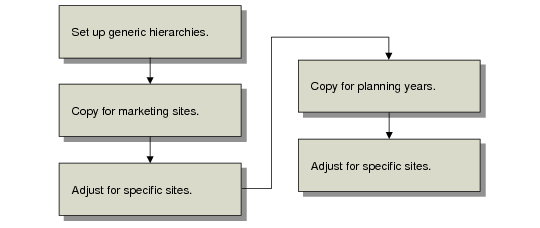
Hierarchy Setup Work Flow summarizes the setup work flow.
Hierarchy Setup Work Flow