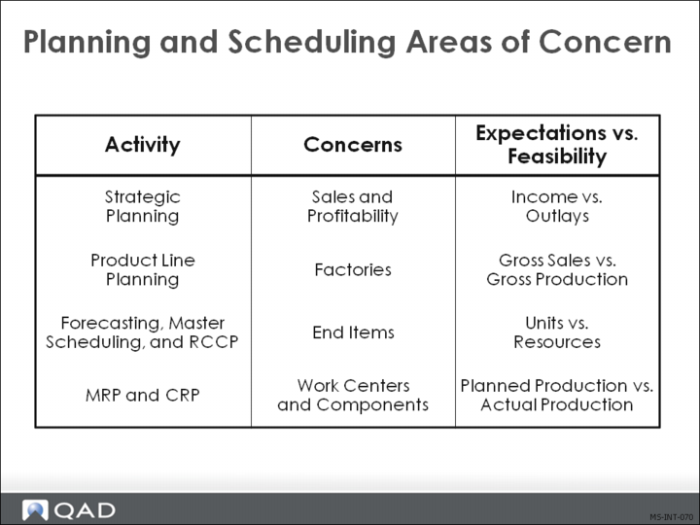
Planning and Scheduling Areas of Concern
Master Schedule
The objective of the master schedule is to:
• Enable implementation of the production plan
• Manage demand and resources
• Keep priorities in line
• Plan resources and capacity requirements
• Ensure good communication between marketing and manufacturing
• Minimize inventory and maximize resource usage
Rough-Cut Capacity Planning (RCCP)
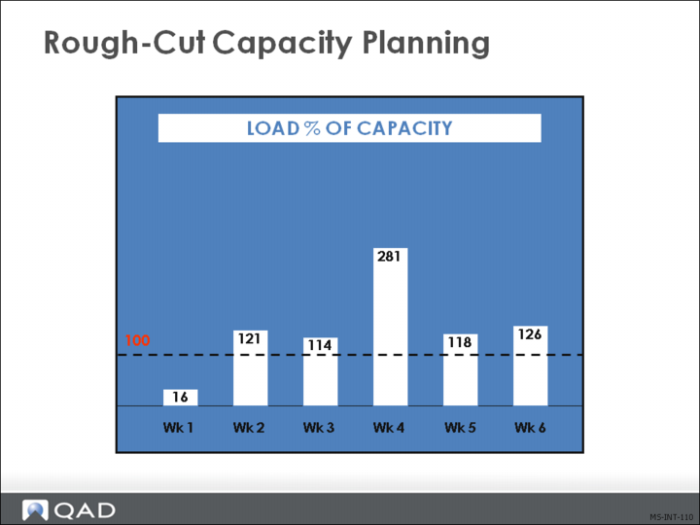
RCCP provides an early warning for schedule problems:
• Provides mid- to long-range capacity planning
• Identifies key material shortages
• Determines labor shortages for critical skills
• Validates the production plan and assists in developing a valid master schedule
• Helps stabilize MRP
• Checks capacity at critical work centers, not at each work center
• A work center is a specific production area with one or more resources with identical capabilities. It can be considered as one unit for CRP and detailed scheduling
RCCP Compared to CRP
CRP differs from RCCP by taking inventories, orders, lot sizes, and lead time offsets into account. Even though RCCP indicates that sufficient capacity exists to execute the master schedule, CRP may show that capacity is insufficient during specific time periods. CRP:
• Provides the load by work center (detailed capacity)
• Offers detailed work center planning
• Indicates if capacity is sufficient to execute the master schedule
• Department and work center levels
• Explodes the routings and processes for MRP planned and firm planned orders
• Updates or creates work order routings
• Determines the start/due dates for each operation using:
• Work center and shop calendars
• Back scheduling (start date of the last operation is the due date of the previous operation)
Coordination of planning activities at different levels within a corporation is essential to meeting a company’s overall goals. At the plant level, effective coordination of plans will result in:
• Increased throughput
• Decreased inventory
• Reduced operational expense
Master Schedule
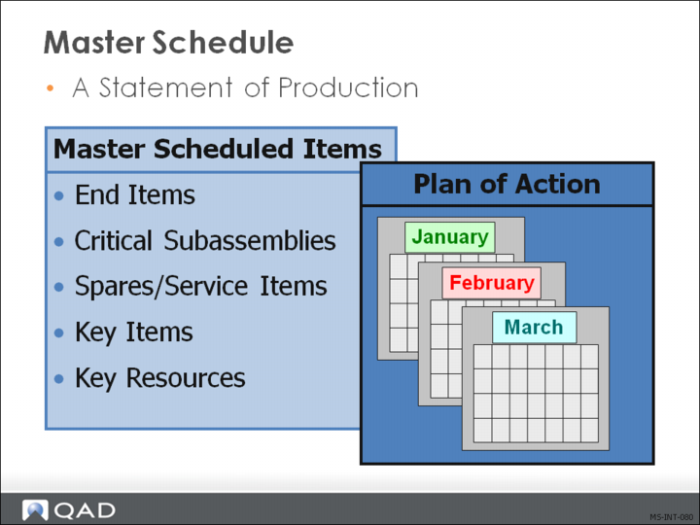
A master schedule is a statement of production set by the master scheduler. It is the key plan that drives results on the factory floor. Developed by site and item, it provides primary input to MRP.
A valid master schedule provides the foundation for effective:
• Customer delivery
• Use of plant capacity
• Implementation of the production plan
• Trade-offs between the marketing and manufacturing organizations
Master scheduled items require human judgment to evaluate the implications for capacity, material, cost, and customer service.
Benefits of a Master Schedule
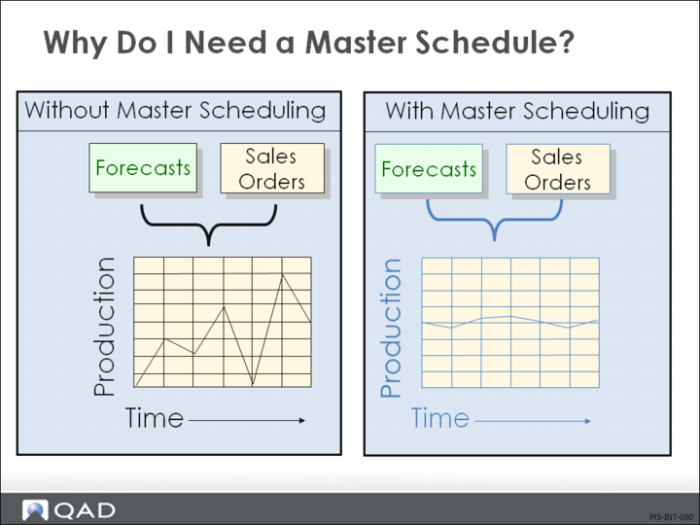
The master schedule acts as a buffer between sales and forecast fluctuations and production. In QAD Enterprise Applications forecasts, along with any confirmed sales orders, are used as input to the master schedule and MRP.
Forecasts and sales orders establish a source of independent demand and are used in calculating the gross requirements for an item. For example, if 100 units per week are forecast, MRP will plan orders to cover this forecast.
As long as actual sales orders due in any period are less than or equal to the forecast in that week, the orders already planned by MRP will cover the requirements. However, if 100 units have been forecast but there are sales orders for 150 units, MRP needs to plan an extra 50 units.
What MRP will plan in any period is the amount of the sales orders plus any net remaining forecast amount.
Independent Demand
Demand for an item that is unrelated to demand for other products
• Finished goods
• Service parts
• End items
• Spare parts
Dependent Demand
Directly related to or derived from the bill of material structure for other items or end products
• Components
• Raw materials
Planning Issues
Nervousness
Fluctuations in MRP would result if forecasts and sales orders were modified or canceled
Overstated Demand
Total demand would be overstated if the forecast quantity were added to the sales order quantity. These issues are resolved in QAD Enterprise Applications by:
• Use and application of forecast consumption rules
• Creation of a master schedule that:
• Anticipates sales
• Stabilizes production
• Calculates gross requirements
Note: Available-to-promise (ATP) in Master Schedule Summary Inquiry (22.18) gives visibility to customer service.
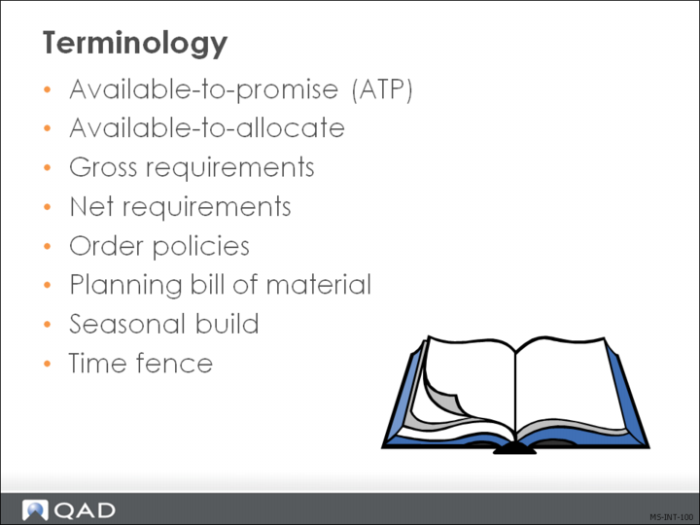
Terminology
Available-to-promise (ATP)
ATP is the uncommitted portion of inventory or planned production. It equals the Master Schedule less customer orders due in the period and all subsequent periods before the next Master Schedule scheduled receipt.
Available-to-allocate
Based on the calculation specified in Sales Order Control. The quantity on hand less what has already been promised to other orders
• Sales orders due to ship in the very near future
• Manufacturing orders that have been released to the shop floor
Note: Future requirements or sources of supply are not considered by this calculation.
Gross Requirements
A gross requirement is the total of independent and dependent demand for a component before the netting of on-hand inventory and scheduled receipts.
Net Requirements
In MRP, the net requirements for a part or an assembly are derived as a result of applying gross requirements and allocations against:
• Inventory on hand
• Scheduled receipts
• Safety stock
Net requirements, lot-sized and offset for lead time, become planned orders.
Order Policies
Order policies are sets of procedures for determining the lot size and other parameters related to an order.
Planning Bill of Material
A planning bill of material is an artificial grouping of items or events in bill-of-material format. It is used to facilitate master scheduling and material planning.
Seasonal Build
An item’s inventory build-up prior to expected demand, for example:
• Christmas
• Fall
• Winter
• Spring
Time Fence
A policy or guideline established to note where various restrictions or changes in operating procedures take place.
For example, changes to the master schedule can be accomplished easily beyond the cumulative lead time, while changes inside the cumulative lead time become increasingly more difficult (to a point where changes should be resisted). Time fences can be used to define these points.
Rough-Cut Capacity Planning (RCCP)
The rough-cut capacity plan provides a tool for:
• Careful evaluation of changes to the master schedule and their impact on material and capacity
• Rough evaluation of potential capacity problems
• Proper balancing of customer needs and manufacturing needs
• Effective stabilization of MRP
Master Schedule and RCCP Uses
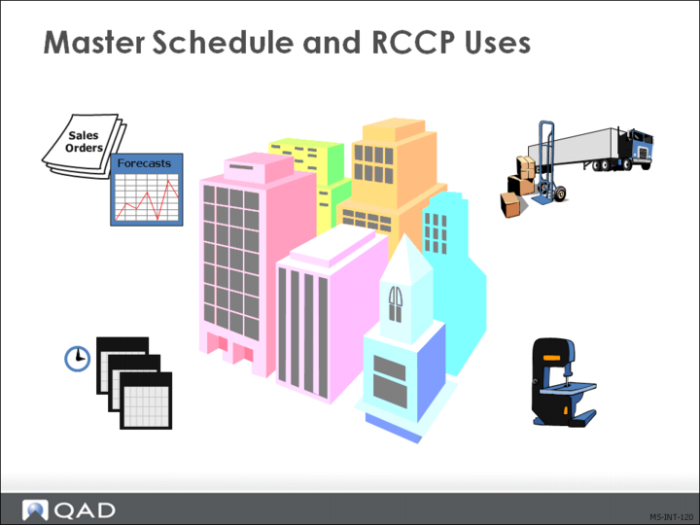
Normal uses of a master schedule include driving RCCP and MRP and planning future production.
• The production plan broken down into buildable units with specific dates for completion
• The production plan will be met if the master schedule is developed to support it
RCCP provides a high-level planning process for key resources that may constrain the execution of the manufacturing plan.
Master scheduling and RCCP should remove most of the capacity constraints before MRP is run.
Course Objectives
These are the course learning objectives for each chapter in this training guide.