Multilevel Master Schedule
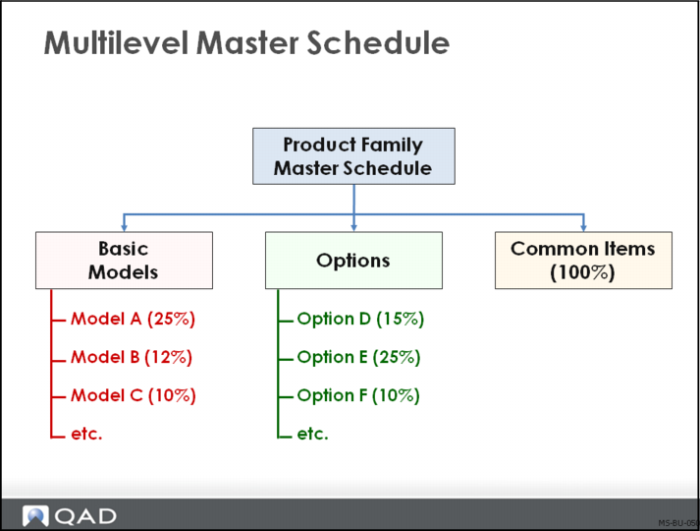
Multilevel master scheduling is an approach where a planning bill of material is used to master schedule an end product or family, along with selected options and accessories.
Production Forecast in QAD Enterprise Applications
Definition
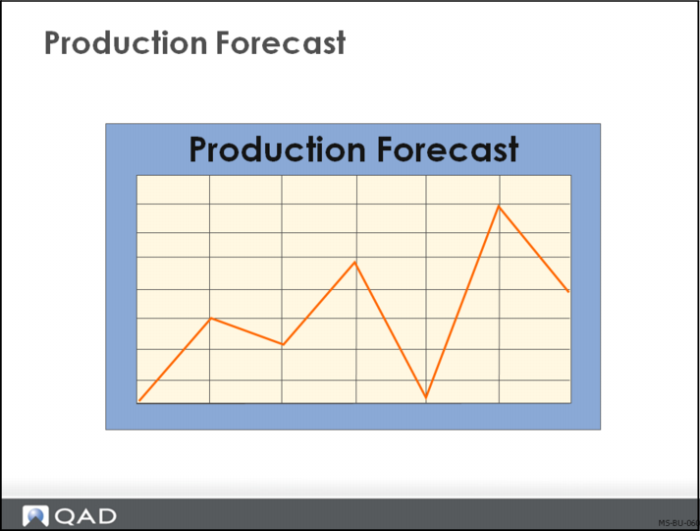
A production forecast is a system-calculated forecast resulting from a planning bill of material and occurs when using multilevel master scheduling. It estimates the projected level of customer demand for a feature (options, accessories) of a make-to-order or an assemble-to-order product.
When you establish planning bills and forecast and master schedule at the family-item level, the system automatically calculates the derived demand for components of the family or upper-level item. These calculations are based on the available-to-promise quantities for the family-level item and the quantity per and forecast percentage for the components of that family item.
Why Consider?
As forecast for the family-level item is consumed, the available-to-promise quantity for that item changes, resulting in revised calculations for the production forecast the next time MRP is run.
Functionality in QAD Enterprise Applications
• The production forecast derives from:
• The master schedule and forecast percentage specified in the planning bill
• Production forecast amounts:
• Display in master schedule reports and inquiries
• Contribute to the total demand that MRP regards as input
• Production forecasts are only created for components with structure codes:
• (P)lanning
• (O)ption
Setup Implications
• Production forecasts only consume at the higher level
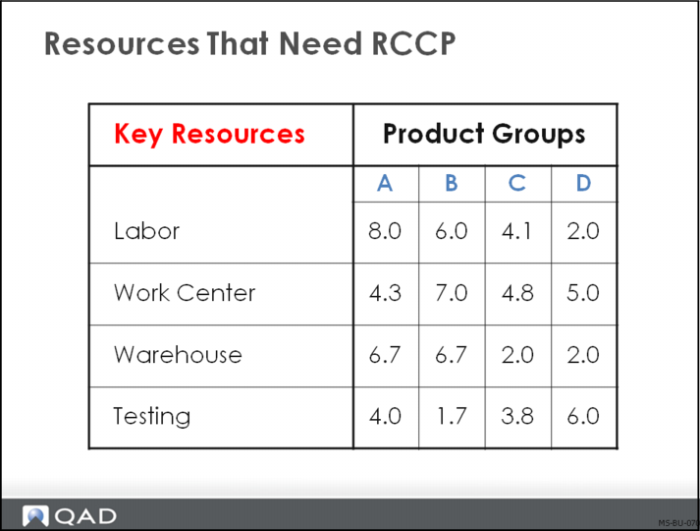
Determine What Resources Need RCCP
• Develop a resource profile to identify critical resources
Seasonal Build Requirements
Definition
Seasonal demand items require a buildup of an item's inventory prior to its expected demand.
Why Consider?
Although you could enter master schedule orders to adjust to seasonal requirements, identifying a demand as seasonal build prevents MRP from issuing action messages to cancel or delay orders for those items whose demand is not yet apparent.
Functionality in QAD Enterprise Applications
In QAD Enterprise Applications, seasonal build inventory is entered into the system using Seasonal Build Maintenance (22.9).
Setup Implications
Setting inventory to zero enables the items to be promised.
MRP Horizon
Definition
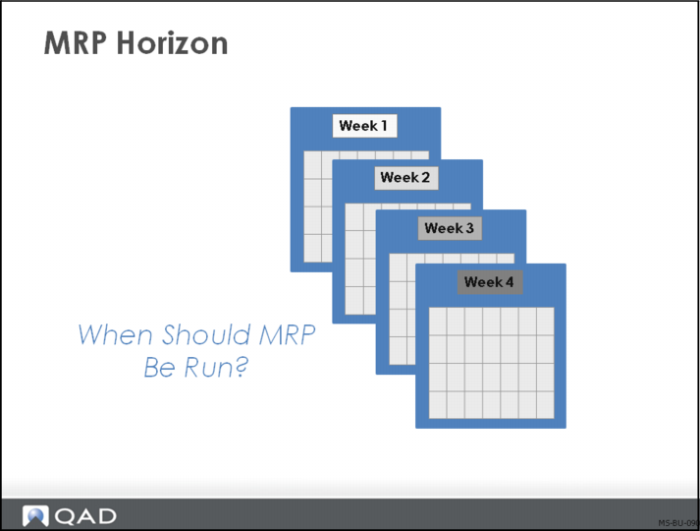
• Amount of time the master schedule extends into the future
Why Consider?
MRP only processes material requirements within this horizon and ignores activity outside this horizon. You need to allow time for:
• Ordering components
• Capacity changes of primary work centers or key suppliers
• Minimum cumulative lead time
Functionality in QAD Enterprise Applications
• Set the planning horizon in MRP Control
• Ensure that all items are replanned by running the Regenerate Materials Plan (23.2)
Since MRP ignores activity outside of the planning horizon, make the horizon at least one day longer than the longest cumulative lead time (30 days is recommended as a minimum). Use the Cumulative Lead Time Report (13.12.16) or the Lead Time Picture Report (13.12.17) to find the longest cumulative lead time in your database.
Setup Implications
• If the horizon is changed, items are not automatically flagged for net change replanning, run Regenerate Materials Plan (23.2)