Time Fence
Definition
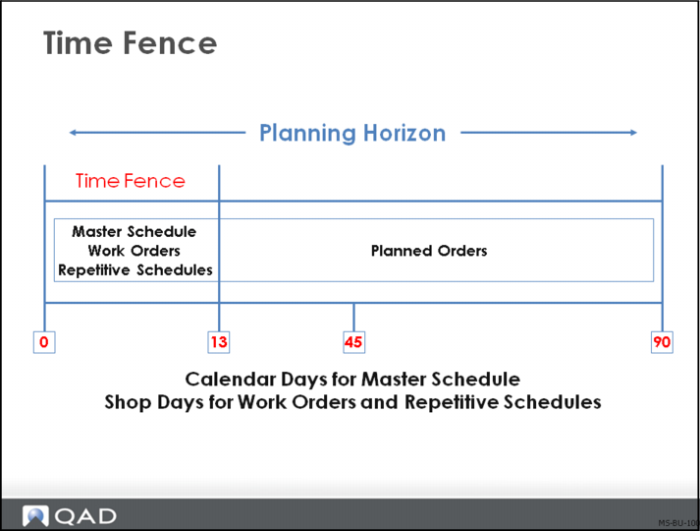
The number of calendar days inside of which MRP should not automatically make changes. To manually control the schedule for a period of time set the time fence to nn days and MRP:
• Adds the number of days time fence to the system date
• Does not create any planned orders within this time period
Note: Time fence is most often used with master scheduled items.
Why Consider?
The time fence gives the master scheduler manual control within the time fence period. MRP is allowed to create planned orders automatically outside of the time fence.
Functionality in QAD Enterprise Applications
The value entered in Item Master Maintenance (1.4.1) is used as the default for all sites. It may be changed manually for any site as needed.
Setup Implications
The time fence designates a period of calendar days from the system date inside of which MRP will not create or change existing planned orders. Order action messages, however, will be generated if necessary. MRP will provide action messages over the near-term horizon.
Features and Options
Definition
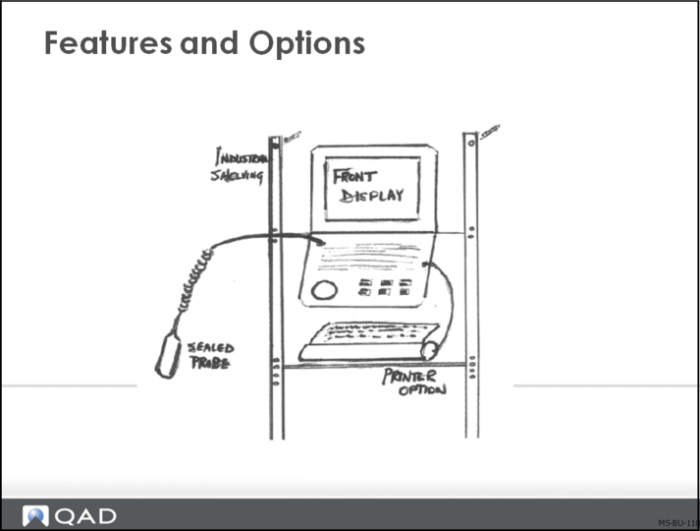
Components of the family item in the planning bill can be either the actual manufactured items or configured products, or item groups representing common components or selected features and options.
Why Consider?
Directly forecast the family/models and forecast options by percent of family.
Functionality in QAD Enterprise Applications
The top-level item of a multilevel master schedule product structure represents the family of buildable products that can be configured from a set of available models and options.
Setup Implications
For master scheduling purposes, it is not possible to forecast accurately the detailed combinations of potential products that can be manufactured and sold. Forecasting at the family-item level or the option-item level is accurate and can drive the master scheduling process.
Production Constraints
Definition
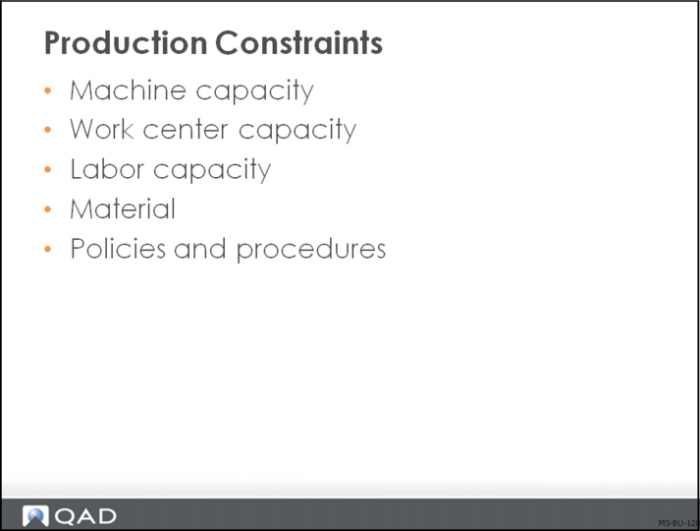
A production constraint is any element or factor that prevents a system from achieving a higher level of performance with respect to its goal.
A priority item plan will help resolve production issues. It sets the number of priority items (end items, level 1 items, service parts, and so forth) that are going to be produced and plans the schedule to produce them. The check on this plan is the availability of critical resources.
If you want to make 150 items next week but your machine only makes 125 in a week, you cannot meet the plan. A component plan determines which work centers and components will be used to meet the plan. The check determines if the work centers have the capacity to meet the schedule.
Why Consider?
A master scheduler must consider and remove potential production constraints when preparing the master schedule and rough-cut capacity plan. A constraint could be physical (machine capacity or lack of material) or managerial (policies and procedures).
Functionality in QAD Enterprise Applications
The master scheduler makes the best use item-level RCCP by considering constraints. RCCP is implemented in QAD Enterprise Applications using Item Resource Load Summary Inquiry.
Setup Implications
The master scheduler tests scheduled production quantities against available resources. This rough-cut capacity plan tests end-item production.
Summary