Report Column Group
The Financial Report Writer produces reports that can have up to 99 columns in the setup and report generation logic. However, the standard layout of the printed output has up to 16 columns predefined. If you want to create a report with more than 16 columns, add the required additional columns using the Report Resource Designer tool. You can define the number of columns, the content of each column, and the presentation details in Report Column Group Create (25.16.12.1).
See User Guide: QAD Reporting Framework for information on the Report Resource Designer tool.
When you create a column group, you can use it as part of the report master record that you create using Report Master Create. You can create as many column groups as you need. Each column group is linked to a report chart because you can specify a report analysis code as the detailed element of a column, and report analysis codes belong to a report chart.
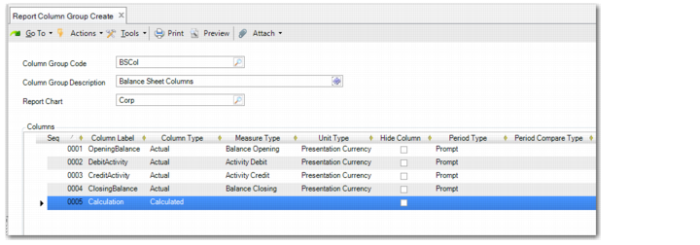
When you open Report Column Group Create from the menu, the following screen opens:
Column Group Code
Enter a maximum of 20 characters for a code to identify the column group.
Column Group Description
Enter a description of the column group. You can enter a maximum of 40 characters. You can optionally enter descriptions in more than one language. See User Guide: Introduction to QAD Enterprise Applications for more information on the Translation Option.
Report Chart
Enter a report chart code. The code must reference an existing report chart.
Grid Fields
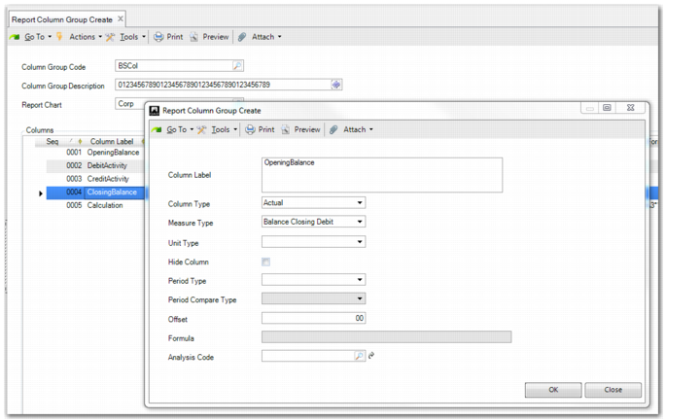
Right-click to insert rows in the grid. You can define column information on the grid line or you can double-click on the grid line and open a child window where you can define the column data. See
Report Column Group Create, Child Window.
Sequence
This field contains the column sequence number. You can specify up to 9999 columns. The first row that you create in the grid is assigned the sequence 001.
Important: You can rearrange the sequence of rows by selecting, dragging, and dropping the rows. The system re-sequences the new row order. See
Moving and Resequencing Columns.
Column Label
Specify a maximum of 20 characters for the label to print above the column on the report. You can enter plain text and use special variables as part of the text. The special variables are:
• FY#: From Year
• FP#: From Period
• TY#: To Year
• TP#: To Period
• FQ#: From Quarter
• TQ#: To Quarter. Periods are mapped to quarters using a fixed logic. Periods 1 to 3 map to Q1, periods 4 to 6 map to Q2, periods 7 to 9 map to Q3, and periods 10 to 12 map to Q4.
When you run the report, the variables are replaced by the report year and the period details you specified on the prompt page. The variables can also be replaced by the year and period, as calculated when comparing results with past GL periods.
Column Type
Specify the type of data that you want to display in this column. The options are:
• Actual: Select this option if the column will contain actuals posting data.
• Budget: Select this option if the column will contain Financials budget data. See
Financial Report Run.
• Calculated: Select this option if the column will contain a calculated value. If you select this option, you must enter the calculation formula in the Formula field.
• Forecast: Select this option if the column will contain forecast data from a Financials budget. See
Financial Report Run.
Measure Type
Specify the type of balance that you want to display in this column. You can choose from Balance Opening, Balance Opening Debit, Balance Opening Credit, Activity, Activity Debit, Activity Credit, Balance Closing, Balance Closing Debit, Balance Closing Credit, Calculated.
• The Balance Opening types provide the opening balance at the beginning of the reported period (From Year and From Period).
• The Balance Closing types provide the closing balance at the end of the reported period (To Year and To Period).
• The Activity types provide the activity during the complete reported period (From Year/Period - To Year/Period).
Unit Type
Specify the currency in which to represent the amounts in the column. The options are:
• Presentation Currency: Select this option if the report column must display amounts in the presentation currency of the report cube.
• Base Currency: Select this option if the report column must display amounts in the currency that is mapped to the presentation currency in the report cube.
If you built the cube with the base currency calculating to the presentation currency, the base currency is used.
If you built the cube with the statutory currency calculating to the presentation currency, the statutory currency is used.
• Quantity: Select this option if the report column must contain quantities posted on GL accounts defined with quantity analysis.
Hide Column
When you include columns in calculations, you may need an extra column to store an intermediate calculation result you do not want to display on a report. In this case, select the Hide Column field.
Period Type
This field indicates which period data to include in the column. There are four period types:
• Prompt
• Compare
• Quarter
• Compare Quarter
When you select Prompt, the column contains data for the year periods entered on the prompt page when running the report. For example:
• You run a report for 2013/01–2013/03. The measure type is Activity. The column contains the activity for the period 2013/01–2013/03.
• You run a report for 2013/01–2013/03. The measure type is Balance Opening. The column contains the opening balance at the beginning of 2013/01.
• You run a report for 2013/01–2013/03. The measure type is Balance Closing. The column contains the closing balance at the end of 2013/03.
When you select Compare, the column contains data from a prior GL period you want to compare with. Instead of showing the activity or balance for the report period entered on the prompt page, the program displays the balance of a previous reporting period. To define the prior period to report on, use the Compare type and Offset fields.
When you select Quarter, you can put columns with quarterly totals next to columns with monthly totals on the same report. Assuming your cube has months as periods, system logic translates the From Period entry to the corresponding quarter.
For example, period 2 belongs to quarter 1, period 8 belongs to quarter 3, and any period from 10 up to 14 belongs to Q4. The To Period entry belongs to a To Quarter in the same way. Therefore, if you run a report from period 1 to period 3, the report displays the results of Q1 in the Quarter column. However, if you run a report from period 3 to period 3, the report also displays the results of Q1 in the Quarter column. This enables you to produce a report with a column displaying last month’s figures and another column with figures from the last quarter next to it. If a cube has only four periods, the period and quarter are treated as equal.
When you select Compare Quarter, you can also put columns with quarterly totals next to the previous quarter’s totals on the same report. The number of quarters entered in the period offset is subtracted from the calculated quarter. For example, if system logic finds Q2 based on the period selected, Compare Quarter with an offset of 1 returns the figures of Q1. If the logic finds Q1, Compare Quarter with an offset of 1 gives the figures of Q4 the previous year.
Period Compare Type
When the Period Type field is set to Compare, this field lets you indicate what values to compare with. The options are:
• Report Period: Compare with a previous report period. You can go back as many periods as there are in a report year.
• Report Year: Compare with a prior report year. You can go back as many years as you want, provided that there is data for that year in the cube.
Note: The ability to compare data is only available if the report cube also spans this time frame. For that reason, it is recommended that you maintain report cubes with data that spans two report years. For example, if you maintain a cube with data from 2011–2012 and 2012–2013, you have data from the prior year to compare in the same cube.
Offset
When the Period Type field is set to Compare, this field lets you enter the number of periods or years you want to go back for the comparison. For example, for a column, you specify:
• Period Type = Compare
• Compare Type = ReportPeriod
• Offset = 3
You then run a report for 2013/01–2013/03 and the measure type is Activity. The comparing column contains the activity for the period 2012/10–2012/12. When running the report, the program goes back three report periods relative to the selected period.
Formula
If you specify Calculated in the Measure Type field, enter a calculation formula in this field. Calculations are always performed using the values from other columns or using constants. The reference to a column in the calculation is in the format letter C followed by a column number with no leading zeros; for example, C9. Component columns must be part of the same column group. This restriction is not validated when you create the column group; only when you use the tree to run a report.
You can add a calculation that references a report analysis code to a Financial Report Writer column. See
Calculations using a Report Analysis Code.
Analysis Code
This optional field allows you to specify a report analysis code, which is useful if you want to include side-by-side comparisons in the report. For example, to compare the balances of several entities, create a special report analysis code for each targeted entity and create a column for each entity that contains the corresponding analysis code. As a result, only the balances of the targeted entities are displayed in each column.
You can do make comparisons for any dimension of the COA. You can compare entities, sub-accounts, cost centers, SAFs, GL accounts, layers, and other elements side-by-side in columns. The report analysis code must belong to the chart specified in the header of the report column group.
Print negative amounts between brackets
Select this field if you want the system to display negative amounts in parentheses in this column.
Note: This field is not currently used. It is reserved for future Financial Report Writer enhancements.
Percentage sign or currency sign
If the system must display the amount in the report column with a percentage or currency sign, enter the sign here.
Note: This field is not currently used. It is reserved for future Financial Report Writer enhancements.
Report Column Group Create, Child Window