Maintaining Report Masters
The Financial Report Writer produces reports that have variable layouts. The report hierarchy is defined when you create a report tree. The report columns are defined in Report Column Group Create and these two elements can be combined in the report master record. The report master also controls a number of general report layout options.
Creating a report master record is also the last step in the setup before you can actually run a report. You can create as many report master records as you need different report layouts. The report tree and the column group components of the report master are linked to a report chart. As a result, the report master is linked to the same report chart as the report tree and column group that are part of the report master.
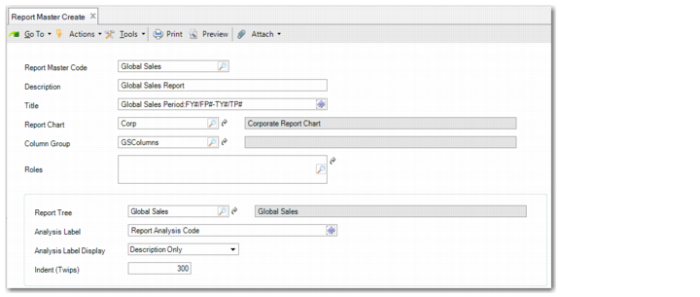
To create a report master, open Report Master Create (25.16.11.1).
Report Master Create
Report Master Code
Enter a report master code that uniquely identifies the report master record in the system.
Description
Enter a description of the report master. This description is displayed in lookup browses.
Title
Enter the title to print at the beginning of the report. The translate functionality allows you to translate the string in this field. You can enter plain text and you can also use the special variables as part of the text. These special variables are replaced on the report with the report year and period details you specify when you run the report. The special variables are:
• FY#: From Year.
• FP#: From Period.
• TY#: To Year.
• TP#: To Period.
• FQ#: From Quarter.
• TQ#: To Quarter. Periods are mapped to quarters using a fixed logic. Periods 1 to 3 map to Q1, periods 4 to 6 map to Q2, periods 7 to 9 map to Q3, and periods 10 to 12 map to Q4.
Report Chart
If you are creating a report master record, enter a report chart code. This code must relate to an existing report chart. All subsequent elements of the report master must be linked to the same report chart. The elements are the report tree, column group, and controlling report analysis code. The description of the report chart is displayed in a read-only field.
Column Group
Enter an existing column group code that is linked to the report chart specified in the report master. The column group specified here determines the column layout of the report. See
Report Column Group. The description of the column group is displayed in a read-only field.
Roles
You can secure reports so that only certain users can run them. When the Roles field is blank, you can only run a report if you have access to all the entities linked to the report. You must have permission to use the menu Financial Report Run in each entity.
Optionally, you can use the lookup to specify a role that a user must have in each of the involved entities. When you specify more than one role, a user must have only one of the roles in each involved entity.
If you do not have the permissions for entities linked to the report, but want to run the report for entities where you have permissions, create an additional filter analysis code. This code filters out the forbidden entities and uses this analysis code as a Filter Analysis Code in the Financial Report Run selection screen. You can then run the report for the allowed entities only.
Report Tree
Enter the top-level report analysis code for the report tree, also referred to as the root node. This code must be an existing report tree linked to the report chart as specified in the report master. The report tree specified here determines the printed report hierarchy structure, including all detail layout options that you can set using Financial Report Tree Import from a CSV file. The description of the report tree is displayed in a read-only field.
Analysis Label
Specify the label you want to print as the column header label above the report tree hierarchy. This label is on the left part of the layout. The string entered in this field can be translated.
Analysis Label Display
Specify whether to print the code, the description, or both for the report tree hierarchy.
• Code and Description: The code and the description of the report analysis code as used in the tree.
• Code Only: Only the report analysis code as used in the tree.
• Description Only: Only the description of the report analysis code as used in the tree.
Indent (Twips)
The report tree hierarchy on the report prints child nodes, indented relative to their parent. Use this field to specify the size of the indent in twips. Three hundred twips are approximately 0.7 cm.
Report Master Modify (25.16.11.2) enables you to modify an existing report master. However, you cannot modify the report master code or the report chart. Report Master Delete (25.16.11.4) enables you to delete a report master, and Report Master View (25.16.11.3) allows you to view a list of the report masters in the system.