Accounting for Joint Orders
All GL transactions for issues, receipts, and shop floor control transactions update the WIP account for the base process work order.
Origins of Account, Sub-Account, and Cost Center Information shows the origins of account, sub-account, and cost center information for work order transactions.
Origins of Account, Sub-Account, and Cost Center Information
|
Account/Sub-Account/Cost Center
|
Base Process
|
Co-product By-product
|
Component
|
|
Inventory
|
|
Product Line
|
Product Line
|
|
Scrap
|
|
Product Line
|
|
|
WIP
|
Work Order
|
|
|
|
Material Usage Variance
|
Work Order
|
|
|
|
Material Rate Variance
|
Work Order
|
|
|
|
Subcontract Usage Variance
|
Work Order
|
|
|
|
Mix Variance
|
|
Work Order
|
|
|
Floor Stock
|
Work Order
|
|
|
Calculating Mix Variances for Joint Orders
Mix, or yield, variance is the costed difference between the actual quantities received and scrapped for a co-product or by-product and the expected receipt quantity for that product.
For a co-product or by-product, the expected receipt quantity is not always the same as the quantity planned when the joint order set was created. For example, you may receive more or fewer co-product or by‑product items than ordered because you issued fewer components than originally planned. In this case, you will probably want the system to consider actual product receipt quantities as part of the mix variance calculation.
Mix variance calculation methods for co-products and by-products can accommodate a wide range of base process types and receipt scenarios.
To determine the mix variance amount for a co-product or by-product work order, the system first calculates the expected receipt quantity for the order by multiplying the following two factors:
• The ratio between the co-product or by-product quantity ordered and the base process quantity ordered, expressed as a decimal value
• The base process quantity complete, which is variable and calculated based on the quantity complete method specified in the co/by-product structure
The base process quantity complete can be based on any one of the following, depending on the setting of Quantity Complete Method in Process/Formula Maintenance (15.18) or Co/By-Product Maintenance (15.12.1):
• The total quantity complete for all co-products and by-products in the joint order set (SUM)
• The total quantity complete for co-products only (SUMC)
• The base process quantity required to complete the co-product that consumed the greatest amount of the base process in proportion to the quantity ordered (MAX)
• The base process quantity required to complete the co-product that consumed the least amount of the base process in proportion to the quantity ordered (MIN)
• The quantity ordered on the base process order (ORD)
Note: When method SUM or SUMC is used, the system converts co‑product or by-product quantities to the base process unit of measure before adding them together.
The following equation is used to calculate the expected receipt quantity for a co-product or by-product:
Expected Receipt Quantity = Base Process Quantity Complete * (Co-product or By-product Qty Ordered / Base Process Quantity Ordered)
To calculate the mix variance amount for a co-product or by-product work order, the system compares the actual work order receipt quantity with what the system expected to receive based on the base process quantity complete. The equation used to calculate mix variance is as follows:
Mix Variance = (Expected Receipt Quantity – Co/By-product Actual Receipt Qty) * Co/By-product Unit Cost
The base process quantity complete, as determined by the quantity complete method, is also used in place of the work order quantity when calculating material and labor usage variances for a base process work order.
For more information on work order variances, see
Work Order Accounting Close.
The following examples illustrate how the setting of Quantity Complete Method on the co/by-product structure determines how mix variances are calculated for co-products and by-product work orders. Each example uses the sample co/by-product structure shown in
Sample Co/By-product Structure.
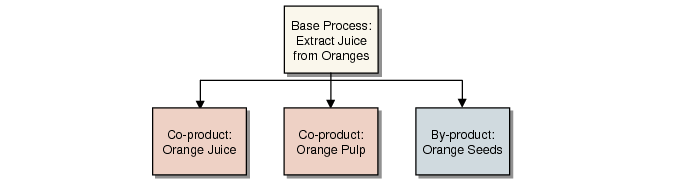
Sample Co/By-product Structure
The sample base process has only one component: oranges. Base process work orders have a batch quantity of 100 base-process units and the expected yield quantities per batch (order quantities) shown in
Sample Co-product and By-product Order Quantities.
Sample Co-product and By-product Order Quantities
Co/By-product | Order Quantity |
Orange Juice (Co-product) | 50 liters |
Pulp (Co-product) | 30 kg |
Seeds (By-product) | 10 kg |
The base process unit of measure (UM) is KG (kilograms). For the first co-product, orange juice, the conversion factor between the base process and co-product units of measure is 1.2 liters (LT) per 1.0 KG.
Co-product and by-product costs are shown in
Sample Co-product and By-product Costs.
Sample Co-product and By-product Costs
Co/By-product | Standard Cost |
Orange Juice | $1.50 per LT |
Pulp | $0.50 per KG |
Seeds | $0.60 per KG |
For a given joint order set, actual co-product and by-product yields are as shown in
Sample Co-product and By-product Yields.
Sample Co-product and By-product Yields
Order ID | Product | Qty Complete | Qty Rejected |
1001 | Orange Juice | 55 liters | 1 liter |
1002 | Pulp | 25 kg | 3 kg |
1003 | Seeds | 15 kg | 0 kg |
Note: Although a single example is used to illustrate all five quantity complete methods, some methods may be more appropriate to particular process environments than others.
To display numeric values in the following examples, these conventions are used:
• Currency amounts are rounded to the nearest hundreth.
• Non-currency decimal values are rounded to the nearest ten‑thousandth.
Summarize
If Quantity Complete Method is set to SUM in the co/by-product structure, the following equation is used to determine the base process quantity complete:
Base Process Quantity Complete = [(Co-prod1 Quantity Complete + Scrap) * Base Process UM Conversion Factor] + (Co-prod2 Quantity Complete + Scrap) + (By-prod1 Quantity Complete + Scrap)
Base Process Quantity Complete = [(55 + 1) * 1.2] + (25 + 3) + (15 + 0) = (56 * 1.2) + 28 + 15 = 67.2 + 28 + 15 = 110.2
In this case, expected co-product and by-product order receipt quantities are calculated as shown in
Sample Expected Receipt Calculations for SUM Method.
Sample Expected Receipt Calculations for SUM Method
Order ID | Product | Expected Receipt Calculation |
1001 | Orange Juice | 110.2 * (50 / 100) = 110.2 * 0.5 = 55.1 |
1002 | Pulp | 110.2 * (30 / 100) = 110.2 * 0.3 = 33.06 |
1003 | Seeds | 110.2 * (10 / 100) = 110.2 * 0.1 = 11.02 |
Based on these expected quantities, mix variance calculations are as shown in
Sample Mix Variance Calculations for SUM Method.
Sample Mix Variance Calculations for SUM Method
Order ID | Product | Mix Variance Calculation |
1001 | Orange Juice | (55.1 – 56) * $1.50 = 0.9 * $1.50 = –$1.35 |
1002 | Pulp | (33.06 – 28) * $0.50 = 5.06 * $0.50 = $2.53 |
1003 | Seeds | (11.02 – 15) * $0.60 = –3.98 * $0.60 = –$2.39 |
The Summarize method may be appropriate for base processes in which the sum of the co-product and by-product output quantities is always close to or equal to the base process quantity. Examples of this type of base process include processes that involve sorting and separation of co‑products and by-products, such as a process that sorts fruit by size and weight.
Summarize Co-products
If Quantity Complete Method is set to SUMC in the co/by-product structure, the following equation is used to determine base process quantity complete:
Base Process Quantity Complete = [(Co-prod1 Quantity Complete + Scrap) * Base Process UM Conversion Factor] + (Co-prod2 Quantity Complete + Scrap)
Base Process Quantity Complete = [(55 + 1) * 1.2] + (25 + 3) = (56 * 1.2) + 28 = 67.2 + 28 = 95.2
In this case, expected co-product and by-product order receipt quantities are calculated as shown in
Sample Expected Receipt Calculations for SUMC Method.
Sample Expected Receipt Calculations for SUMC Method
Order ID | Product | Expected Receipt Calculation |
1001 | Orange Juice | 95.2 * (50 / 100) = 95.2 * 0.5 = 47.6 |
1002 | Pulp | 95.2 * (30 / 100) = 95.2 * 0.3 = 28.56 |
1003 | Seeds | 95.2 * (10 / 100) = 95.2 * 0.1 = 9.52 |
Based on these expected quantities, mix variance calculations are as shown in
Sample Mix Variance Calculations for SUMC Method.
Sample Mix Variance Calculations for SUMC Method
Order ID | Product | Mix Variance Calculation |
1001 | Orange Juice | (47.6 – 56) * $1.50 = –8.4 * $1.50 = –$12.60 |
1002 | Pulp | (28.56 – 28) * $0.50 = 0.56 * $0.50 = $0.28 |
1003 | Seeds | (9.52 – 15) * $0.60 = –5.48 * $0.60 = –$3.29 |
Because it does not consider by-product quantities, the Summarize Co‑products method may be appropriate in environments where completed by-products cannot always be traced to particular base process orders. For example, in some business environments, completed by‑product quantities are reported in bulk at the end of each shift instead of in conjunction with work order operations.
Maximum
If Quantity Complete Method is set to MAX in the co/by-product structure, the system considers the quantity complete for each co-product and determines the quantity of the base process typically required to generate that co-product quantity.
The following calculation is performed for each co‑product with a nonzero order quantity:
(Co-product Quantity Complete + Scrap) * (Base Process Quantity Ordered / Co-product Quantity Ordered)
The co-product that yields the highest result determines the base process quantity complete for the joint order set.
For the sample joint order set, calculations are as follows:
Co-prod1 Quantity = (55 + 1) * (100 / 50) = 56 * 2 = 112
Co-prod2 Quantity = (25 + 3) * (100 / 30) = 28 * 3.3333 = 93.3324
Since the calculation for co-product 1 (orange juice) yields the highest result, 112 is used as the base process quantity complete for the joint order set.
Expected co-product and by-product receipt quantities are calculated as shown in
Sample Expected Receipt Calculations for MAX Method.
Sample Expected Receipt Calculations for MAX Method
Order ID | Product | Expected Receipt Calculation |
1001 | Orange Juice | 112 * (50 / 100) = 112 * 0.5 = 56 |
1002 | Pulp | 112 * (30 / 100) = 112 * 0.3 = 33.6 |
1003 | Seeds | 112 * (10 / 100) = 112 * 0.1 = 11.2 |
Based on these expected quantities, mix variance calculations are as shown in
Sample Mix Variance Calculations for MAX Method.
Sample Mix Variance Calculations for MAX Method
Order ID | Product | Mix Variance Calculation |
1001 | Orange Juice | (56 – 56) * $1.50 = 0 * $1.50 = $0.00 |
1002 | Pulp | (33.6 – 28) * $0.50 = 5.6 * $0.50 = $2.80 |
1003 | Seeds | (11.2 – 15) * $0.60 = –3.8 * $0.60 = –$2.28 |
When the Maximum method is used, the co-product that consumed the largest quantity of the base process in proportion to the quantity ordered always has a zero mix variance. This is because the base process quantity complete is derived directly from the actual quantity complete for that co‑product.
The Maximum and Minimum methods are most appropriate when a particular co-product in the co/by‑product structure is considered the primary co-product for the base process. A primary co-product typically drives demand and determines the rate of production for the base process. Examples of production processes that involve a primary co-product include sheet-metal stamping and injection molding.
Minimum
If Quantity Complete Method is set to MIN in the co/by-product structure, the system performs the same calculations for each co-product in the joint order set as when Quantity Complete Method is MAX. However, the calculation that yields the lowest rather than the highest result is used to determine the base process quantity complete.
For the sample joint order set, calculations are as follows:
Co-prod1 Quantity = (55 + 1) * (100 / 50) = 56 * 2 = 112
Co-prod2 Quantity = (25 + 3) * (100 / 30) = 28 * 3.3333 = 93.3324
Since the calculation for co-product 2 (pulp) yields the lowest result, 93.3324 is used as the base process quantity complete for the joint order set.
Expected co-product and by-product receipt quantities are calculated as shown in
Sample Expected Receipt Calculations for MIN Method.
Sample Expected Receipt Calculations for MIN Method
Order ID | Product | Expected Receipt Calculation |
1001 | Orange Juice | 93.3324 * (50 / 100) = 93.3324 * 0.5 = 46.6662 |
1002 | Pulp | 93.3324 * (30 / 100) = 93.3324 * 0.3 = 27.9997 |
1003 | Seeds | 93.3324 * (10 / 100) = 93.3324 * 0.1 = 9.3332 |
Based on these expected quantities, mix variance calculations are as shown in
Sample Mix Variance Calculations for MIN Method.
Sample Mix Variance Calculations for MIN Method
Order ID | Product | Mix Variance Calculation |
1001 | Orange Juice | (46.6662 – 56) * $1.50 = –9.3338 * $1.50 = –$14.00 |
1002 | Pulp | (27.9997 – 28) * $0.50 = 0.0003 * $0.50 = $0.00 |
1003 | Seeds | (9.3332 – 15) * $0.60 = –5.6668 * $0.60 = –$3.40 |
When the Minimum method is used, the co-product that consumed the smallest quantity of the base process in proportion to the quantity ordered always has a zero mix variance. This is because the base process quantity complete is derived directly from the actual quantity complete for that co‑product.
For more information on when to use this method, see
Maximum.
Order
If the Quantity Complete Method for the co/by-product structure is ORD, the base process quantity complete is equal to the quantity ordered on the original base process work order (100).
In this case, expected co-product and by-product order receipt quantities are calculated as shown in
Sample Expected Receipt Calculations for ORD Method.
Sample Expected Receipt Calculations for ORD Method
Order ID | Product | Expected Receipt Calculation |
1001 | Orange Juice | 100 * (50 * / 100) = 100 * 0.5 = 50 |
1002 | Pulp | 100 * (30 / 100) = 100 * 0.3 = 30 |
1003 | Seeds | 100 * (10 / 100) = 100 * 0.1 = 10 |
Based on these expected quantities, mix variance calculations are as shown in
Sample Mix Variance Calculations for ORD Method.
Sample Mix Variance Calculations for ORD Method
Order ID | Product | Mix Variance Calculation |
1001 | Orange Juice | (60 – 56) * $1.50 = 4 * $1.50 = $6.00 |
1002 | Pulp | (30 – 28) * $0.50 = 2 * $0.50 = $1.00 |
1003 | Seeds | (10 – 15) * $0.60 = –5 * $0.60 = –$3.00 |
The Order method may be appropriate in environments where batch quantities for co‑products and by-products are determined by some external factor such as the production equipment used and are, therefore, constant.