Common Transaction Data
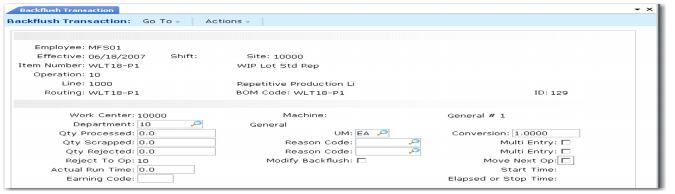
All repetitive transactions use common information entered in the first frame.
Transaction Programs— Common Information shows the first frame of Backflush Transaction (18.22.13).
Transaction Programs— Common Information
The Employee field is mandatory. Enter a valid employee set up either in Employee Create (36.1.7.1) or Actual Pay Rate Maintenance (14.13.21). A valid effective date, site, item number, and operation are required. Shift is optional.
If the item number is associated with a production line, you must enter a valid production line in the Line field. Enter Routing and BOM only if you are not using the default. ID is a system-generated cumulative order ID and cannot be modified.
The system uses the values entered in the Effective, Site, Item Number, Operation, (Production) Line, BOM, and Routing fields to locate the appropriate cumulative order.
The selected cumulative order has start and end effective dates that include the transaction effective date.
How a Cumulative Order is Selected describes the way a cumulative order is selected, based on the effective date entered.
How a Cumulative Order is Selected
If | Then |
A cumulative order has a blank start effective date, indicating that its effective interval is from the end effective date into the indefinite past, | it will always be selected if the transaction effective date is on or before the end effective date. |
A cumulative order has a blank end effective date, | its effective interval is from its start effective date into the indefinite future, and will always be selected if the transaction effective date is on or after the start effective date. |
A cumulative order has blank start and end effective dates, | the cumulative order will always be selected. |
No cumulative order is found matching the above criteria, | one is immediately created. The start and end effective dates are set according to the parameters defined in Repetitive Control. |
The dates in the new order overlap with the dates in some other cumulative order, | the dates in the new order are adjusted forward or backward to prevent overlap. |
The cumulative order creation process retrieves the routing in effect as of the transaction effective date and copies it to the cumulative order. For each operation in the routing, this process retrieves the product structure in effect as of the transaction effective date and copies it to the cumulative order operation. Any phantoms are blown through.
A cost rollup is then performed in the new cumulative order, and the calculated operation costs are recorded by operation in the cumulative order routing. These costs are used for WIP valuation reporting and calculating variances.
The costs are independent of the item cost and routing cost. The Cumulative Order Cost Report (18.22.4.10) displays the operation costs stored in the cumulative order.