Intrastat Effects of EMT Orders
Intrastat features support regulatory-agency reporting requirements for tracking business transactions involving companies in countries that are members of the European Union (EU).
See User Guide: QAD Intrastat for information on Intrastat.
If your EMT orders involve direct shipments among trading partners in multiple EU nations, specific rules apply to which trading partner—the PBU, the SBU, or the end customer—is responsible for reporting the transaction.
When you receive a PO shipper or post an invoice for a direct-ship Intrastat item, the system uses the following rules to determine whether to create an Intrastat history record, which is used as the basis for reporting:
• Dispatches: When the PBU and SBU are in the same country, the PBU is responsible for reporting the shipment. When they are in different countries, the SBU is responsible.
• Arrivals: When the PBU and the end customer are in the same country, the PBU is responsible for reporting the receipt. When they are in different countries, the end customer is responsible.
Note: Standard Intrastat logic applies to non-EMT and transshipment items. Setting Up EMT
EMT setup is required at both the PBU and the SBU. Most EMT setup takes place at the PBU, and consists of defining appropriate default values.
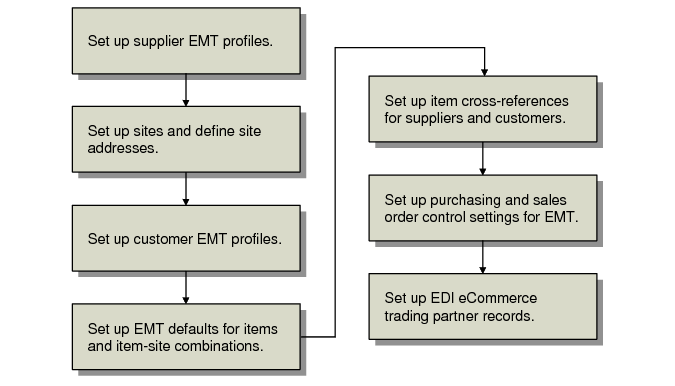
EMT Setup Workflow illustrates a general workflow for setup activities.
Some differences in setup data are required if you use multilevel EMT. These differences are described within the appropriate setup tasks and are also summarized in the section covering multilevel EMT.
EMT Setup Workflow
EMT Setup lists the programs used to complete EMT setup tasks at the PBU and SBU in standard EMT.
EMT Setup
Function | Set Up | PBU | SBU |
Supplier Data Maintenance (2.3.1) | Supplier’s EMT order processing information. | | |
Site Maintenance (1.1.13) | Primary and secondary business units as sites and define default suppliers. | | |
Company Address Maintenance (2.12) | Newly created sites as company records. | | |
Customer Data Maintenance (2.1.1) | Customer’s EMT profile. | | |
Item Master Maintenance (1.4.1) | How the system processes EMT items. | | |
Item-Site Planning Maintenance (1.4.17) | How the system processes EMT items at a particular site (PBU, SBU, or both). | | |
Customer Item Maintenance (1.16) | Item cross-reference at SBU. | | |
Supplier Item Maintenance (1.19) | Item cross-reference at PBU. | | |
Sales Order Control (7.1.24) | Defaults for EMT sales orders. | | |
Purchasing Control (5.24) | Defaults for purchase orders. | | |
Trading Partner Maintenance (35.13.7) | Trading partners; used with EDI eCommerce module. | | |
Trading Partner Parameter Maint (35.13.10) | Parameters associated with specific trading-partner site and address cross-references; used with EDI eCommerce module. | | |