Setting Up Financial Foundations > Setting Up Profiles
  
Setting Up Profiles
You use profiles to identify the relationships between records in shared sets of different types.
Consider the example discussed in the section on shared sets where customers, suppliers, and exchange rates are used by all entities in both domains, but COA elements are not shared between domains.

Sample Shared Sets
 
Shared Set Type
North America Domain
European Union Domain
Customer
AllCustomers
AllCustomers
Supplier
AllSuppliers
AllSuppliers
Account
NA_Accounts
EU_Accounts
Sub-Account
NA_SubAccounts
EU_SubAccounts
Cost Center
NA_CCs
EU_CCs
Project
NA_Projects
EU_Projects
Exchange Rate
SystemExRates
SystemExRates
Daybook
NA_Daybooks
EU_Daybooks
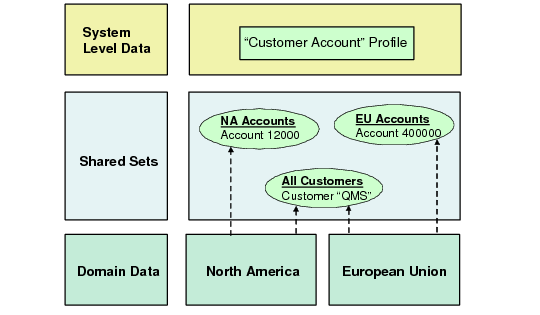
Each customer needs an associated Customer Control account. However, if you assign a control account from the NA_Accounts shared set, it would be invalid when sales orders are created in the European Union domain.
Instead you assign the customer a Customer Account profile that indicates the account to use in each domain. Then, regardless of which entity does business with the customer, valid accounts are referenced when invoices are registered.

Profiles and Sharing
You may need only one profile of each type. However, there are cases when you may want more than one. For example, it is a common practice to have different AR and AP accounts for domestic and international trade. This requires defining a different profile code for each type.