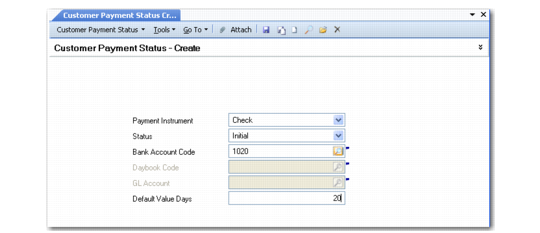
Creating Customer Payment Status Codes
Use the Customer Payment Status activities (27.6.2) to create, modify, view, and delete payment statuses.
The payment status is the transition state through which you process the customer payment, and contains the posting details for the transitions.
Note: Once a payment status has been used in a transaction, it cannot be modified.
Customer Payment Status Create
Field Descriptions
Payment Instrument
Select a payment instrument from the drop-down list. See
Types of Customer Payment Instruments for details about each instrument.
Check
Draft
Direct Debit
Promissory Note
Summary Statement
Credit Card
Status
Select a status to associate with the payment instrument from the drop-down list. See
Customer Payment Statuses and Account Activity for status descriptions.
Initial
Accepted
Allocated
Bounced
Conditional Collection
For Collection
Paid
Paid Conditionally
Bank Account Code
Specify the GL account code for your bank that is used to process the payment. The account must be of type Bank.
Daybook Code
Specify a code for the daybook to contain the status transition postings. The daybook must be of type Customer Payments. Daybook cannot be specified for the Initial status.
GL Account
Specify the code of the account used for status transition postings.
• For all statuses except Initial and Bounced, you must specify an account type of Customer Payment.
• For the Initial status, this field does not apply.
• For the Bounced status, this must be an account of type Open Items.
This account is only used for Paid Conditionally payments that are bounced. Instead of crediting the bank account, the open item account is credited so that a special follow-up process can be started for requesting a new payment from the customer.
Accounts are updated automatically when you change the payment status. The account balance reflects the value of all payments that have this status.
Default Value Days
Specify the number of value days it takes to change from one payment status to another.
This value defaults to zero. When a status transition requires some activity on the part of the bank, you can increase the number of days, in line with banking practice. This information is added to the current date when determining the due date for cash reporting.