Updating Burden and Overhead Costs
You can calculate overhead and burden as a percentage of lower-level costs. This is useful for electronics manufacturers and other companies who calculate overhead and burden based on material cost rather than labor cost. Use the following programs to update burden and overhead:
• Use Item Burden Cost Update (1.4.20) to override item burden costs calculated in Routing Cost Roll-Up (14.13.13). You can change the burden cost for individual items, groups of items, or all items.
• Use Item Overhead Cost Update (1.4.21) to generate overhead allocations as a percentage of other costs.
You can test for the effect of a change in burden or overhead by simulating it. Do this by setting the Update field to No. The system calculates cost data using the specified parameters and prints a report, but does not actually update any cost fields.
Important: Take care when making any global changes to ensure that only changes you want are made. Some items may have burden applied differently.
Calculate overhead and burden in three steps:
2 Calculate this-level item overhead costs for the lower-level items by using Item Overhead Cost Update, or calculate this-level item burden costs by using Item Burden Cost Update.
3 Roll up the product structure costs again to add the calculated overhead to the lower-level costs.
The following example calculates overhead for a parent item with several components.
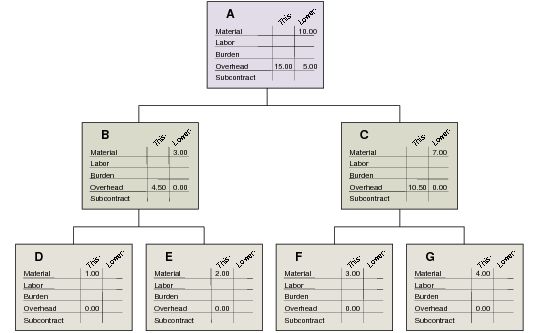
Example: The product structure for item A, illustrated in
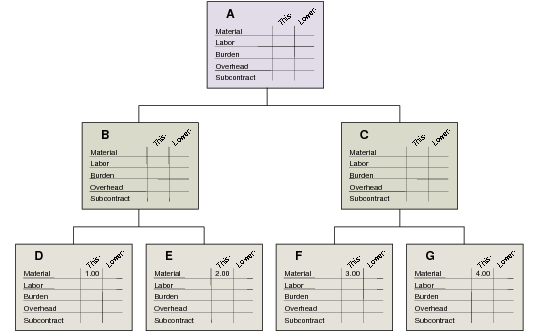
Product Structure for A, consists of lower-level items B and C. The lower-level material costs originate in the components for B and C—items D, E, F, and G. This-level overhead is 150% of lower-level material cost. The lower-level material costs are:
• Item D = 1.00
• Item E = 2.00
• Item F = 3.00
• Item G = 4.00
Product Structure for A
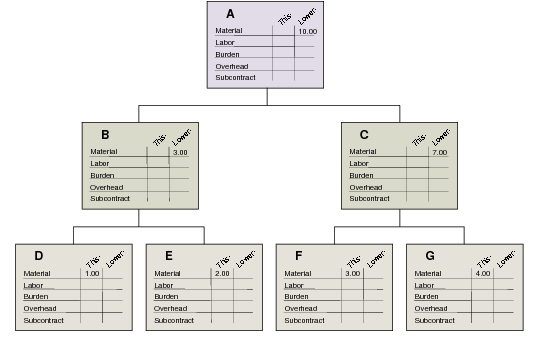
The first product structure cost rollup for item A calculates lower-level material costs of 3.00 for item B, 7.00 for item C, and 10.00 for item A.
Results of First Product Structure Cost Rollup
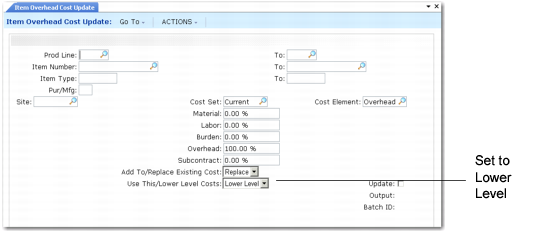
In Item Overhead Cost Update, the material percentage is set to 150% and the other percentages to zero. Use This/Lower Level Costs is set to Lower Level.
Item Overhead Cost Update (1.4.21)
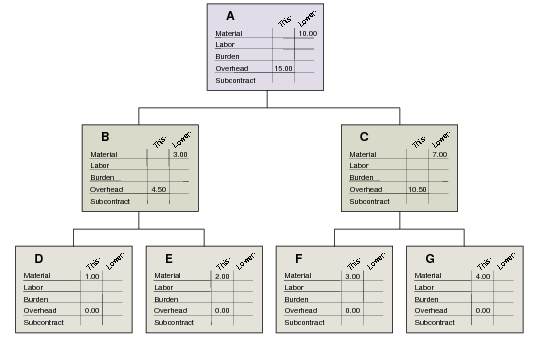
This calculation generates overhead costs of 4.50 (150% of 3.00) for item B, 10.50 (150% of 7.00) for item C, and 15.00 (150% of 10.00) for item A. Items D, E, F, and G have overhead costs of zero.
Item Overhead Cost Calculation
The second product structure cost rollup adds the calculated this-level overhead costs for items D and E to B, then the costs of F and G to C, then the costs of B and C to A.
Note: You cannot calculate this-level costs for a specific cost element based on both this-level and lower-level cost elements in the same calculation. Calculate this-level costs first for the lowest level, then the next highest level, and so on. Since you must do lower-level and this-level cost updates separately, check each level before going to the next.
Results of Second Product Structure Cost Rollup