Costing Methods
Companies use costing methods for managing business as dictated by business conditions or, in some cases, law. Costing methods include:
Standard Cost
Standard costs measure how much an item should cost. Typically, standard costs are used for general ledger (GL) transactions and are not automatically updated by the system. The standard cost for an item is used as the basis for all inventory-related accounting transactions as they are processed. Actual expenses are tracked and measured against this standard.
Standard Cost Variances
Because the standard is only a target or estimate of item costs, the actual costs incurred rarely match the standard exactly. In order to account for the difference between standard and actual costs, variances are calculated and recorded.
Total variance is the difference between standard cost and actual cost. Total variance can result from a difference in purchase price, quantity used, or both. A rate variance occurs when the actual cost of a resource differs from the standard rate. A usage variance occurs when the actual quantity of the transaction differs from the standard quantity. For example, a usage variance occurs when components are issued for a different quantity than those defined on the standard bill of material (BOM), or when additional non-standard components are issued.
Average Cost
With average costing, costs are recalculated during item receipts and other inventory-related activities using a simple weighted-average calculation.
These system activities can update item costs:
• Receiving inventory from a work order or repetitive schedule or using Receipts–Backward Exploded (3.12).
• Running the accounting close function for a work order or cumulative order to consider any costs posted after the last receipt.
• Transferring inventory between sites; for example, using distribution orders or inventory transfer functions.
• Receiving quantities from purchase orders or supplier schedules or returning items to a supplier using functions such as Purchase Order Returns (5.13.7).
• Finalizing matching of a purchase order receipt with a supplier invoice. This reverses the effect of the corresponding purchase order receipt and applies only when Current Cost from AP is Yes in Inventory Accounting Control (36.9.2).
The following equation is used to calculate average costs for materials:
(Receipt Quantity * Receipt Cost) + (Item Quantity on Hand * Current Material Cost)
The result is then divided by the new quantity on hand (including the receipt) to determine the new average cost of the item.
For manufactured items, current labor, subcontract, and burden costs are calculated for each work order or repetitive operation using the following equation:
(Item Quantity Received / Cumulative Quantity Completed at the Operation) * Operation’s Cumulative Work-In-Process (WIP) Cost
If you are using the Cost Management module, you can use the average costing method to calculate site-specific GL costs as well as current costs. Otherwise, the average costing method is used only for current costs. See
Cost Management.
The following example illustrates how average costs are calculated when receiving items on a work order.
Average Cost Example
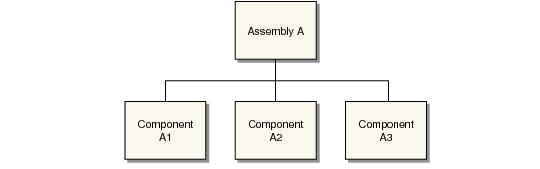
Assembly A has three components: A1, A2, and A3.
Assembly A Product Structure
A quantity of 20 is received for an assembly A work order. First, the labor, burden, and subcontract cost categories are calculated.
Operation Costing, Labor uses labor as an example.
Operation Costing, Labor
Operation | Cum. Qty. Completed | Cum. WIP Labor Cost | Work Order Receipt Cost Calculation |
10 | 100 | $100 | 20/100 * $100 = $20 |
20 | 75 | $150 | 20/75 * $150 = $40 |
30 | 50 | $20 | 20/50 * $20 = $8 |
40 | 40 | $50 | 20/40 * $50 = $25 |
Next, material cost is calculated.
Operation Costing, Material
Component | Qty. Per Assembly | Unit Cost | Work Order Receipt Cost Calculation |
A1 | 1 | $5.00 | 20 * $5.00 = $100 |
A2 | 1 | $1.00 | 20 * $1.00 = $20 |
A3 | 2 | $1.00 | 40 * $1.00 = $40 |
For this work order, the cost of Assembly A is:
(93 + 160) / 20 = $12.65
For a quantity of 10 in stock at $12.00 each, the new average cost for each assembly A would be:
(10 * $12.00) + (20 * $12.65) / 10 + 20 = $12.43
Last Cost
The last cost method is used only for current costs and is not available for costing in the general ledger. Costs are updated each time the item is received. For example, an item’s material cost is updated to the purchase order (PO) cost each time a PO is received.
Periodic Cost
Periodic costing provides functions that can meet local requirements and business practices when companies revalue and recalculate inventory, transactions, and cost of goods sold.
Periodic costing is a part of the Costing Menu (30) within the Financials module. Programs in the Periodic Costing menu (30.5) calculate the actual cost of an item based on recorded data—inventory transactions, BOMs, routings, purchase prices, labor/burden expenses—over a certain user-defined period, which can be any length, up to an entire GL period. Under most circumstances, it also takes into the account the beginning balance of the item while it is performing the calculation of the period costing. It then batch generates GL transactions based on the cost calculations.
In periodic costing, costs are recalculated for each period, and a new average cost is defined according to what happened during that period—so no amounts need to be posted to variance accounts.
Periodic costing includes functionality to meet IFRS requirements. You can set the costing method to weighted average (WAVG) or first in first out (FIFO) and print numerous reports, including legal reports. Periodic costing calculates the cost of items periodically and generates GL transaction according to the period costs for all costs. For more information on QAD Periodic Costing, see
QAD Periodic Costing User Guide.