Preparing to Use Self‑Billing
AR Self-Billing uses processed shipping information to match incoming customer-initiated payments. The system must first process shipping information for the incoming remittance.
Shipment details are captured at the time a shipper is confirmed. Invoice, tax, order-level discount, and trailer information is captured at the time of invoice posting.
Note: The Sales Order Shipment program does not capture self-billing information.
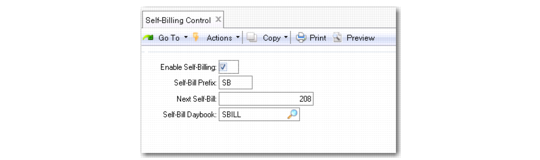
You activate Self-Billing for the system using Self-Billing Control (27.6.12.24).
Self-Billing Control (27.6.12.24)
Set the following parameters:
Enable Self Billing
Select to enable self-billing in the system.
Self-Bill Prefix
Define the three-character, self-bill numbering prefix according to your requirements. In cases where the customer supplies the remittance prefix and number, you can choose to leave this field blank.
Next Self-Bill
Enter the next self-bill number (maximum 20 characters). In cases where the customer supplies the remittance number, you can choose to leave this field blank.
Self-Bill Daybook
Select a daybook to use for self-billing transactions. You must define at least one self-billing daybook in the system.
Setting Up Customers
Configure the following self-billing fields in Customer Data Maintenance (2.1.1):
Capture Self-Billing Information
Select this field to capture self-billing information for this customer bill-to address. When sales orders or schedules are used with shippers, this field triggers the creation of shipment invoice cross-reference records for every line item of a shipment. These cross-reference records are updated when the invoice is created, and can then be retrieved by the Self-Billing program. The records do not include sales order shipment postings.
Note: This field is displayed only after you activate self‑billing in Self‑Billing Control.
Customer Data Maintenance, Self-Billing Fields (2.1.1)
Create Payments Automatically
Select this field to automatically create a customer payment from the self-bill transaction.
The default customer bank account to be used for the payment is selected on the Banking tab of the Customer record (by selecting the Self-Bill Default field for that account), and you also select a status for the payment from a drop-down menu on this tab. The drop-down menu displays all the valid payment statuses for that account.
If no customer account is selected for self-billing, the default account and payment format is used for the payment, and the customer payment is created with a status of For Collection (if this status is already defined for the customer), or Paid (if no status is defined for the customer).
If you do not select this field, you process the self-billing invoice using any of the other customer payment processes or a banking entry.