Logistics Charges
The individual costs payable to third-party suppliers for the transportation of goods are referred to as logistics charges. Logistics Accounting lets you define logistics charges for any inbound and outbound transportation costs payable to third-party suppliers.
Inbound logistics charges are the transportation costs associated with purchasing items from external suppliers. Outbound logistics charges are the transportation costs associated with the shipment of items from a company location to customers or other company locations.
For some companies, a significant proportion of purchases are imports. Logistics costs have a large financial impact since they can represent a high percentage of the total delivered cost and must be included in price comparisons with local sources. In Logistics Accounting, inbound logistics charges are considered part of the overall cost specific to each item and included in the item cost.
For other companies, the shipment of goods by third-party carriers is a frequently occurring expense. Tracking the amounts owed to carriers as a separate liability in the general ledger (GL) provides better control over invoices from suppliers. Identifying variances in expected freight charges and actual invoice amounts reduces the risk of duplicate or overpayment of logistics charges. Tracking these charges improves visibility of total outbound freight costs, helping to reduce these costs by reviewing order quantities or seeking alternative carriers.
Logistics Charge Accruals
When items are purchased or shipped, you can accrue logistics charges as part of the process. GL accruals for inbound logistics charges are triggered by purchase receipts. GL accruals for outbound logistics charges are triggered by shipments. For each receipt or shipment, a pending invoice is created for each logistics charge accrual. Inbound logistics charges are built into the GL cost for items.
Note: See
Accrual Currency for information on how the system determines the accrual currency used for inbound and outbound logistics charges.
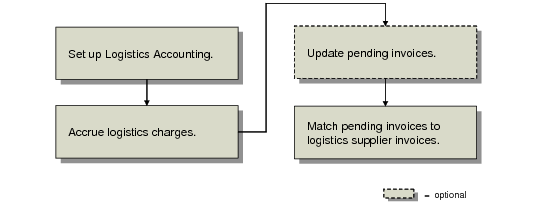
Logistics Accounting Workflow summarizes the steps involved in accruing logistics charges.
Logistics Accounting Workflow
Receiver matching of pending invoices is described in
QAD Financials User Guide.
Apportioning Logistics Charges
When an invoice is received from a logistics supplier, the total amount of the invoice is recorded in Supplier Invoice Create (28.1.1.1). To capture the logistics costs for individual line items, a portion of the total invoice amount is allocated to each line item on the associated order.
The system apportions inbound and outbound logistics charges to line items on an order when the pending invoice is created, based on the apportion method associated with the logistics charge code. The total invoice amount is allocated to individual line items as a ratio of the accrued logistics charges.
When recording an invoice for inbound logistics charges, you can automatically update the current costs of PO line items with the allocated amounts. Current costs are updated whether the last cost method or average costing is used.
Logistics Accounting now supports both standard and average costs for GL Cost Sets.
Example: Item A and item B are purchased from a single supplier and shipped to a company location. The GL and current costs for these items consist of the unit cost from the item supplier and the cost to ship each item.
Note: Logistics Accounting is now fully supported by the Periodic Costing module.
Example Item Costs
| Item A | Item B |
Material | 10 | 12 |
Freight | 3 | 2 |
Total cost | $13 | $14 |
When the order arrives, item A is received in a quantity of 400 and item B in a quantity of 200.
Apportioning by Accrued Value shows the accrued freight charges for each item.
The logistics supplier sends an invoice in the amount of $2000 for freight. The total accrued freight is $1600. When the freight invoice is recorded, the system uses the following equation:
Apportion Value = Line Item Accrual / Total Accrual * Total Invoice Amount
Apportioning by Accrued Value
Item | PO Qty | GL Freight | Accrued Freight | Apportion Value |
A | 400 | $3 | $1200 | 1200 / 1600 * 2000 = $1500 |
B | 200 | $2 | $400 | 400 / 1600 * 2000 = $500 |
The actual freight cost for item A is $3.75 per unit ($1500 / 400) and $2.50 for item B ($500 / 200). When the last cost method is used for the current cost set, the system updates the current costs for items A and B with the allocated values.
You specify the apportion method in Logistics Charge Code Maintenance (2.15.1). Use any of the following apportion methods:
• 1: Default
• 2: Weight (based on item master data)
• 3: Volume (based on item master data)
• 4: Price (net unit price of the item)
The default apportion method is based on the standard cost defined for the element that is linked to the logistics charge. If a method other than “default” is used, you must also manually change the unit of measure (UM) and select a calculation method (either unit or bulk). If you enter the wrong UM, an error displays.