QAD 2017 Enterprise Edition
>
User Guides
>
Security Administration
>
E-signatures
>
Set Up E-Signature Functionality
Set Up E-Signature Functionality
When setting up e-signature functionality, the following tasks must be completed:
Load E-signature Initial Data
The initial data, QAD-provided default profiles, must be loaded into the system first. Use E-Sig Initial Data Load (36.12.14.13) to load the data.
Enter the directory of the files and all the default profiles in that directory will be loaded into the system. These files are located on the server side under installdir/config/electronic-signature, where installdir is the root application installation directory.
Set Up E-signature Reason Codes
The signature reason code is a critical element of the e-signature. In regulatory environments, the signature record typically must include the meaning of the signature. The system uses reason codes to provide the meaning.
Each time the system prompts for an e-signature, the user must provide a valid reason code. For example, reason codes might indicate that a quality record has been approved, reviewed, or inspected. See
Record E-Signatures.
Use Reason Codes Maintenance (36.2.17) to define signature reason codes that are appropriate to your environment.
Important: All reason codes used by e-signatures must be associated with the QAD-provided ESIG reason type. Reasons of any other type cannot be entered in the signature prompt frame.
Define Security Control Settings
To prevent any unauthorized individuals from applying e-signatures using another user’s ID, e‑signatures uses the same validation logic used in the sign-in process. See
Security Overview for information on setting up and using sign-in security.
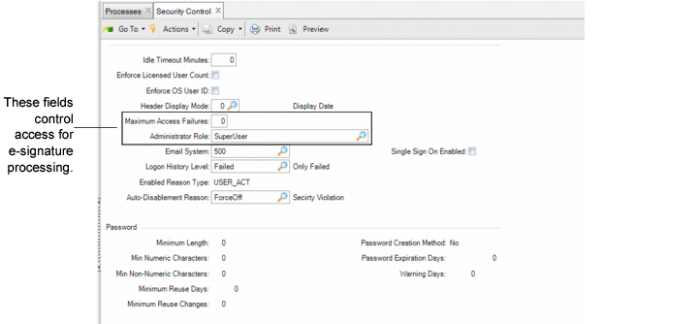
When setting up e-signature functionality, define the security control settings in Security Control (36.3.24) to see how sign-in security is defined in terms of password structure and use rules.
Security Control (36.3.24)
Two fields directly control how the system manages unsuccessful e-signature attempts:
• Maximum Access Failures indicates how many consecutive unsuccessful signature attempts cause the user’s session to terminate, disable the account, and inform the administrator role of a potential unauthorized access attempt.
• Administrator Role is the name of the role—defined in Role Create (36.3.6.1)—assigned to the system users who are notified by e-mail when a session is terminated because of excessive unsuccessful signature attempts. The system also sends e-mail to users who are assigned this role when a signature profile is activated. See
E-Mail Notifications.