QAD 2017 Enterprise Edition
>
User Guides
>
Warehousing
>
Wave Planning
>
Key Concepts
Key Concepts
A major key to understanding how the wave features work is the relationship between the different areas of a warehouse and how stock moves among the areas. To fully understand the flow of a wave, concepts from functional areas outside of wave planning are introduced in the following paragraphs.
Using Waves in a Warehouse
Wave planning applies best to companies that have many sales or distribution order lines. For example, large component manufacturers can typically fulfill 7,000 sales order lines with as many as 14,000 different items to pick per day.
In this scenario, extra space can be required to hold numerous pallets full of different types of items. This, in turn, results in greater distances for picking staff to travel. To reduce travel time, companies typically designate smaller areas to pick items and keep items in reserve to replenish the items being picked. These picking areas typically consists of a few aisles of pallets, boxes, or containers with items. The picking area is sometimes called the forward picking area, detail picking area, or the pickface area.
Picking for waves is done through batch picking or normal picking. Working with a separate picking area, though, is not a mandatory requirement. When volumes are lower or staff pick mostly in full pallets, you typically only need one picking area. Wave planning can accommodate both situations.
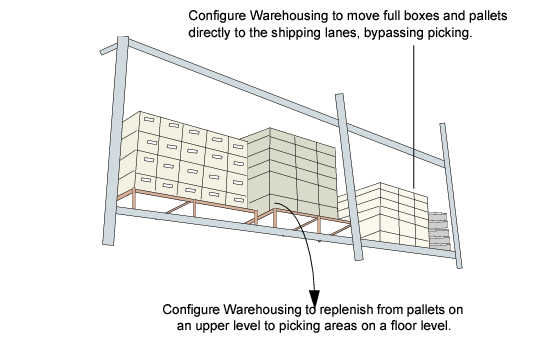
The holding area or the reserve area has larger quantities of the items, usually in pallets, that replenish the picking area. For this reason, the reserve area is sometimes termed the pallet area, bulk area, or full pallet area. When order lines can be filled with pallets, it saves time to simply move the pallets from the reserve area to the shipping area, bypassing the picking area.
Wave planning lets you have a continuous throughput of stock across the warehouse from the reserve area to the forward picking area to the consolidation area to the staging area. The consolidation area is an area where warehouse staff assemble items on pallets or containers; the staging area is the area where warehouse staff drop off wrapped pallets that are ready for shipment.
Replenishment is the movement of stock from the reserve area to the picking area. The picking area should always maintain enough stock to complete order lines of the planned wave. But because the picking area is a finite area within the warehouse, it may not be large enough to hold all items needed for the order lines. Therefore, a method of replenishment must be in place to move stock from the reserve area to the picking area to complete the orders.
Replenishment is not always required, though. For example, if a warehouse does not include a specific picking area, there is no need to move items. In this case, stock is randomly distributed throughout the warehouse. Also, if enough inventory exits to cover the requirements of a wave for a particular item, there is no need to replenish that item. Usually inventory is sufficient to cover the items of a wave because warehouse staff use multiple replenishment techniques and because the locations are big enough to cover a few days’ worth of requirements.
In some warehouses, detail picking areas are on the floor levels of the racks, while reserve areas with full pallets are upstairs. In this case, the replenishment movement is from the upper levels to the floor levels. You can configure wave planning to do this.
Reserve Area depicts a typical reserve area in a warehouse.
If the warehouse stores pallets on upper levels, typically the detail picking area contains stock for fast moving items only. In this case, the replenishment is a very short movement.
Reserve Area