NRM Overview
NRM generates sequence numbers built from one or more segments, each with its own set of characteristics and behavior.
You can add or remove segments during sequence definition, but once a sequence has been used to generate or validate numbers, you cannot change its structure.
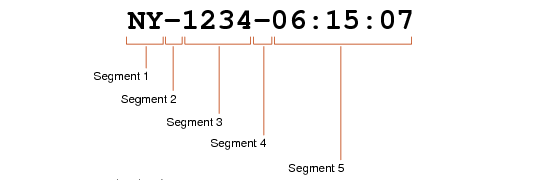
Example Sequence Number illustrates a sample sequence with five segments: three fixed-value segments (NY and two dashes), one incrementing integer segment (1234), and one date-driven segment (06:15:07).
Example Sequence Number
Segment Types describes the three segment types.
Segment Types
Segment Type | Description | Required |
Incrementing Integer | A range of values, with a lower bound, an upper bound, initial, and reset value. | Yes. Each sequence number must have one and only one incrementing integer segment. |
Date-Driven | A value that depends on the transaction effective date or the fiscal period that corresponds to the effective date. The format is a compound string that allows the optional display of date components such as year, month, week, day, including delimiters between components. Delimiters separate the individual components of a segment. For example, 06:15:07 uses colons as delimiters. | No. Each sequence can have one date-driven segment. |
Fixed-Value | Any printable character except a comma. For example, NY may be a fixed-value segment assigned by a client in New York. A fixed-value segment is not changed in any way during sequence number generation. | No. |
Sequence Number Generation
To update a sequence number, the system examines each segment separately. Only date-driven or incrementing integer segment types are modified. A fixed-value segment is never changed.
Control Segments
You can set up a date-driven segment as a control segment. In this case, changing its value causes the incrementing integer segment to reset to its assigned reset value. When a control segment does not exist or does not change, the incrementing integer segment is incremented.
Sequence Parameters
Create sequence numbers and define sequence parameters using Number Range Maintenance (36.2.21.1). A distinct segment editor defines the format and parameters of each segment type.
Internal and External Sequences
There are two types of sequence number: internal and external.
Internal sequences automatically generate numbers in ascending order as needed. NRM examines each segment in the sequence to determine whether to update its value. A fixed-value segment remains unchanged during sequence number generation.
External sequences accept a sequence number entered externally and validate it against a sequence definition. NRM verifies that the number belongs to the set defined by the sequence and that it has not yet been used. The system parses the number into segments and validates each segment against the corresponding segment in the sequence definition.