Overview
A
base process is a manufacturing operation that creates more than one product. These products are called
co-products or
by-products. For this discussion, a co-product is an intended result of a base process and generally has significant value. In contrast, a by-product is an incidental result of a base process.
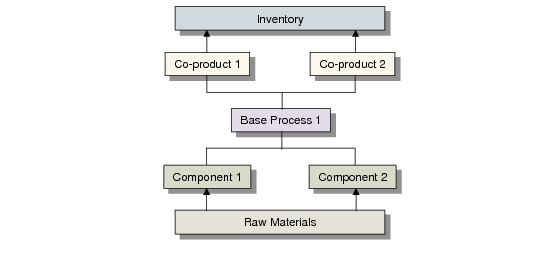
A Base Process Produces Multiple Products illustrates a typical base process that produces two co-products.
A Base Process Produces Multiple Products
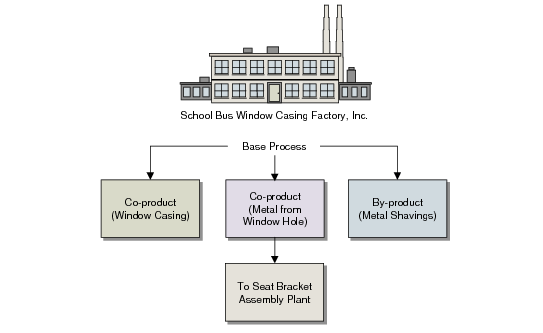
Example: A sheet metal stamping process yields a piece of sheet metal used to make school bus window casings. The stamping process also yields two other products:
• Pieces of metal that are removed from the window hole and used to make seat brackets in another process
• Metal shavings that are swept up and disposed of at a cost
The pieces cut from the window hole have value, and are considered a co-product. The metal shavings have little value and an associated disposal cost, and are considered a by-product. If the shavings can be sold as scrap, the manufacturer may decide to define them as a co-product instead. See
Defining Co‑products and By-products.
Defining Co‑products and By-products
The co-products and by-products of a base process do not have their own product structures or routings. These are defined in the base process. Base processes are items containing formulas for co/by-product operations, and are defined in the same way as regular items. A base process has:
• An associated item record
• A product structure listing its co-products and by-products
• A formula (product structure) listing its component requirements (optional)
• A routing listing its operations (optional)
The BOM/formula code for a co-product is the item number of the co‑product’s base process.
There are some important distinctions between base process items and regular items:
• Base process items are never regarded as items to be stocked. Item status codes are used to restrict inventory transactions related to base process items and to ensure that these items never appear on sales or purchase orders. Should base process items end up in inventory, or on sales or purchase orders, they are ignored by MRP.
• Base process items cannot be used as components in another process.
More About Co-products and By-products
Demand for co-products drives the planning of base processes, and the co-product that has the most demand is the one planned for.
Example: Base process X produces two co-products, Y and Z. Since there is greater demand for Y than for Z, base process X is planned to produce the desired quantity of Y. The quantity of Z produced will therefore exceed demand.
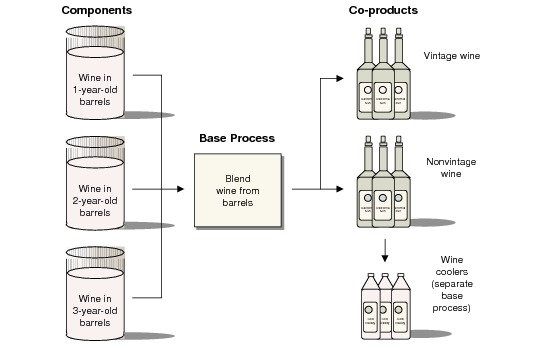
A co-product can be a component of another process or product structure. For instance, for Company Q, nonvintage wine may be a co-product of the wine manufacturing process and a component of the wine cooler manufacturing process, as shown in
A Co-product Used as a Component in Another Structure.
A Co-product Used as a Component in Another Structure
By definition, demand for by-products is not expected. If demand for a by‑product is generated, MRP treats it as demand for a normal item. MRP does not plan work orders to satisfy by-product demand.
Co-product/By-product Work Flow
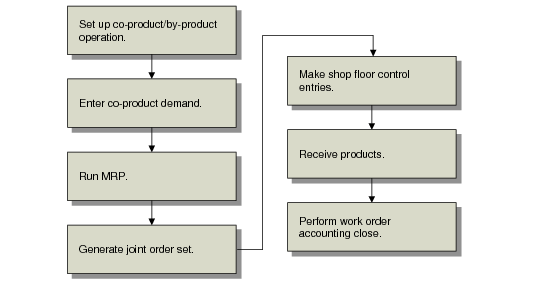
General Work Flow for Co-products/ By-products shows steps for setting up and managing a typical operation involving a base process with co-products and by-products.
General Work Flow for Co-products/ By-products