Flex Fences
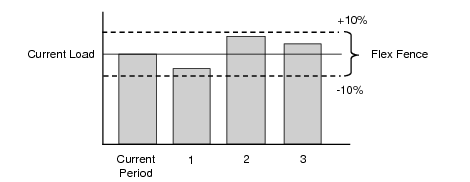
Flex fences let you determine if the total amount entered in a schedule for a future period is within a realistic variance from the total amount scheduled for the current period. This lets you see if schedules are maintaining a reasonably constant level of production over several periods.
Flex fences are based on the scheduled load for the current period, so the allowed variances in scheduled quantities for future periods does not remain static. As production levels rise and fall over time, so does the flex fence.
Flex fence data is assigned as a percentage value for allowable variances in future periods. Flex fence percentages apply to minimum and maximum scheduled load. For example, a 10% flex fence measures if the total schedule entered is within plus or minus 10% of the production line’s scheduled load for the current period.
Flex Fence Example
Typically, flex fence percentages increase over time. You may assign an allowable variance of plus or minus 5% for one week in the future and 20% for any periods more than four weeks in the future.
When you enter flow scheduled orders for a future period in Flow Schedule Maintenance, the system can calculate how the requirements compare with those of the current period and display a warning if they are outside the specified time fence.