Receiving Completed Flow Scheduled Orders
Use Flow Schedule Receipts (17.21.7) to receive completed products made on a flow production line and backflush the items used to make them at the same time. The quantity received is applied to flow scheduled orders and any associated work orders. Optionally, you can update component backflush information.
Note: Depending on how the flow schedule order is entered, you may be able to use alternative methods to receive completed quantities:
• When a flow schedule references a non-type W (flow) work order, you can receive the items in two ways:
• Using Flow Schedule Receipts. The system updates the Completed field in both Flow Schedule Maintenance (17.21.3) and Work Order Maintenance (16.1).
• Using Work Order Receipt (16.11) or Work Order Receipt Backflush (16.12) as part of your standard work order processing tasks. The system also updates the Completed field in Flow Schedule Maintenance for that schedule.
• When the Work Order field is blank in Flow Schedule Maintenance, you can record receipts for the flow scheduled order only in Flow Schedule Receipts.
Important: Regardless of the method you use, your work procedures should require receipts to be entered as close to completion as possible. When you analyze production performance data using Linearity Summary Inquiry (17.21.13.1), recording timely receipts allows completion information to be up-to-date. Linearity is an important concept in flow manufacturing because it lets you measure planned flow rates against actual rates and adjust your production methods accordingly.
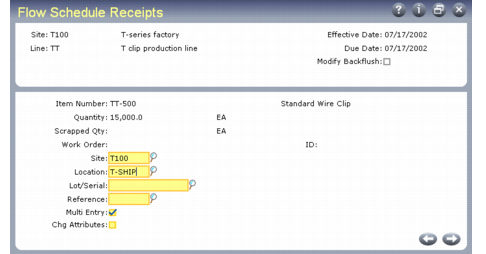
In the first two frames of Flow Schedule Receipts, provide basic data for the receiving process. Based on the settings in some of the fields, additional frames may display.
Flow Schedule Receipts (17.21.7)
Site and Line
Identity the site and production line that produces the item to be received.
Due Date
Specify the due date associated with flow scheduled orders that the system will consider first in applying completions based on the quantity entered in this program.
Using this date as a starting point, the system applies the quantity to orders on the specified production line. No receipts are recorded against orders with due dates later than this.
Modify Backflush
When this field is Yes, additional screens let you update information on the quantity and location of components used during production.
When you modify backflush while receiving flow scheduled orders, the system uses the same process as when you receive standard work orders using Work Order Receipt Backflush (16.12).
Otherwise, the system uses default information in determining how to issue components. If you have defined component issue locations in Work Center/Location Maintenance (17.21.1.22), it uses those locations first.
Item Number
Enter the number of the item being received. This must be a valid item associated with this production line in Production Line Maintenance.
Quantity
Enter the completed quantity of the item being received.
Note: If the production line flow schedule for the due date does not include open scheduled quantities for this item, the system displays an error message.
After this quantity has been received, it displays in the Completed field in Flow Schedule Maintenance. If a work order is referenced in the flow schedule, the quantity completed is also recorded on that work order.
If you receive an incorrect quantity using Flow Schedule Receipts, you can reverse it by running the program again with a negative quantity. Be sure to enter the same site, location, lot/serial, and lot reference numbers as you entered on the original transaction. After you reverse the original entry entirely, run the program again with the correct quantity. This maintains a complete audit trail.
Scrapped Quantity
Enter the number of items scrapped while producing the quantity being received.
Scrapped quantity displays on work order history and cost reports. The total GL cost of the rejected items posts to the scrap account.
Work order reject items have usually completed the entire process before being rejected, so their entire standard cost is written off to Scrap. Items rejected part way through the process should be rejected at that operation. Then only the excess costs incurred to process the rejected item up through that operation are written off to the Method and Material Usage Variance accounts.
Work Order
Optionally enter the number of a work order referenced on a flow scheduled order.
If you enter a value, it must be a valid non-type W (flow) work order. The work order status cannot be F (firm planned) or C (closed).
The system applies the entire quantity to the associated flow scheduled order. This quantity is added to the Completed field for the flow schedule in Flow Schedule Maintenance and for the referenced work order in Work Order Maintenance.
ID
If you entered a value in Work Order, enter the associated ID number.
This must be a valid ID associated with the work order number.
Multi Entry
Specify whether you want to receive quantities into more than one site or location. When this is Yes, an additional data-entry frame displays.
Change Attributes
Specify whether you want to modify the default inventory attributes of the items being received.
No: Received items are assigned the default inventory attributes.
Yes: The system prompts you to enter the Inventory Status, as well as Assay%, Grade, Expire Date, and Active settings.