GTM Conversions > Converting Canadian Taxes to GTM > Converting Master Records
  
Converting Master Records
Once you finish the GTM setup, the next activity is to update tax settings in the following master records:
 
Suppliers
Trailer codes
Customers
Service categories
Product lines
Service agreement terms
Items
 
GTM has additional fields and may require new values for existing fields.
CAN to GTM–Masters
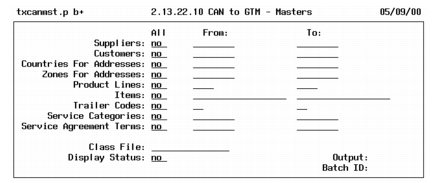
Use CAN to GTM–Masters (2.13.22.10) to convert master records.

CAN to GTM–Masters (2.13.22.10)
In addition to updating the tax settings in the master records, this program assigns tax zone codes to supplier, customer, and company address records. For verification of changes, the program generates an audit trail.
Important: Before you run CAN to GTM–Masters, do the following:
Run CAN to GTM–Setup (2.13.22.9).
To avoid record-contention conflicts with other users, shut down the database and restart it when no other users are on the system.
You can convert all records, a range of records, or individual records. This program converts records in the order in which their selection options display on the screen. For separate audit trail reports, run the report separately for each type of record.
If you created a class file during the setup step, specify its name in the Class File field. Display Status, Output, and Batch ID are the same as in the setup program.
See Defining Custom Tax Class and Tax Usage Codes.
Master Audit Trail
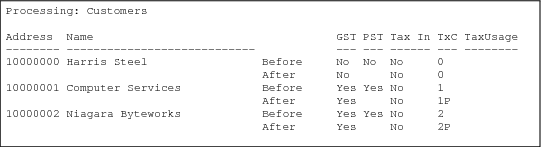
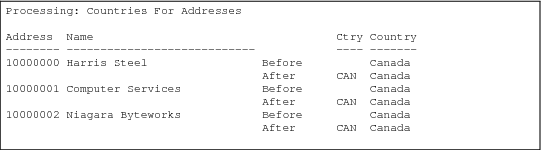
CAN to GTM–Master prints a report of changed records. The format varies depending on the records included in the conversion. For each group of converted records, the report shows the record number and name followed by the before and after tax information, such as country code, tax zone code, GST and PST taxable status, whether tax is included in item amounts, tax class, and tax usage.
Groups of converted records are printed in the same order as the screen selection criteria, and each group is separated by a page break. Warning and error messages identify potential conversion problems.
Customers Audit Trail and Countries for Addresses Audit Trail show representative audit trail formats.

Customers Audit Trail

Countries for Addresses Audit Trail
Troubleshooting Master Conversions
The error messages in the audit trail identify conditions you should analyze and address before you convert transactions. Troubleshooting the Master Conversion lists some common problems along with explanations. Before you make corrections, restore the database from backup.
Warning Do not proceed to the transaction conversion until the master conversion audit trail is free of errors.

Troubleshooting the Master Conversion
 
Error
Explanation
Tax class cannot be converted.
Class file does not contain a GST class that matches the one in the master record.
GST class must exist 0%.
GST class master must have at least one GST class with a zero percentage.
Blank tax class not allowed.
GST class is blank in the class file.
Tax class cannot exceed 3 characters (xxx).
GST class in the class file is longer than three characters. The message shows the first three characters.
Tax class does not exist (x).
GST class in the class file does not exist in the GST master.
Tax class is not unique (x).
GST class occurs in multiple places in the class file.
Tax class does not exist (xxx).
GTM tax class in the class file does not exist in the GTM tax class master.
Tax usage cannot exceed 8 characters (xxxxxxxx).
GTM tax usage in the class file is longer than eight characters. Message shows the first eight characters.
Tax usage does not exist (xxxxxxxx).
GTM tax usage in the class file does not exist in the GTM tax usage master.
Tax class/tax usage combination is not unique (xxx xxxxxxxx).
GTM tax class and tax usage combination occurs in multiple places in the class file.
Conversion will ignore tax class (x).
Class file does not have an entry for a GST class that is in the class master.
x, xxx, and xxxxxxxx are placeholders for the actual codes displayed in the error message.
How the Conversion Changes Master Records
The following is provided to assist developers and others who require technical information on how the master conversion updates the database.
The menu-level program for CAN to GTM–Masters, txcanmst.p, calls subprograms that set the GTM tax values in the individual tables.
When setting the GTM tax class value, these programs can set the existing tax class code or retrieve an alternate value from a class file.
See Implementing GTM.
Changes to Master Records lists the affected database tables and summarizes the changes.

Changes to Master Records
 
Table
Summary of Changes
ad_mstr
In supplier records, txcanvd.p sets ad_taxable from vd_taxable. It also sets ad_taxc and ad_tax_usage from ad_taxc or from the class file, if any. If vd_taxable is No, ad_taxc is GST only; otherwise, GST + PST.
In customer records, txcancm.p sets ad_taxable from cm_taxable and ad_tax_in from cm_tax_in. It also sets cm_taxc and ad_tax_usage from cm_taxc or from the class file, if any. If cm_pst is No, the tax class is GST only; otherwise, GST + PST.
In all address records, txcanct.p sets ad_ctry from ad_country and visa versa. txcanzn.p calls txtxzget.p to set ad_tax_zone.
fsc_mstr
txcanfsc.p sets fsc_taxc from fsc_taxc or from the class file if any. Tax class is set to GST only.
pl_mstr
txcanpl.p sets pl_taxc from pl_taxc or from the class file, if any. If pl_pst is No, the tax class is GST only; if it is Yes, to GST + PST.
pt_mstr
txcanpt.p sets pt_taxc from pt_taxc or from the class file, if any. Tax class is set to GST only.
sv_mstr
txcansv.p sets sv_taxc and sv_tax_usage from sv_taxc or from the class file, if any. Tax class is set to GST only.
trl_mstr
txcantrl.p sets trl_taxc from trl_taxc or from the class file, if any. It also sets trl_taxable to Yes. If trl_pst is No, the tax class is GST only; if it is Yes, to GST + PST.