
For over a decade, manufacturing has been caught in a perplexing paradox. While I have watched the advent of transformative technologies like the Internet of Things (IoT), Industry 4.0, and advanced Big Data and Analytics, productivity growth has plateaued over the past 15 years. This stagnation has left many in manufacturing, supply chain, procurement, finance, and IT departments wondering if the promised land of efficiency and effectiveness will ever truly materialize. We’ve invested heavily, deployed new systems, collected mountains of data, and declared ourselves masters of digital transformation (as seen on many LinkedIn posts), yet the needle on the productivity gauge has barely budged. Those digital transformations have overpromised, and underdelivered.
Why haven’t these technological advancements delivered on their potential? And more importantly, how will Artificial Intelligence (AI) finally break this cycle and irrevocably change the manufacturing landscape?
The Productivity Puzzle: A Decade of Disappointment
Let’s face the uncomfortable truth: the hype surrounding previous industrial revolutions usually outpaced the real results; that is the results that manufacturers would require from such expensive undertakings. While IoT connected our machines and sensors, generating unprecedented volumes of data, we often lacked the sophisticated tools to extract meaningful, actionable insights from it. Industry 4.0 painted a vision of smart factories, but the integration across disparate systems proved to be a formidable challenge. Big Data and Analytics provided the capability to process large datasets, but the business knowledge and sweat equity effort required to clean, interpret, and leverage this data for strategic decisions was a significant bottleneck.
The core issue wasn’t the lack of data, it was the lack of intelligence to truly understand and act upon it in a dynamic, autonomous way. We built powerful systems, but we were still relying on human drivers to navigate the complex terrain with a fog that still limited our sight. This often led to reactive decision-making, inefficiencies masked by an abundance of data, and ultimately, a missed opportunity for productivity gains. The promise of connection and data-driven insights were there, but the ability to translate that into sustained, impactful improvements remained elusive. Enter Artificial Intelligence, which I believe will provide a fundamental shift in how we approach manufacturing challenges.
AI: The Missing Piece of the Puzzle
AI is not just another technology; it’s a wholesale shift in paradigm. Unlike its predecessors, AI doesn’t just collect data or connect devices; it learns, adapts, and makes intelligent decisions. It must be trained, platforms must be built, and expertise is required to realize the benefit, but it brings the cognitive capabilities that have been the missing link in turning vast amounts of data into tangible productivity advances. AI can identify patterns, predict outcomes, and optimize processes with a speed and accuracy that no human workforce, no matter how skilled, can match. This isn’t about replacing human ingenuity, but augmenting it, freeing up valuable human capital for more complex, strategic tasks.
The sheer volume of data points generated in a modern manufacturing plant is staggering. From sensor readings on production lines to inventory levels, supply chain movements, and customer demand forecasts – the complexity is staggering. Previous technologies allowed us to capture this data, but AI provides the analytical horsepower to truly harness it. It moves us beyond reports showing us what happened, to reports showing us why something happened. The end state goal of course will be reports that show us what will happen, or even better, “here is what was going to happen, but AI intervened to prevent the problem.” This shift from understanding the past to actively shaping the future is what makes AI a game-changer for manufacturing. It’s about being proactive rather than reactive, intelligent rather than just informed.
The fundamental difference lies in AI’s ability to learn, adapt, and make intelligent decisions, bringing a cognitive capability that was missing in previous technologies.
While IoT connected devices and generated data, and Big Data provided the means to process large datasets, they lacked the intelligence to truly understand and act upon this data in a dynamic and autonomous way. AI moves beyond just collecting and processing data; it provides the analytical power to harness it, shifting from understanding the past to shaping upcoming events through predictive and prescriptive analytics. This is why AI is a game-changer for manufacturing, enabling proactive, intelligent decision-making and unlocking significant productivity gains. In the last two months previous to the writing of this blog, I have personally encountered senior level employees at manufacturing firms make these statements:
“We need to know how AI will help us.”
“We are exploring how AI will take away repetitive tasks from our buyers.”
“We are going to spend a lot of money on AI next year.”
There is a much different discussion on Artificial Intelligence than I remember around IoT, Industry 4.0, RPA, and Big Data. The discussions on AI are far more active and animated than those previous items, and there are far more instances of use and investment in a much shorter time frame.
Agentic AI refers to autonomous, goal-directed software agents that perceive plant conditions, reason over constraints, plan actions, and execute changes in systems like ERP, MES, and SCADA, with human-in-the-loop guardrails. Levels: Assistive (recommend), Semi‑autonomous (act with approval), Fully autonomous (act within policies).
What Is Agentic AI in Manufacturing?
If previous waves of technology gave manufacturers more data, agentic AI is what enables them to actually act on it.
At its core, agentic AI represents a shift from insight to execution. Traditional systems can report on what happened. More advanced analytics can suggest what might happen next. But they still rely on people to interpret outputs, connect the dots across systems, and decide what to do.
Agentic AI closes that gap.
Rather than focusing on a single task or output, it is designed around outcomes. It can evaluate changing conditions, determine the next best action, and initiate the steps required to move the business forward, all within the context of existing processes.
For manufacturers, that distinction is important:
- Traditional automation follows predefined rules
- AI and analytics surface patterns and predictions
- AI agents handle specific, contained tasks
- Agentic AI connects decisions across functions and helps drive them to completion
This is where the impact becomes tangible. Most of the challenges manufacturers face today, from inventory imbalances to supply chain disruptions, are not caused by a lack of data. They are caused by the difficulty of coordinating decisions across disconnected systems and teams.
When embedded within platforms like QAD Adaptive ERP and QAD Digital Supply Chain Planning, agentic AI brings those decisions closer to the point of execution. It doesn’t just highlight an issue. It helps resolve it.
Single-Agent vs. Multiagent Systems in Manufacturing
Not every use case requires a complex approach.
In many cases, a single agent is enough to deliver value. These are typically focused, high-frequency decisions where the objective is clear and the inputs are well understood. For example, continuously evaluating inventory policies or identifying when supplier performance begins to drift.
But manufacturing is inherently interconnected. Decisions made in one area quickly ripple into others.
That is where multiagent systems come into play.
Instead of relying on a single perspective, multiple specialized agents can work together across functions. One may evaluate supply risk, another production constraints, another financial impact. Together, they provide a more complete view of the trade-offs involved and help guide the business toward the best possible outcome.
This is particularly relevant in environments supported by QAD Digital Supply Chain Planning, QAD Advanced Scheduling, and Supplier Relationship Management, where decisions span planning, sourcing, production, and finance.
The key is not complexity for its own sake. It is applying the right level of intelligence to the problem at hand.
Some decisions benefit from a single, focused agent. Others require coordination across the enterprise.
What makes agentic AI different, and why it matters now, is that manufacturers are no longer limited to choosing between visibility and action. For the first time, they can begin to achieve both at scale.
Four Ways AI Will Irrevocably Impact Manufacturing
Key Agentic AI Applications in Manufacturing:
- Autonomous process optimization: Agents monitor quality KPIs (e.g., Cp/Cpk, scrap rate) and adjust machine parameters (temperature, feed rate) in real time.
- Proactive maintenance: Agents analyze vibration/thermal/sound data, create work orders, order parts, and schedule downtime automatically.
- Supply chain resilience: Agents detect supply risks, simulate alternatives, and update purchase orders, routings, and logistics plans in ERP.
- Energy management: Agents shift energy-intensive jobs to off‑peak hours based on real-time pricing and carbon targets.
- Intelligent shop‑floor management: Agents summarize shift handovers, open deviations, and production risks.
How to Prioritize Agentic AI Use Cases
The opportunity for agentic AI in manufacturing is broad. But not every use case will deliver equal value, and not every process is ready for autonomy.
The challenge is not identifying possibilities. It is knowing where to start.
The most successful organizations focus on use cases where agentic AI can do what previous technologies could not: coordinate decisions across functions, respond in real time, and move from insight to action.
A practical way to prioritize is to evaluate opportunities across four key dimensions:
- Coordination complexity
The more a process spans functions, systems, or teams, the greater the opportunity for agentic AI to create value. Use cases that require alignment between supply chain, production, procurement, and finance are often strong candidates because they are difficult to optimize through manual processes alone. - Real-time responsiveness
Processes that are sensitive to timing benefit most from faster decision-making. When conditions change quickly, whether due to demand shifts, supply disruptions, or production variability, the ability to continuously evaluate and act becomes a meaningful advantage. - Autonomy potential
Not every decision needs to be fully automated. The goal is to identify where actions can be partially or fully executed with confidence. In some cases, this may mean surfacing recommendations for approval. In others, it may mean allowing the system to act within defined thresholds. - Business value
Ultimately, prioritization should be grounded in measurable impact. This may include improvements in service levels, reductions in inventory, increased throughput, or better margin performance. The highest-value use cases are those where better decisions translate directly into financial or operational outcomes.
Individually, these factors are important. Together, they help identify where agentic AI can move the needle.
In practice, the strongest candidates tend to share a common profile: they are cross-functional, time-sensitive, and tied to core operational metrics. These are the areas where traditional systems have historically fallen short, and where a more adaptive, decision-driven approach can deliver meaningful results.
By starting here, manufacturers can focus their efforts on initiatives that are not only technically feasible, but also capable of driving immediate and sustained business impact.
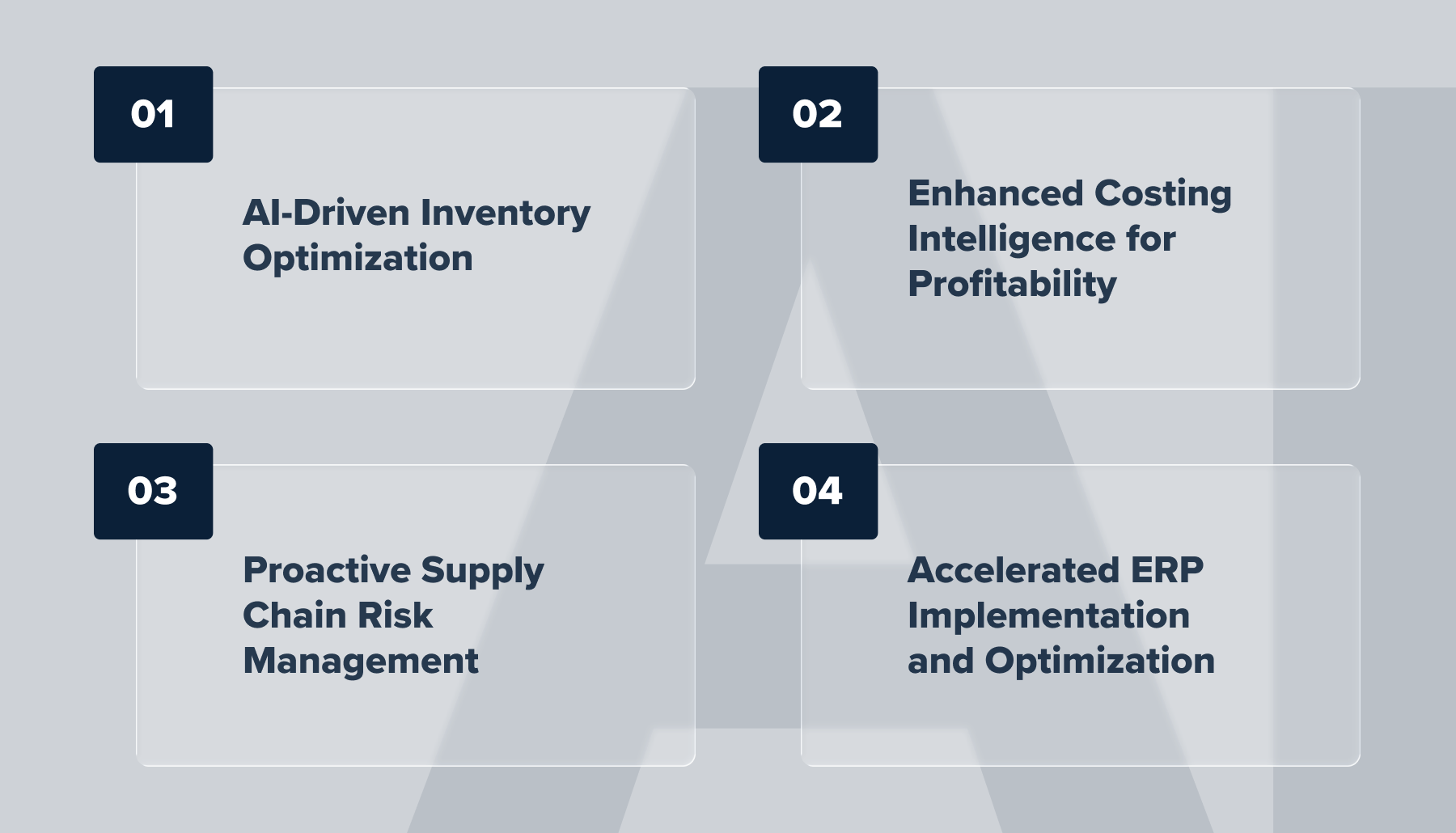
AI’s influence will be felt across every facet of the manufacturing enterprise, fundamentally reshaping operations, decision-making, and competitive landscapes. Here are four specific ways AI will deliver the productivity gains that previous technologies only hinted at:
1. AI-Driven Inventory Optimization
AI will continuously monitor and analyze the entire inventory landscape within the ERP system to identify opportunities for optimizing stock levels. This includes proactively flagging inefficiencies, suggesting adjustments to replenishment parameters (considering historical performance, current stock, and supplier lead times), and simulating future scenarios to help inventory and purchasing planners make data-driven decisions. With human approval, AI agents can even directly implement these optimized parameters within the ERP, reducing inventory carrying costs and stockout risks.
2. Enhanced Costing Intelligence for Profitability
AI will act as an intelligent assistant for finance teams, continuously scrutinizing product costs within the ERP system. It will autonomously extract and analyze complex costing data across raw materials, components, and finished goods, identifying anomalies, trends, and potential areas for improvement. Users have been running profitability analysis reports for decades. They would be able to see what variances were being tracked. With the advent of AI in Costing Intelligence, this allows finance and operations to pinpoint and address inefficiencies in material management and production processes that lead to cost variances, ultimately resulting in more accurate pricing strategies and improved bottom-line results. It is possible that Agentic AI could also implement necessary costing adjustments directly within the ERP to reach an ideal state, with human approvals and controller authorization.
3. Proactive Supply Chain Risk Management
AI can analyze vast datasets to identify potential supply chain disruptions (e.g., geopolitical shifts, natural disasters, supplier solvency issues) before they escalate. AI agents can then autonomously generate optimal alternative sourcing, logistics, and production plans within the ERP, significantly reducing the time and cost associated with manual intervention. In a time of geopolitical risks and tariffs, this ability to alternatively source becomes potentially an existential issue for many corporations. This type of proactive approach also includes continuously monitoring supplier reliability, quality, and compliance, flagging deviations, and recommending corrective actions or alternative suppliers to minimize single points of failure.
4. Accelerated ERP Implementation and Optimization
AI can significantly reduce ERP implementation time by assisting with data migration and optimizing setup parameters, leading to faster time to value. Beyond initial implementation, AI can also continuously improve the ERP system, coaching users on best practices for areas like inventory and purchasing cycles, shortening the time to value, and ensuring ongoing optimization.
Factory-Floor Examples by Industry
While many early applications of AI in manufacturing have focused on planning and ERP workflows, some of the most immediate opportunities for agentic AI exist closer to the factory floor.
These environments are dynamic, highly interdependent, and often constrained by timing, variability, and throughput requirements. They are also where small improvements can translate into significant operational gains.
The following examples illustrate how multiagent approaches can be applied in different manufacturing contexts.
Automotive: Line Balancing and Throughput Optimization
In automotive manufacturing, production lines are tightly synchronized. A delay in one station can quickly cascade across the entire line.
A multiagent system can continuously monitor station performance, labor availability, material flow, and equipment status. One agent may track cycle times and identify emerging bottlenecks. Another may evaluate staffing or sequencing adjustments. A third may assess downstream impact on delivery schedules.
Together, they can recommend or initiate changes to rebalance the line in real time, reducing idle time, minimizing disruption, and maintaining throughput without requiring manual intervention at every step.
Chemical: Process Control and Yield Stability
In chemical manufacturing, consistency is critical. Small deviations in temperature, pressure, or input composition can affect yield, quality, and safety.
A multiagent approach can bring together process monitoring, quality control, and production planning. One agent may track real-time sensor data and detect drift. Another may evaluate potential adjustments to maintain optimal conditions. A third may assess the impact on batch schedules or downstream processing.
Instead of reacting after a deviation occurs, the system can help stabilize operations as conditions change, improving yield while reducing waste and unplanned downtime.
Electronics: Quality Management and Defect Reduction
Electronics manufacturing often involves high variability, complex assemblies, and tight quality tolerances. Identifying the root cause of defects can be time-consuming, especially when issues span multiple steps in the process.
A multiagent system can connect inspection data, production parameters, supplier inputs, and test results. One agent may identify patterns in defects. Another may trace those patterns back to specific components or process conditions. A third may recommend adjustments to prevent recurrence.
By coordinating these insights, manufacturers can move more quickly from detection to resolution, reducing scrap, improving first-pass yield, and maintaining product quality at scale.
Embracing the Irrevocable Shift
The past 15 years have taught us that technology alone is not enough to drive significant productivity gains, no matter how many of our LinkedIn profiles profess that we are masters of Digital Transformation. It requires system intelligence, technological ingenuity – and a lot of computing power – with the ability to learn, adapt, and make optimal decisions from the vast amounts of data generated. This is precisely what AI brings to the table, and why this time, the manufacturing landscape will be irrevocably altered. For manufacturing, procurement, finance, and IT professionals, the message is clear: Artificial Intelligence is not an optional add-on; it is the fundamental force that will define the future of our industry. We’ve heard this before, correct? “Those who embrace it will lead; those who don’t risk being left behind.” This time is indeed different. The revolution is here, and the impact of AI will be profound and lasting. I believe this technology will finally deliver on the promise of a smarter, more productive manufacturing future.
Getting Ready for Agentic AI
For many manufacturers, the question is no longer whether to adopt AI, but how to do so in a way that delivers meaningful, sustained impact.
Agentic AI introduces new capabilities, but it also places new demands on systems, data, and teams. Success depends as much on readiness as it does on technology.
The following checklist outlines where to focus:
- Align on high-impact use cases
Start with clearly defined business problems tied to measurable outcomes. Prioritize areas where decisions are cross-functional, time-sensitive, and directly linked to operational or financial performance. - Establish the right architecture
Agentic AI is most effective when embedded within core systems rather than layered on top. Platforms like QAD Adaptive ERP provide a foundation where insights and actions can exist within the same environment. - Connect data and context across the enterprise
Decisions rarely live in one system. Bringing together operational, supply chain, production, and financial data is essential. This often includes creating shared context layers, such as connected data models or knowledge structures, that allow agents to operate with a consistent understanding of the business. - Enable real-time and edge responsiveness
Many manufacturing decisions cannot wait. Ensuring that systems can process and respond to data with low latency, particularly in plant environments, is critical for capturing the full value of agentic AI. - Define governance and oversight
Not every decision should be fully autonomous. Establish clear guardrails, approval workflows, and escalation paths. The goal is to balance speed with control, allowing the organization to build confidence over time. - Integrate across planning and execution
The greatest value comes from connecting decisions end to end. Solutions like QAD Digital Supply Chain Planning help ensure that insights generated upstream can be translated into coordinated action across sourcing, production, and delivery. - Prepare the workforce for new ways of working
Agentic AI changes how decisions are made, not just how tasks are executed. Teams need to shift from manual coordination to oversight, exception management, and continuous improvement. Clear communication and targeted enablement are key. - Start small, then scale deliberately
Early success builds momentum. Begin with focused implementations, validate outcomes, and expand into more complex, multiagent scenarios as capabilities mature.
Manufacturers have spent decades investing in systems that improve visibility. Agentic AI builds on that foundation, making it possible to turn visibility into coordinated action.
Those who prepare now will be better positioned to move faster, respond more effectively to change, and capture the full value of what this next wave of technology makes possible.
FAQs
Traditional AI agents execute predefined tasks reactively (e.g., defect detection). Agentic AI plans multistep actions toward goals, sets subgoals, collaborates with other agents/humans, learns from feedback, and can act autonomously within guardrails across interconnected processes.
Use multiagent systems when operations span multiple ISA-95 layers, require orchestration across systems/roles, need real-time trade-offs between conflicting KPIs, or must adapt to frequent disruptions. Single agents fit narrow, task-focused workflows with limited coordination.
Score use cases on two dimensions: relevance for agentic AI (coordination complexity, real-time responsiveness, autonomy potential within guardrails) and business value (impact on cost, quality, throughput, resilience). Pilot high-scoring opportunities first.
Define a modular agent architecture, ensure shared context via data integration and knowledge graphs, provide edge/low-latency infrastructure, establish event-driven pipelines, and implement observability, governance, and security from the outset.
Embed dashboards for human oversight, enforce compliance and safety checks, maintain audit trails, and provide targeted training and change management so teams can supervise and collaborate with agents while preserving quality and regulatory adherence.




Finally, a technology that might actually deliver on the manufacturing transformation promise! AI seems to be the key we’ve been waiting for.