
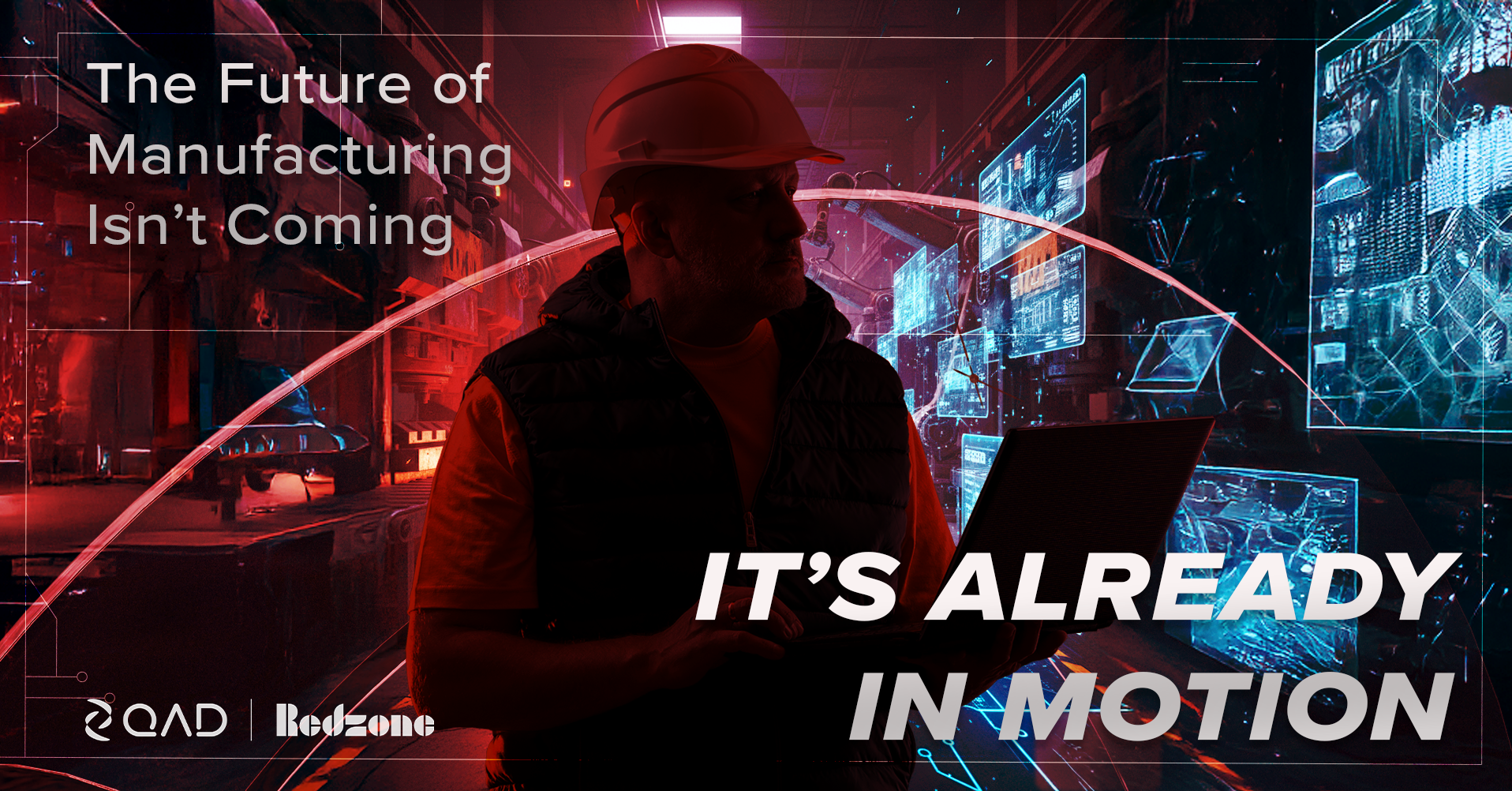
If you’ve ever walked the floor of a factory, you know there’s a heartbeat to it.
The whir of machines, the rhythm of people — shift leaders, technicians, planners — all moving in sync to keep the world supplied. That human rhythm has always defined manufacturing.
Now, it’s accelerating.
We’ve entered a once-in-a-generation moment — where intelligence, automation, and human potential are converging to reshape how everything gets made.
The energy is unmistakable: billions in new investment, supply chains being reimagined in real time, and artificial intelligence maturing from theory to necessity.
This isn’t just evolution — it’s ignition.
And this week, at QAD | Redzone, we’ve felt that ignition first-hand.
From Systems of Record to Systems of Action
For decades, manufacturers have relied on systems of record — strong but static. They captured what happened yesterday, but rarely helped decide what to do tomorrow.
That era is ending.
With the launch of Champion AI, we’re ushering in a new generation of manufacturing intelligence — one that acts with people, not just for them.
Champion AI doesn’t just analyze; it anticipates. It doesn’t replace humans; it amplifies them.
Think of it as a digital co-pilot — one that knows your production rhythms, learns from your data, and takes action to help you move faster.
Whether it’s rebalancing inventory, optimizing production schedules, or accelerating implementation, it’s the difference between knowing what’s happening and doing something about it.
That’s what we mean by Systems of Action — platforms that learn, reason, and act alongside people.
The Human Edge in the Age of AI
The most advanced factories of the future won’t be defined by robots or algorithms — they’ll be defined by the people who use them.
That’s why our mission isn’t to replace workers with AI; it’s to elevate them.
With Champion AI, repetitive work fades into the background so creativity, craftsmanship, and collaboration can move to the forefront.
Frontline teams get digital coaches that help them learn faster. Seasoned experts get intelligent co-pilots that help them anticipate issues before they occur.
Because when people and AI learn together, the result isn’t just efficiency — it’s pride, ownership, and progress.
As I’ve said many times: technology doesn’t replace the human heartbeat of manufacturing — it helps it beat stronger.
Powered by Partnership
No transformation happens alone.
That’s why we’ve deepened our partnership with Amazon Web Services (AWS) — combining their world-class cloud infrastructure and AI capabilities with our deep manufacturing expertise.
Together, we’re making AI practical and secure for every manufacturer, not just the largest ones.
Using AWS technologies like Amazon Bedrock AgentCore and Amazon SageMaker, we’re bringing real-time intelligence and automation directly into manufacturing workflows.
In our collaboration with AWS, Matt Garman put it best — the real breakthrough in manufacturing AI isn’t the technology itself, but making that technology accessible to every manufacturer. That spirit of inclusion and enablement is exactly what fuels our partnership.
That’s the heart of it. This partnership is about making transformation possible for every company, no matter where they start.
Accelerating the Future with Kavida.ai
We also announced our agreement to acquire Kavida.ai, an incredible team of innovators who’ve built agentic AI for procurement and supply chain automation.
Their technology has already processed over a billion dollars in AI-managed orders — proof that this isn’t theory, it’s traction.
Their agents will strengthen our Champion AI platform and fast-track our roadmap by nearly two years, unlocking automation and insight where manufacturers need it most: in procurement, planning, and supplier collaboration.
Kavida.ai was founded with a clear purpose — to fix one of the most persistent pain points in manufacturing: the disconnect between supplier collaboration and enterprise systems. It’s a mission that resonated deeply with me, because it mirrors our own belief that when people and systems truly connect, everything accelerates.
By joining QAD | Redzone, Kavida’s vision now scales globally — and their team joins us in building the world’s most capable AI platform for manufacturing.
A Defining Decade for Manufacturing
This week’s announcements — Champion AI, our expanded AWS collaboration, and the acquisition of Kavida.ai — share one purpose: to help manufacturers move faster, think smarter, and thrive through change.
But more than that, they represent a mindset shift.
We’re leaving behind passive systems and entering an era of intelligent action — one where human ingenuity meets machine precision, and where speed becomes a strategic advantage.
We’re standing at the threshold of a new industrial renaissance.
The companies that act now — that build with agility, intelligence, and humanity — will define the next century of manufacturing leadership.
At QAD | Redzone, we’re proud to help build that future.
Because the future of manufacturing isn’t about replacing people with smarter machines — it’s about empowering people through smarter systems, and building a world that works better for everyone.




As a 32-year QAD Solution Partner, Eagle helps get that important shop floor data into QAD Adaptive with Champion AI accurately and quickly.
https://www.qad.com/blog/2025/10/growing-importance-of-real-time-automated-data-collection
This new era of manufacturing sounds exciting, but I’m curious how smaller manufacturers will afford to implement these systems.