An expert guide to modern manufacturing quality, how to structure an ISO-aligned QMS, and the document control capabilities that speed approvals, prevent defects, and ensure compliance in regulated industries.
Introduction to Quality Management Systems in Manufacturing
Manufacturing quality is no longer just the absence of defects; it’s the disciplined ability to produce consistent outcomes at speed, under control, and with clear evidence. This article explains how Quality Assurance (QA) and Quality Control (QC) fit together, how to structure a risk-based Quality Management System (QMS) aligned to ISO 9001 and sector overlays, and which document control software capabilities keep procedures, work instructions, and records synchronized with production realities.
Key Takeaways
Use these at-a-glance points to align teams and set priorities before diving into the details.
- Prevention – The only way to significantly increase margins is by reducing defects from even happening. Quality Assurance is generally the discipline that focuses on preventive measures. Practices such as Advance Product Quality Planning (APQP), Production Part Approval Process (PPAP), Failure Mode Effects Analysis (FMEA), SPC and Corrective Action Preventive Action are tools or processes that form the backbone of prevention. Being a “prevention-first” organization is the way to realize margin improvements.
- Detection – This is the backup plan if prevention fails. Detection, usually in the form of inspections, allows us to protect our customers from getting a defective product and undesired outcomes. Detection does little to reduce margin leakage because you detect defective product after it is produced. At this point you either scrap the product or rework it, both cost you.
- Specifying what “good” means and setting expectations – The production workforce and those supporting them need to understand what “good” looks like. Tools like Documents for SOPs, Work Instructions, Control Plans, and Training Requirements define how work should be done or what is expected to be successful.
- Increasing consistency and predictability – There are certain practices that are important to ensure quality always happens. For example, Gauge calibrations and studies ensure gauges are both precise and accurate so we know measurements are accurate, employee competence and training ensure the individuals doing the work can do so consistently.
- Feedback loops and monitoring – We need both leading and lagging indicators that we are actually performing with high quality. From a supplier standpoint this means practices such as supplier audits, supplier PPAPs, supplier scorecards, supplier non-conformances and receiving inspection. From an internal standpoint, this can be in the form of internal audits (often layered process audits), WIP inspection and internal non-conformances. From a customer standpoint this is generally measured by customer complaints, PPAP submission responses and external non-conformances.
- Risk management – With anything new or any change to something that exists, there is risk. Much of quality is about evaluating these risks and eliminating or at least mitigating them to acceptable levels. Evaluating risks allows us to focus on the most likely and/or severe risks.
Quality Management Systems & Manufacturing – What It Means Today
In practical terms, manufacturing quality is the capability to deliver products that consistently conform to requirements and are fit for their intended use. Requirements span drawings and specifications, regulatory obligations, and customer-specific needs—whether that’s torque and finish on a machined bracket or viscosity and purity in a chemical blend. Quality, then, is measured not only by defects per million but by predictability and confidence in use.
Quality Assurance (QA) and Quality Control (QC) play distinct, complementary roles. QA is process-oriented and preventive: setting standards, designing capable processes, qualifying suppliers, training operators, and controlling changes so defects never materialize. QC is product-oriented and detective: inspecting, testing, and verifying characteristics to detect nonconforming outputs before they escape. ASQ’s framing is helpful—QA builds quality in; QC checks quality out—and organizations need both to tighten variability, reduce rework, and accelerate throughput.
The cost and lead-time impacts are tangible. Poorly controlled documentation or uncontrolled changes ripple from the office to the line, causing delays, scrap, and customer disruptions. Audits from customers or regulators reinforce consistency, but it’s the day-to-day execution—enabled by a robust QMS and disciplined document control—that turns standards into sustained performance and higher customer satisfaction.
Our business to consumer (B2C) interactions are resetting our expectations in business to business (B2B) interactions. Gone are the days where customers were formulating opinions of our performance based on price, quality, and delivery. I argue that quality is transforming to encompass all aspects of the customer experience and this should not be overlooked.
Quality Management System (QMS): Structure, Standards, and Continuous Improvement
A Quality Management System (QMS) is the governance framework that aligns leadership, processes, people, and data to deliver consistent results. Its core components include leadership commitment and policy, planning with risk-based thinking, competence and awareness, controlled operations, performance evaluation, and improvement. In practice, that means translating strategy into process maps and controls, assigning ownership, and measuring outcomes to guide continual improvement.
ISO 9001 is the baseline reference for many manufacturers. It embeds the process approach and PDCA (Plan-Do-Check-Act) cycle: plan the system and processes, operate under control, check performance with audits and metrics, and act through corrective and preventive actions. Sector-specific standards define additional expectations: IATF 16949 adds automotive-specific requirements around APQP/PPAP and defect prevention; ISO 13485 defines quality for life sciences, ISO 22000 adds requirements for food safety, AS9100 extends aerospace quality management.
Documented information is the connective tissue. Procedures, work instructions, forms, and records must be created, updated, and controlled so only the right revision is used. Change control ensures impacts are assessed, approvals captured, and downstream training or requalification completed before release. This discipline reduces uncertainty and avoids the costly churn that comes from contradictory or outdated instructions.
When these elements are in place, organizations see lower variability, audit readiness, faster problem resolution, and safer, more predictable launches. Cross-functional ownership—engineering, operations, supply chain, and quality—keeps the QMS practical and responsive rather than bureaucratic, ensuring it drives outcomes rather than paperwork.
Prevention: Embedding quality from design through production
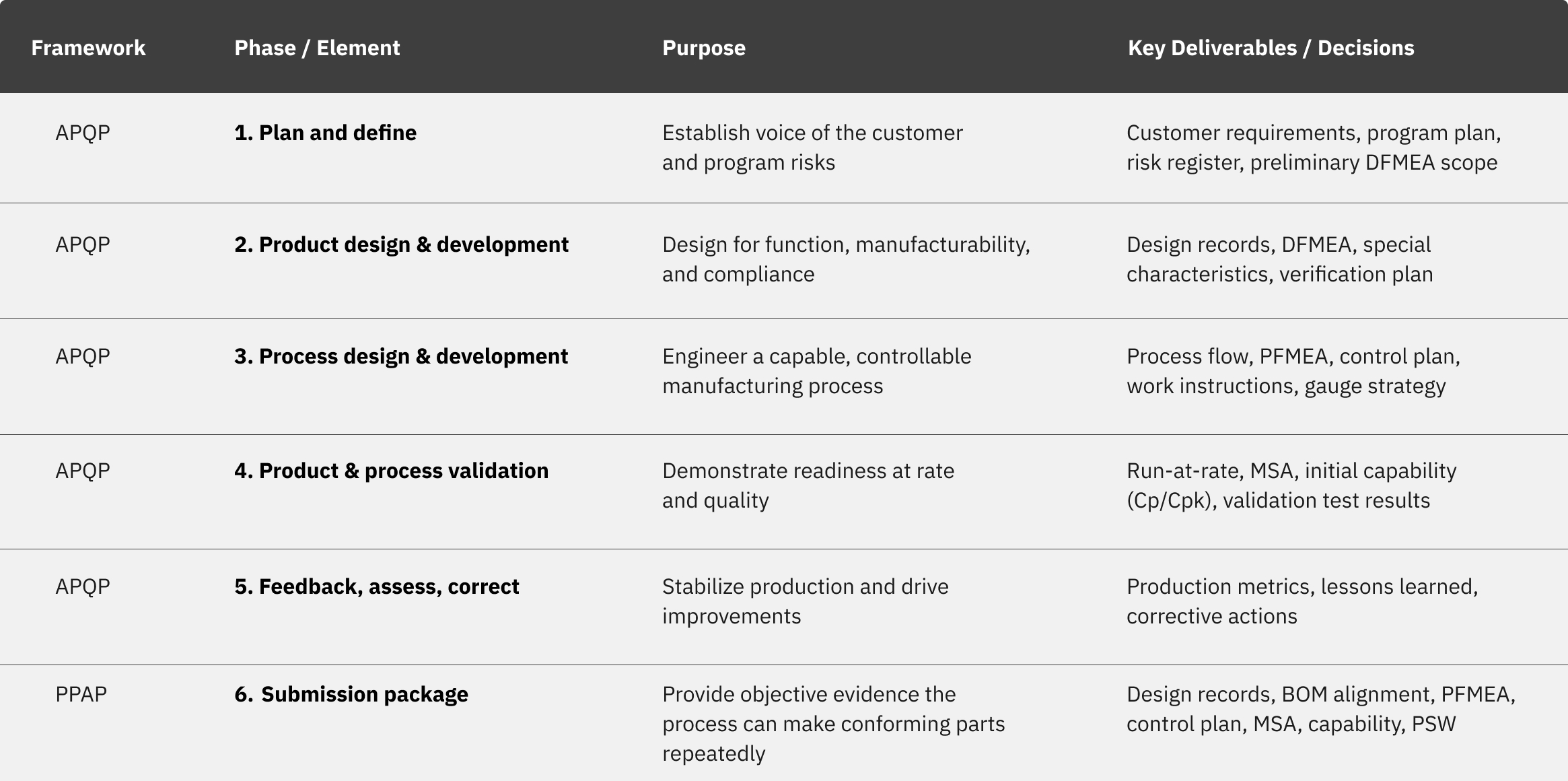
Prevention is the only way to significantly increase margins because defects are totally avoided. Advanced Product Quality Planning (APQP) typically structures product and process development into five phases: planning and definition; product design and development; process design and development; product and process validation; and ongoing production with feedback. It ensures cross-functional teams agree on what success looks like, which risks matter most, and how controls will prevent failure modes before they reach customers.
Production Part Approval Process (PPAP) is the evidence package that a supplier’s process can repeatedly make a conforming product at the quoted rate. It links design records to process capability through artifacts such as FMEAs, control plans, MSA, and capability studies, culminating in a Part Submission Warrant. In addition, CAPA is preventive in nature in that it seeks to ensure an existing issue is prevented from ever occurring again. While rooted in automotive, the logic applies universally: prove the process, not just the part.
Regardless of sector, using APQP and PPAP-style gates delivers defect prevention, launch readiness, and tighter collaboration among engineering, operations, suppliers, and customers.
Detection: Financial trap, but often necessary evil
Many manufacturers fall into the trap of prioritizing detection because, on the surface, it appears cheap and easy to implement. However, this perceived low cost is an illusion. While inspections serve as a critical backup plan—particularly for high-risk applications or specific customer mandates—they are reactive rather than proactive. Detection shields the customer from defective products and undesired outcomes, but it fails to protect the business’s bottom line. Because the defect is identified only after production is complete, margin leakage is unavoidable; the company has already incurred the cost of goods sold and must now face the additional financial burden of scrapping or reworking the material.
Success: Needs to be both defined and understood
What does “Good” look like? You cannot hit a target you cannot see. It is critical to define what “good” looks like for the production floor and support staff to ensure everyone is aligned. We achieve this alignment by utilizing foundational tools such as:
- Standard Operating Procedures (SOPs) and Work Instructions to standardize methods.
- Control Plans to monitor quality.
- Training Requirements to ensure competency. Together, these documents remove ambiguity and define the path to successful production.
Consistency: Requires control of variation
Increasing Consistency and Predictability: Consistency is the bedrock of quality. To achieve it, we rely on two main pillars to eliminate variation:
- Measurement Reliability: We utilize gauge calibrations and studies to ensure our tools are both precise (repeatable) and accurate (true to standard). If the gauge is wrong, the product is wrong.
- Operator Competence: We invest in training to ensure that the people doing the work understand the standard and can execute it consistently, shift after shift.
Feedback and Monitoring: We cannot assume outcomes are meeting expectations
Feedback Loops and Performance Monitoring: To validate that we are performing with high quality, we must establish robust feedback loops that utilize both leading (predictive) and lagging (historical) indicators. We monitor these metrics across three distinct phases of production:
- Supplier (Upstream): We ensure incoming quality through Supplier Audits, PPAPs, Scorecards, receiving inspections, and the tracking of supplier non-conformances.
- Internal (Process): We maintain process control through internal audits (specifically Layered Process Audits), Work-In-Process (WIP) inspections, and the monitoring of internal non-conformances.
- Customer (Downstream): We measure final success through customer complaints, PPAP submission outcomes, and external non-conformances.
Risk Management: Effective mitigation and focus
Risk Management: Innovation and change—whether introducing new products or modifying existing processes—inherently introduces risk. A fundamental objective of Quality Management is to systematically evaluate these variables and either eliminate them or mitigate them to within acceptable tolerances. By conducting thorough risk assessments, we prioritize our resources, allowing us to focus specifically on the risks with the highest probability of occurrence or the most severe potential impact.
Frequently Asked Questions
What is the difference between QA and QC in manufacturing quality and why does it matter?
Quality Assurance (QA) is process-oriented and preventive: it designs and controls the system—standards, training, supplier qualification, and change control—so defects don’t occur. Quality Control (QC) is product-oriented and detective: it inspects and tests outputs to detect defects before release. Using both reduces variability, speeds lead times, and improves customer satisfaction and compliance.
How should a QMS be structured to meet ISO 9001 and sector-specific requirements?
Build a process-driven, risk-based QMS with leadership commitment, planning, competence, controlled operations, performance evaluation, and improvement via PDCA. Use ISO 9001 as the baseline, then apply overlays—such as IATF 16949 for automotive and AS9100/AS9145/AS13100 for aerospace—to address sector expectations. Control documented information and changes so only correct revisions are used and evidence is captured for audits.
Which capabilities should manufacturing document control software include to support compliance and speed execution?
Look for a central, version-controlled repository with e-signatures, automated routing/approvals, robust metadata and search, linkage to BOMs/routings, and complete audit trails for document changes and training acknowledgments. These features shorten review cycles, prevent production delays, and make it easy to demonstrate conformance during audits.